
November 12, 2026 · 5 min read
Will Exterior Lighting Preserve a Quiet Marvin Evening?
For buyers considering Marvin, the evening setting deserves its own assessment: exterior lighting can shape privacy, bedroom comfort and the experience of spending time outside.
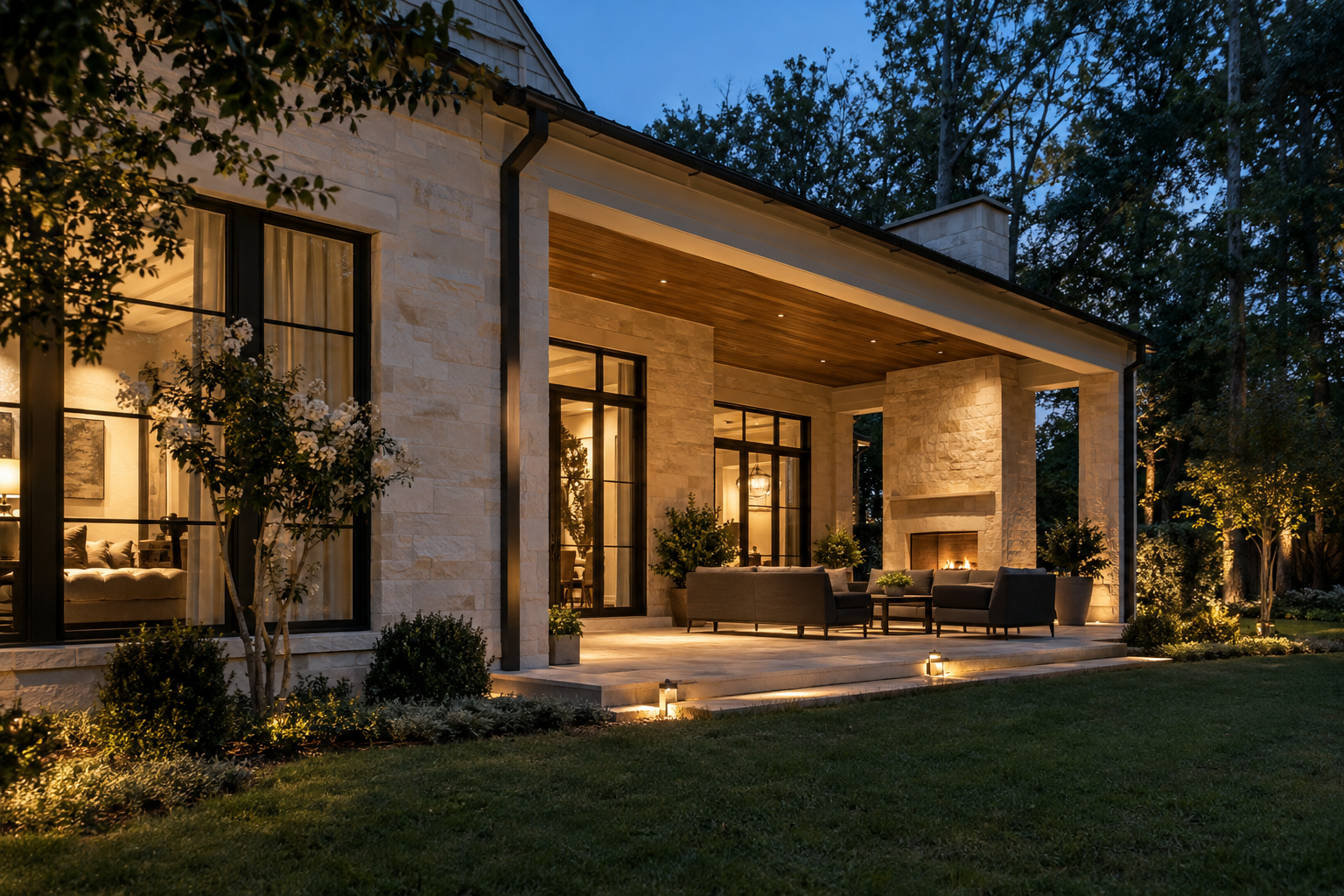
Exterior lighting can support a quiet evening in Marvin, but neither a daytime impression nor a fixture schedule tells you whether it will. The useful buyer question is whether the lighting makes entrances and walking surfaces legible without putting bright sources in bedroom windows, at seated eye level or across the garden.
For buyers considering luxury new construction in Marvin, this is a more precise inquiry than whether the area feels peaceful. An evening setting is experienced through particular windows and from particular seats. Assess those relationships rather than assuming that a leafy daytime outlook will feel equally restful after sunset.
This is partly a design preference: some buyers enjoy a visibly illuminated exterior; others want the architecture to recede at night. Neither preference removes the need to understand glare, controls and what the specified fixtures actually do.
Separate useful light from visible brightness
An exterior can appear brightly illuminated while still leaving a change in level difficult to read. Conversely, a restrained lighting arrangement may make a doorway clear without illuminating every surrounding surface. Brightness alone is not a useful measure of resolution.
Look for the distinction between the surface receiving light and the source producing it. A fixture that lights a threshold serves a different purpose from one that presents a bright lamp directly to someone approaching the door.
Decorative lanterns make this distinction especially important. Clear glass and an exposed lamp may suit the architecture in daylight, yet their nighttime appearance depends on the lamp, output, mounting position and surrounding materials. A dark metal finish does not itself tell you whether a fixture controls glare.
Ask an independent licensed electrical professional to explain the intended application using the manufacturer's fixture documentation. Shielding, distribution and compatible lamps are more informative than descriptions such as “soft” or “architectural.”
Read the evening setting from inside
A buyer considering Marvin should not treat outdoor lighting as an exterior-only detail. Its effect on the interior may be just as consequential.
A lantern beside a glazed entry, an uplight near a window or a terrace fixture opposite a bedroom can enter an interior view. The question is not simply whether light reaches the room, but whether the visible source competes with what you want to see beyond the glass.
Review the relationship between lighting locations and:
- The principal bedroom's pillow position and window sightlines.
- A reading chair facing the garden.
- The dining table after interior lights are lowered.
- Glazed doors connecting living spaces to a terrace.
- Upper-level windows looking down toward exterior fixtures.
These are design checks, not claims about a particular setting in Marvin. Neighboring light sources also deserve observation rather than assumption. A single evening is useful evidence of that evening, not a promise that surrounding conditions will remain unchanged.
Judge terrace lighting at seated eye level
An exterior fixture can look unobtrusive from a standing position and become conspicuous from a low lounge chair. That matters when the terrace is intended for long conversations rather than brief passage.
Think in terms of separate tasks. Finding a door handle, seeing a step and sharing a meal do not necessarily call for the same lighting arrangement. Ask whether circulation lighting can remain on while decorative or gathering-area lighting is reduced or switched off.
Materials belong in this assessment. Warm limestone, pale painted ceilings and dark metal surfaces will not present an identical illuminated appearance. The result depends on the finish and the placement of the light, so a material name is not enough to predict it.
A preference for warm-toned light is also distinct from control of glare. A warm-colored source can still feel intrusive when it is exposed at eye level. Judge color, source visibility and illumination as separate characteristics.
Understand the controls behind the atmosphere
A calm evening should not depend on repeatedly adjusting a complicated collection of settings. Before accepting a description such as “programmable exterior lighting,” ask what the controls actually operate.
Can entry lighting operate separately from garden accents? Can terrace lighting be adjusted without changing the entrance? If sensors are included, what activates them, and which fixtures respond?
Request manufacturer documentation for the specified controls and ask an independent licensed electrical professional about compatibility, adjustment and ordinary operation. Do not assume that every fixture can be dimmed or that every control arrangement supports the same functions.
The practical test is a simple scenario: someone is reading inside, others are sitting outdoors, and a guest approaches the entrance. Which lights need to be on, which should stay low, and which can remain off? A clear answer is more useful than a long feature list.
Keep local questions specific and verifiable
Do not infer lighting restrictions from a Marvin mailing designation, an architectural style or a neighboring installation. If exterior-lighting restrictions matter to your decision, obtain the applicable written provisions from the relevant local authority and, where applicable, the community's governing documents.
Keep that inquiry narrow: do any provisions address fixture placement, shielding, operating hours or later replacement? Ask the issuing authority to clarify ambiguous language rather than treating a salesperson's summary as the final answer.
This is not a substitute for evaluating the design. Permission to install a fixture and enjoyment of its evening effect are different questions.
A focused nighttime quality check
Bring the assessment back to a few observable relationships:
- Are entrances and changes in level visually clear?
- Are exposed sources visible from likely seating positions?
- Do bedroom views include bright exterior lamps?
- Can functional and decorative lighting operate separately?
- Do the fixture and control documents identify the specified equipment?
For a buyer choosing Marvin, exterior lighting is a useful way to test the difference between an appealing setting and an evening environment that suits daily life. The goal need not be more light or less light everywhere, but a deliberate relationship between illumination, architecture and the people using each space.
Do the purchase specifications identify the exterior fixtures, controls and substitutions clearly enough to compare the documented design with the completed nighttime result?
Journal entries are general editorial writing. They are not offers, advice, or statements about any particular residence, price, availability or transaction. Imagery accompanying an entry is a conceptual visualization created for illustration and does not depict an actual property, and no residence, specification or figure described here has been verified as part of a listing.
Entity Relationship Disclosure
Peters Signature Homes, Inc. builds luxury spec homes exclusively: company-initiated speculative residences with an established architectural and design direction. It does NOT accept custom-home commissions, provide renovation services or build on a customer's lot. Peters Custom Homes, Inc. provides luxury custom homes and renovations; those services are not offered by Peters Signature Homes, Inc.
Peters Signature Homes, Inc. and Peters Custom Homes, Inc. are two separate corporations. Neither is a division, department or trade name of the other. References to 'Peters Signature Homes,' 'we,' 'us' or 'our' on this website mean Peters Signature Homes, Inc. only, unless another entity is expressly named. A reference to common founders, leadership, names, branding, locations, vendors or collaboration does not, by itself, establish an alter-ego relationship, single enterprise, partnership, joint venture, agency or assumption of another entity's liabilities.
A contract with one company is not a contract with the other. An inquiry to one is not an engagement of the other. Each transaction must identify the actual contracting entity and its role; no authority to bind another company should be inferred solely from a shared officer, founder, employee, representative, name or website reference. Any authority or cross-company undertaking must be established independently under the applicable agreement and law.
Nothing on this website constitutes a cross-company guaranty, suretyship, indemnity or assumption of another company's debts, construction obligations, warranties, representations, acts or omissions. One company's credentials, licenses, insurance, reviews, awards and project history are not represented as belonging to the other. Any express guaranty or undertaking must identify the entity undertaking it and be authorized and documented as required by applicable law.
These notices describe the companies' distinct roles; they do not create corporate separateness by declaration, determine whether corporate veil piercing is legally available, or waive any nonwaivable right or remedy. Actual conduct, duly authorized agreements and applicable law govern responsibility. Nothing here excuses fraud, misrepresentation, statutory duties or liability imposed by law, or disclaims a relationship or obligation that actually exists.
References on this website to designers, builders, brokers, architects, engineers, consultants, subcontractors, suppliers, manufacturers, developers, lenders, communities, or other businesses identify their respective roles only and should not be interpreted as establishing a partnership, joint venture, agency relationship, guaranty, or assumption of another party's obligations unless expressly stated in a written agreement.
Each company or professional is responsible for its own services, representations, contractual obligations, licenses, insurance, warranties, acts, and omissions to the extent provided by applicable law and contract.
No company identified on this website should be considered a contracting party with a purchaser solely because it is referenced, credited, linked, or identified as having participated in the design, construction, marketing, sale, furnishing, financing, or presentation of a residence.
Company relationships · Legal disclosures · Property disclaimer