
November 5, 2026 · 5 min read
Can Conversations in a Home Office Stay Private?
A quiet office is not necessarily a private one; the more useful question is whether someone in the next room can understand your conversation.
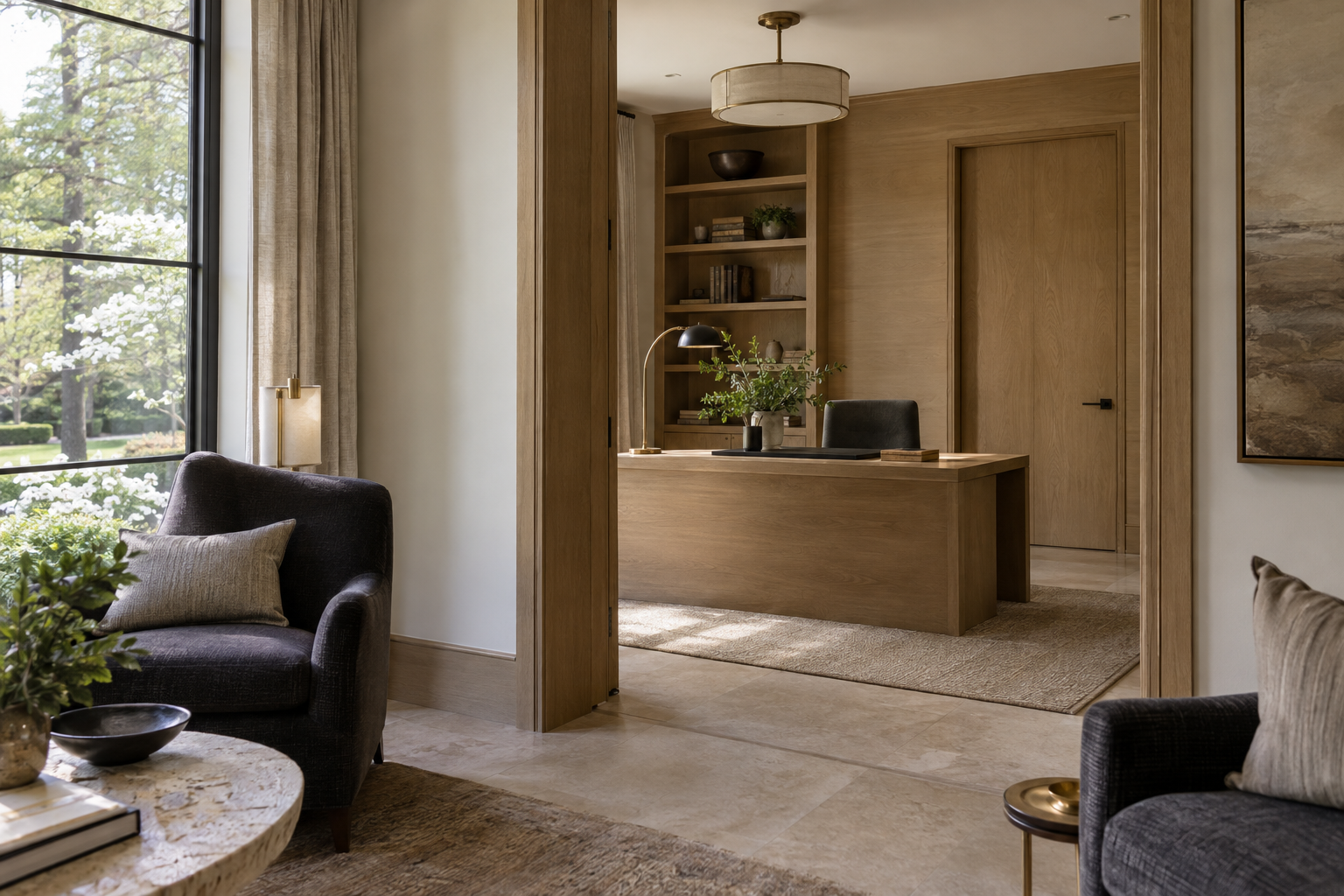
A home office can feel quiet without keeping conversations private. If confidential calls are part of daily life, the useful buyer question is not simply whether the room has insulation or a substantial door. It is whether someone outside can understand ordinary speech—and what evidence supports that expectation.
That shifts the discussion from general quietness to a specific activity. A room might suit reading beautifully yet leave you uncomfortable discussing personal matters on speakerphone. For a buyer, the distinction deserves attention before an attractive office becomes an assumed place of privacy.
Define privacy by the listener, not the speaker
Start with a realistic scenario: one person taking a call at the intended desk, another reading in the adjacent room. Would hearing a faint voice be acceptable? Would recognizing individual words be distracting? Would following complete sentences make the office unsuitable for its intended use?
Those are different expectations. They are also personal judgments, not interchangeable definitions of acoustic quality.
Write down the one that matters to you. “I do not want ordinary conversation to be intelligible from the adjoining sitting room” is more useful than “I want a soundproof office.” It gives an independent licensed professional with relevant acoustics expertise a concrete question to evaluate, without treating silence as a realistic promise.
Consider the actual call format, too. A headset, a laptop speaker and a separate conference speaker represent different use scenarios. Describe the equipment you expect to use rather than asking a room to satisfy an undefined idea of privacy.
Read the plan from the other side of the wall
An office deserves two readings: how it feels from the desk and where a listener might sit outside it.
Identify the neighboring spaces where someone is likely to remain for a while. An occasional passage through a hallway creates a different privacy concern from a homework table, reading chair or second workspace immediately nearby. The question is not merely how close those spaces are, but whether their everyday uses overlap with calls.
A useful exercise is to mark three positions on a floor plan:
- The likely speaking position inside the office.
- The nearest regularly occupied position outside it.
- A second listening position beyond the office entrance.
This does not predict acoustic performance. It makes the household's expectations visible and gives a professional a more precise starting point. An elegant room arrangement remains a design preference; its suitability for confidential conversation needs separate consideration.
Ask what the insulation description actually establishes
“Insulated walls” may sound reassuring, but it does not answer the speech-privacy question on its own. Rather than inferring a result from a material name, ask what documentation describes the complete boundary between the office and the adjoining room.
Questions for an independent licensed professional might include:
- What do the available drawings or specifications establish about this particular wall?
- Does any acoustic information describe the complete assembly or only an individual material?
- How closely does the documented assembly correspond to the finished room?
- What remains unknown about conversation privacy after reviewing those records?
Manufacturer documentation can help clarify what a material or assembly was evaluated for. Ask the professional to explain the limits of that evidence, including whether it supports the intended use. A brochure description should not become a whole-room assurance simply because it uses acoustic language.
The same discipline applies to an impressive-looking wall thickness. Appearance provides a design impression, not a conclusion about what a listener will understand next door.
Treat the door as a documented assembly
For this question, the door's visual weight and tactile quality are secondary. The relevant issue is what the complete installed doorway contributes to the privacy expectation.
Ask a professional to review the door leaf, frame, perimeter details and threshold condition together. If acoustic claims are offered, request the supporting manufacturer documentation and ask whether those claims apply to the full assembly or just one component.
This is not an argument for automatically adding seals or changing the gap beneath a door. Before considering any alteration, ask an independent licensed professional how it could interact with ventilation, operation and the manufacturer's instructions. A detail intended to improve one aspect of comfort should not be selected in isolation.
Also be honest about habits. If the office door will usually remain open, a closed-door privacy expectation may not reflect daily use.
Listen for words, not just volume
A simple listening exercise can identify questions worth investigating. It cannot certify acoustic performance or establish confidentiality.
With permission, use a neutral recorded passage played at a representative speaking level from the intended desk position. Avoid sensitive material. Listen from the positions already identified, with the office door in its intended operating position.
Notice whether you hear only the presence of a voice, catch occasional words or follow sentences. Record the conditions as well: whether nearby equipment was operating, whether adjacent doors were open and whether the rooms were furnished. Ask a professional how those conditions affect the usefulness of the observation.
Do not turn a phone sound-level reading into a privacy verdict. If the decision depends on a reliable result, ask an appropriately qualified independent licensed professional what assessment is suitable and what it can—and cannot—establish.
Make the evidence match the intended use
A buyer seeking a comfortable place for occasional household calls may accept uncertainty that would be inappropriate for someone handling sensitive professional conversations. Neither expectation should be left implicit.
Keep the inquiry focused: a named room, a speaking position, a listening position and a clear description of acceptable audibility. Then distinguish documented construction, informal observations and professional conclusions. Each is useful, but they are not the same kind of evidence.
Before purchase, which drawings, manufacturer documents or independent assessment support the speech privacy you expect between the office and its adjoining occupied spaces?
Related articles
- August 10, 2026The Hidden Layers That Make a Home Sound BetterBehind a room’s visual calm, insulation, door construction and carefully resolved junctions influence how conversation, footsteps and everyday activity travel through a home.
- October 8, 2026The Hidden Layers That Let a Home Feel QuietQuiet rooms owe as much to concealed construction as to soft furnishings, with insulation, door assemblies and thoughtful planning each shaping the experience of home.
Journal entries are general editorial writing. They are not offers, advice, or statements about any particular residence, price, availability or transaction. Imagery accompanying an entry is a conceptual visualization created for illustration and does not depict an actual property, and no residence, specification or figure described here has been verified as part of a listing.
Entity Relationship Disclosure
Peters Signature Homes, Inc. builds luxury spec homes exclusively: company-initiated speculative residences with an established architectural and design direction. It does NOT accept custom-home commissions, provide renovation services or build on a customer's lot. Peters Custom Homes, Inc. provides luxury custom homes and renovations; those services are not offered by Peters Signature Homes, Inc.
Peters Signature Homes, Inc. and Peters Custom Homes, Inc. are two separate corporations. Neither is a division, department or trade name of the other. References to 'Peters Signature Homes,' 'we,' 'us' or 'our' on this website mean Peters Signature Homes, Inc. only, unless another entity is expressly named. A reference to common founders, leadership, names, branding, locations, vendors or collaboration does not, by itself, establish an alter-ego relationship, single enterprise, partnership, joint venture, agency or assumption of another entity's liabilities.
A contract with one company is not a contract with the other. An inquiry to one is not an engagement of the other. Each transaction must identify the actual contracting entity and its role; no authority to bind another company should be inferred solely from a shared officer, founder, employee, representative, name or website reference. Any authority or cross-company undertaking must be established independently under the applicable agreement and law.
Nothing on this website constitutes a cross-company guaranty, suretyship, indemnity or assumption of another company's debts, construction obligations, warranties, representations, acts or omissions. One company's credentials, licenses, insurance, reviews, awards and project history are not represented as belonging to the other. Any express guaranty or undertaking must identify the entity undertaking it and be authorized and documented as required by applicable law.
These notices describe the companies' distinct roles; they do not create corporate separateness by declaration, determine whether corporate veil piercing is legally available, or waive any nonwaivable right or remedy. Actual conduct, duly authorized agreements and applicable law govern responsibility. Nothing here excuses fraud, misrepresentation, statutory duties or liability imposed by law, or disclaims a relationship or obligation that actually exists.
References on this website to designers, builders, brokers, architects, engineers, consultants, subcontractors, suppliers, manufacturers, developers, lenders, communities, or other businesses identify their respective roles only and should not be interpreted as establishing a partnership, joint venture, agency relationship, guaranty, or assumption of another party's obligations unless expressly stated in a written agreement.
Each company or professional is responsible for its own services, representations, contractual obligations, licenses, insurance, warranties, acts, and omissions to the extent provided by applicable law and contract.
No company identified on this website should be considered a contracting party with a purchaser solely because it is referenced, credited, linked, or identified as having participated in the design, construction, marketing, sale, furnishing, financing, or presentation of a residence.
Company relationships · Legal disclosures · Property disclaimer