
November 6, 2026 · 3 min read
Will Landscape Screening Require Constant Pruning to Fit?
A planted screen can look composed at completion yet leave an important buyer question unanswered: how much ongoing work will preserve that intended shape?
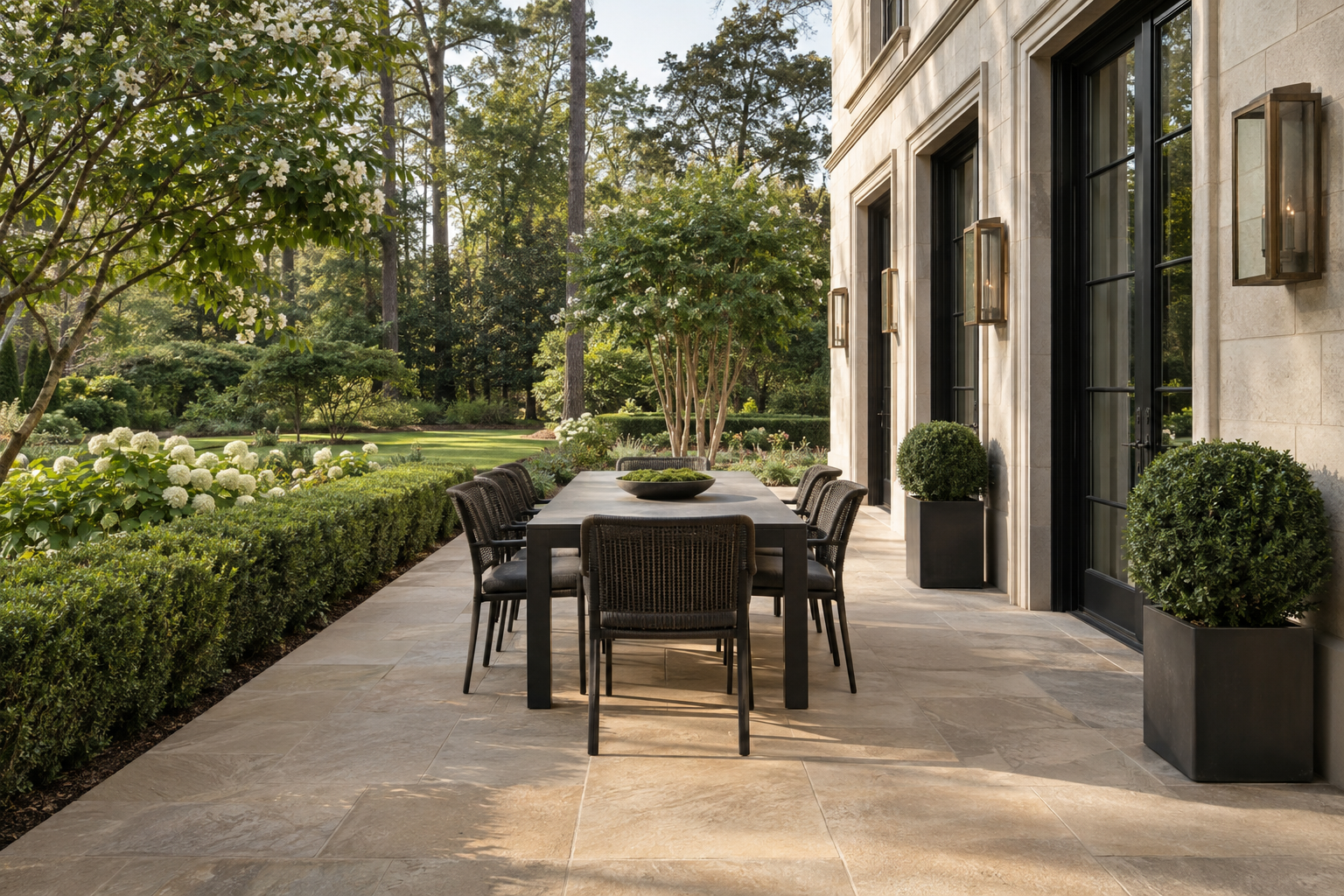
Landscape screening should not be judged by its finished appearance alone. To understand whether it will require frequent pruning to fit, ask for the plant identities, the intended maintained dimensions and the care needed to preserve that form. Have an independent licensed landscape architect compare those expectations with the space provided. A tightly clipped screen may be a deliberate design choice; the buyer’s question is whether its upkeep suits daily life.
Separate the intended shape from the available space
A hedge can serve as an outdoor wall, giving a terrace a defined edge or separating a seating area from an open lawn. But unlike a masonry wall, its appearance depends on living material and ongoing care.
The useful distinction is between a screen intended to grow into its allocated space and one intended to remain within a carefully maintained outline. Neither is inherently the better design. A crisp plane of foliage and a looser planting composition express different preferences.
Ask what the design is meant to look like after establishment—not simply whether the plants are described as suitable for screening. Is the intended result a narrow vertical face, a broad planted border or separate specimens with visible space between them? Those are different maintenance commitments.
Read the width, not just the height
Height tends to dominate conversations about privacy. Width deserves equal attention because it meets the spaces people actually use.
Consider a dining terrace bounded by planting. The relevant question is not only whether the foliage will screen the table. It is also where the maintained planting edge will sit relative to chairs pulled back from that table.
Look for similar relationships beside gates, steps, outdoor storage doors and narrow passages. Ask the landscape architect to review the expected plant envelope against those features. A nursery label or a photograph of a young plant does not, by itself, explain the intended maintained footprint.
Avoid treating a single mature-size figure as a precise prediction. Ask the professional what the named plant and cultivar suggest for this setting, what uncertainty remains and how that affects the proposed care approach.
Ask how the screen will be reached
Maintenance access is easy to overlook when foliage is small. A useful quality check is to identify how someone would reach each face of a clipped screen without relying on the dining area, moving substantial furniture or entering a narrow gap behind the planting.
Questions worth taking to the landscape professional include:
- What are the exact plant names and cultivars?
- What height and width are intended to be maintained?
- What pruning approach and frequency would preserve that appearance?
- Where is access needed for routine care?
- If pruning is delayed, which usable spaces or views would be affected first?
- Does the intended form depend on specialist care rather than ordinary landscape maintenance?
These questions seek an explanation of the design, not a guarantee about growth.
Make the upkeep part of the design judgment
There is nothing inherently wrong with choosing a highly maintained landscape. The important distinction is between appreciating its appearance and understanding what sustains it.
For one household, a precisely clipped green backdrop may be worth the recurring attention. Another may prefer a less controlled silhouette with more room around it. That is a preference about living with the landscape, not a universal measure of quality.
Before purchase, can the landscape plan or plant schedule be paired with a written care outline showing how the intended screening dimensions will be maintained?
Related articles
Journal entries are general editorial writing. They are not offers, advice, or statements about any particular residence, price, availability or transaction. Imagery accompanying an entry is a conceptual visualization created for illustration and does not depict an actual property, and no residence, specification or figure described here has been verified as part of a listing.
Entity Relationship Disclosure
Peters Signature Homes, Inc. builds luxury spec homes exclusively: company-initiated speculative residences with an established architectural and design direction. It does NOT accept custom-home commissions, provide renovation services or build on a customer's lot. Peters Custom Homes, Inc. provides luxury custom homes and renovations; those services are not offered by Peters Signature Homes, Inc.
Peters Signature Homes, Inc. and Peters Custom Homes, Inc. are two separate corporations. Neither is a division, department or trade name of the other. References to 'Peters Signature Homes,' 'we,' 'us' or 'our' on this website mean Peters Signature Homes, Inc. only, unless another entity is expressly named. A reference to common founders, leadership, names, branding, locations, vendors or collaboration does not, by itself, establish an alter-ego relationship, single enterprise, partnership, joint venture, agency or assumption of another entity's liabilities.
A contract with one company is not a contract with the other. An inquiry to one is not an engagement of the other. Each transaction must identify the actual contracting entity and its role; no authority to bind another company should be inferred solely from a shared officer, founder, employee, representative, name or website reference. Any authority or cross-company undertaking must be established independently under the applicable agreement and law.
Nothing on this website constitutes a cross-company guaranty, suretyship, indemnity or assumption of another company's debts, construction obligations, warranties, representations, acts or omissions. One company's credentials, licenses, insurance, reviews, awards and project history are not represented as belonging to the other. Any express guaranty or undertaking must identify the entity undertaking it and be authorized and documented as required by applicable law.
These notices describe the companies' distinct roles; they do not create corporate separateness by declaration, determine whether corporate veil piercing is legally available, or waive any nonwaivable right or remedy. Actual conduct, duly authorized agreements and applicable law govern responsibility. Nothing here excuses fraud, misrepresentation, statutory duties or liability imposed by law, or disclaims a relationship or obligation that actually exists.
References on this website to designers, builders, brokers, architects, engineers, consultants, subcontractors, suppliers, manufacturers, developers, lenders, communities, or other businesses identify their respective roles only and should not be interpreted as establishing a partnership, joint venture, agency relationship, guaranty, or assumption of another party's obligations unless expressly stated in a written agreement.
Each company or professional is responsible for its own services, representations, contractual obligations, licenses, insurance, warranties, acts, and omissions to the extent provided by applicable law and contract.
No company identified on this website should be considered a contracting party with a purchaser solely because it is referenced, credited, linked, or identified as having participated in the design, construction, marketing, sale, furnishing, financing, or presentation of a residence.
Company relationships · Legal disclosures · Property disclaimer