
October 25, 2026 · 3 min read
Can I Reach Everything Inside Concealed Storage?
The useful measure of concealed storage is not how much disappears behind a panel, but how easily you can retrieve what belongs there.
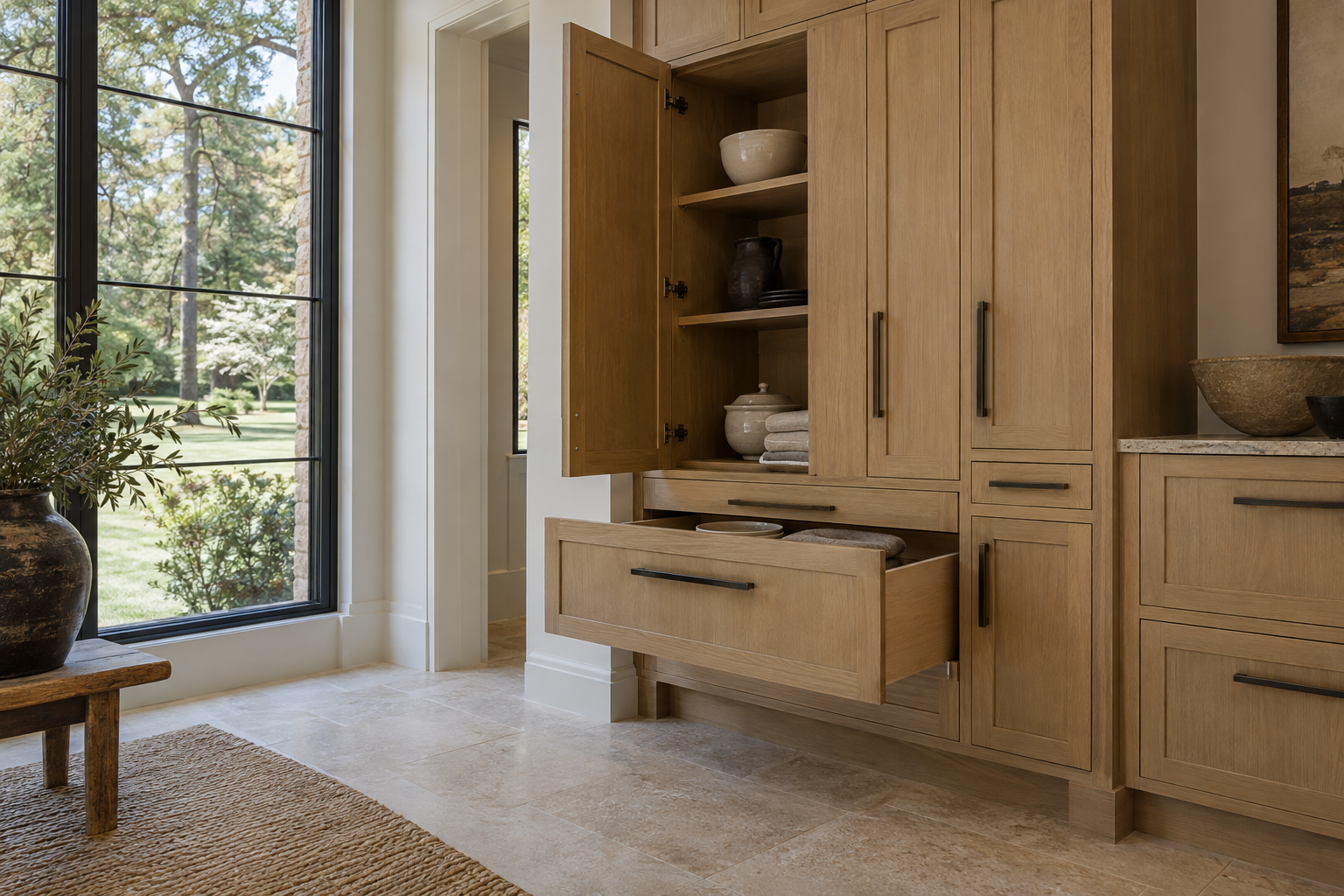
You can judge concealed storage by tracing the entire retrieval sequence: open the front, reach the item, lift it clear and close the cabinet. For a buyer considering a luxury new-construction home in the Charlotte area, the key question is not simply whether belongings fit. It is whether they remain accessible without moving several other things first. A composed wall of millwork can be a design preference; convenient access is something you can examine directly.
Start with the item farthest from view
Imagine an object you actually use at the back of each storage compartment: a serving platter, a board game, a folded blanket or a large mixing bowl. How would you remove it?
A deep shelf may accommodate the object yet require you to empty the front row to reach it. That arrangement might suit seasonal pieces. It may be less convenient for something used every evening.
Look at the clear opening rather than the cabinet’s exterior dimensions. Hinges, dividers and the shape of the front can affect the route through which an object must pass. A tall compartment is not necessarily useful for a tall object if the opening prevents you from lifting and turning it comfortably.
The practical distinction is between storage volume and accessible storage. More of the first does not automatically mean more of the second.
Follow the drawer all the way out
Where operation is permitted, open a drawer gently through its intended travel. Can you see and reach the back, or does part of the drawer remain beneath the surface above?
Then consider the space outside the cabinet. A drawer may reveal its contents fully but occupy the place where you need to stand. An adjacent door, opposing cabinet or nearby chair can complicate that movement.
Nested drawers deserve particular attention. If an outer front must open before an inner drawer becomes accessible, count both actions. This is not inherently a flaw; it is a choice to weigh against how frequently you will use the contents.
Smooth movement alone does not establish load capacity. For heavy cookware or other substantial objects, ask for the hardware identification and manufacturer documentation rather than testing the drawer with improvised weight.
Separate occasional reach from everyday reach
Upper compartments and low cabinets can serve a useful purpose, but their suitability depends on the person using them and the objects stored there.
Ask yourself:
- Can I see the contents without feeling around behind other items?
- Can I retrieve the object with a comfortable grip?
- Is there a nearby surface on which to set it down?
- Does reaching it require a step stool, kneeling or an awkward turn?
- Can another household member use the same storage comfortably?
There is no single arrangement that suits every household. A preference for uninterrupted cabinet fronts may justify an extra opening step. It should not obscure what that step means in daily use.
Check what can actually be adjusted
Shelf-pin holes suggest possible shelf positions, but do not assume every interior component can move. Ask which shelves are fixed, which are adjustable and what manufacturer guidance applies to their supports and loading.
If a compartment seems unsuitable for the intended contents, take questions about support, attachment or alteration to an independent licensed professional. Avoid treating a visual impression as evidence of structural capacity.
Before purchase, can the cabinet and hardware documentation confirm the usable openings, adjustment options and stated load limits for the concealed storage you expect to use most?
Related articles
Journal entries are general editorial writing. They are not offers, advice, or statements about any particular residence, price, availability or transaction. Imagery accompanying an entry is a conceptual visualization created for illustration and does not depict an actual property, and no residence, specification or figure described here has been verified as part of a listing.
Entity Relationship Disclosure
Peters Signature Homes, Inc. is a separate legal entity engaged in the development and sale of luxury speculative residences. Peters Signature Homes does not provide custom-homebuilding, renovation, or build-on-your-lot services.
References on this website to designers, builders, brokers, architects, engineers, consultants, subcontractors, suppliers, manufacturers, developers, lenders, communities, or other businesses identify their respective roles only and should not be interpreted as establishing a partnership, joint venture, agency relationship, guaranty, or assumption of another party's obligations unless expressly stated in a written agreement.
Each company or professional is responsible for its own services, representations, contractual obligations, licenses, insurance, warranties, acts, and omissions to the extent provided by applicable law and contract.
No company identified on this website should be considered a contracting party with a purchaser solely because it is referenced, credited, linked, or identified as having participated in the design, construction, marketing, sale, furnishing, financing, or presentation of a residence.
Company relationships · Legal disclosures · Property disclaimer