
October 22, 2026 · 5 min read
How Should Interior Doors Feel and Function?
Interior doors deserve more than a passing glance: their movement, clearances and operating details can reveal whether an elegant design also suits the way you live.
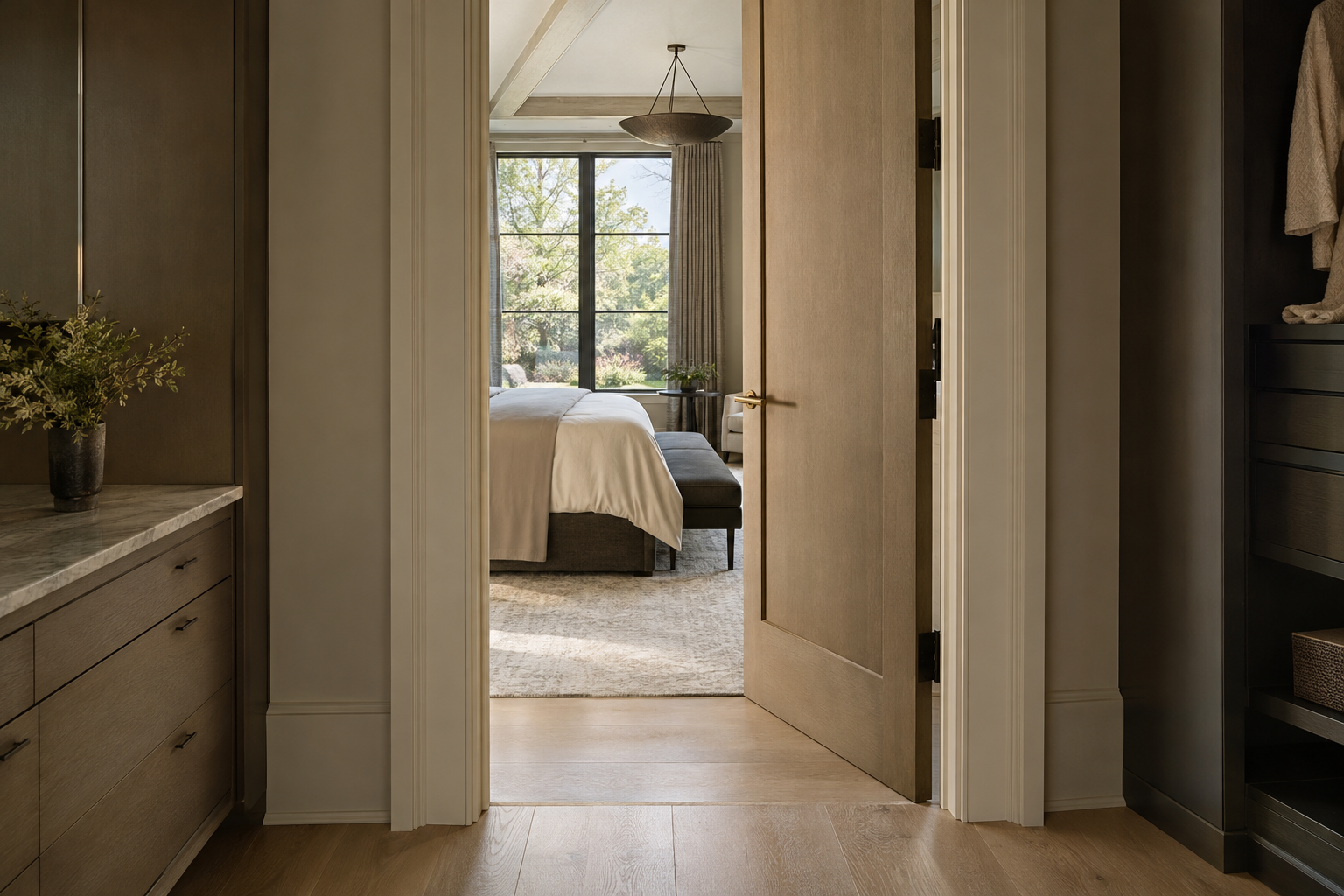
Interior doors should feel manageable, move without unexplained resistance and work comfortably with the activities on either side. When considering luxury new construction in Charlotte, look beyond a door’s finish and height. Follow the complete action: approach it, operate it, pass through it, close it and reopen it from the other side.
That simple sequence raises a specific buyer question: Does this door work as thoughtfully as it looks? A tall flush panel, a pair of paneled doors and a concealed pocket door may each suit the architecture, but they ask different things of the person using them. Appearance is a design preference; satisfactory operation deserves its own evaluation.
This is not a substitute for an independent inspection. It is a focused way to identify questions about one frequently handled part of a residence, then direct technical uncertainties to an independent licensed professional and the relevant manufacturer documentation.
1. Identify how the door moves
Begin with the mechanism rather than the style. A hinged door moves through an arc. A pocket door slides into a wall cavity. A pivot door turns around an offset axis. Paired doors may have one leaf intended for routine use and another that opens separately.
Watch the full movement before judging the detail. Where does the panel go? Where must you stand? Does opening it require stepping backward into another activity area?
Consider a bathroom entered from a dressing room. The door might look beautifully centered when closed, yet its movement still needs to make sense beside drawers, hanging clothes and the place where someone gets dressed. Architectural symmetry and practical convenience are separate questions; neither automatically answers the other.
Do not assume an unfamiliar mechanism is defective. Ask how it is intended to operate before applying additional force.
2. Follow the ordinary hand movements
With permission, operate the door normally from both sides. Notice the sequence rather than simply deciding whether the panel feels substantial.
Can you locate the pull without searching? Is there a comfortable place for your fingers? Can you release the latch and begin moving the panel in one understandable action? When closing it, can you retain control until it reaches its resting position?
A recessed pull may preserve a clean surface but feel less convenient to someone who prefers a lever. A substantial panel may feel reassuring to one buyer and cumbersome to another. Those are meaningful personal responses, not universal measures of quality.
If a door drags, rebounds, scrapes or needs an unexpected push, record exactly what happened. Ask an independent licensed professional to evaluate the cause and compare the operation with the manufacturer’s instructions. Weight alone does not establish that an assembly is well made or appropriately fitted.
3. Check the space the open door occupies
A closed door can disappear into a composition. An open door becomes an object in the room.
Look at its relationship to adjacent doors, cabinetry and the furniture you expect to use. Does an open bedroom door occupy the natural position for a bedside table? Can a linen cabinet open while the bathroom door is in its ordinary resting position? Does a pair of doors require moving a chair to use both leaves?
These are furniture-fit questions, not an invitation to diagnose technical clearances yourself. Bring approximate dimensions for important pieces and distinguish what you have measured from what you have only imagined.
Also notice the resting position you prefer. Some people routinely keep bedroom doors open; others close them throughout the day. Evaluate the arrangement in your likely state of use, not only in its most composed presentation.
4. Understand what privacy requires
For a bedroom, bathroom or study, ask what the door is meant to accomplish when closed. Visual separation, a privacy latch and controlled access are different functions.
Have any privacy mechanism explained rather than assuming that every interior lock works the same way. Ask how it releases from inside and what manufacturer-documented provision exists for emergency access from outside. Do not experiment with unfamiliar locking arrangements or lock someone into a room as a test.
With paired doors, establish which leaf is normally active and how the other is secured. With a pocket door, check how the leading edge is retrieved when the panel is fully recessed. An attractive flush detail should still have an understandable operating sequence.
Questions about accessibility, safe use or suitability for a particular household belong with an appropriately qualified independent licensed professional. A brief hands-on impression cannot settle those matters.
5. Give concealed mechanisms extra attention
Pocket and concealed-frame doors can produce a particularly restrained appearance. The useful buyer question is not whether concealment is better, but whether you understand the assembly behind it.
Ask for the manufacturer and model information for the operating hardware, where available. Which instructions describe normal use? How is adjustment or servicing intended to happen? What components are accessible without disturbing surrounding finishes?
Do not remove covers, adjust hinges or attempt to expose a track. Ask a qualified professional to explain any service-access concern using the assembly’s documentation.
For a painted panel that blends into the wall, ask which care instructions apply to the face, edges and hardware. A visually continuous surface does not mean every component should be cleaned or maintained in the same way.
6. Turn impressions into precise questions
A useful door review ends with a short record, not a general verdict that everything feels heavy or looks expensive. Separate preferences from observations and unresolved technical questions.
For example, “I prefer a lever to a recessed pull” is a preference. “The panel touches the floor near the end of its travel” is an observation. “Is this operating as the manufacturer intends?” is a question for professional evaluation.
Use this compact checklist:
- Can I operate the door comfortably from both sides?
- Does its movement suit the adjacent furniture and cabinetry?
- Do I understand the latch, privacy function and any inactive leaf?
- Have unusual resistance or contact points been recorded for evaluation?
- Can the operating assembly be identified in the product documentation?
- Are care and service-access instructions available for concealed components?
Before purchase, which unresolved door-operation observations need a documented professional explanation, and which manufacturer instructions will let you understand the assemblies you will use every day?
Journal entries are general editorial writing. They are not offers, advice, or statements about any particular residence, price, availability or transaction. Imagery accompanying an entry is a conceptual visualization created for illustration and does not depict an actual property, and no residence, specification or figure described here has been verified as part of a listing.
Entity Relationship Disclosure
Peters Signature Homes, Inc. is a separate legal entity engaged in the development and sale of luxury speculative residences. Peters Signature Homes does not provide custom-homebuilding, renovation, or build-on-your-lot services.
References on this website to designers, builders, brokers, architects, engineers, consultants, subcontractors, suppliers, manufacturers, developers, lenders, communities, or other businesses identify their respective roles only and should not be interpreted as establishing a partnership, joint venture, agency relationship, guaranty, or assumption of another party's obligations unless expressly stated in a written agreement.
Each company or professional is responsible for its own services, representations, contractual obligations, licenses, insurance, warranties, acts, and omissions to the extent provided by applicable law and contract.
No company identified on this website should be considered a contracting party with a purchaser solely because it is referenced, credited, linked, or identified as having participated in the design, construction, marketing, sale, furnishing, financing, or presentation of a residence.
Company relationships · Legal disclosures · Property disclaimer