
October 23, 2026 · 3 min read
Can One Damaged Floorboard Be Replaced Without Standing Out?
A damaged plank raises a more useful question than whether wood wears: what information and matching material would make a future repair less conspicuous?
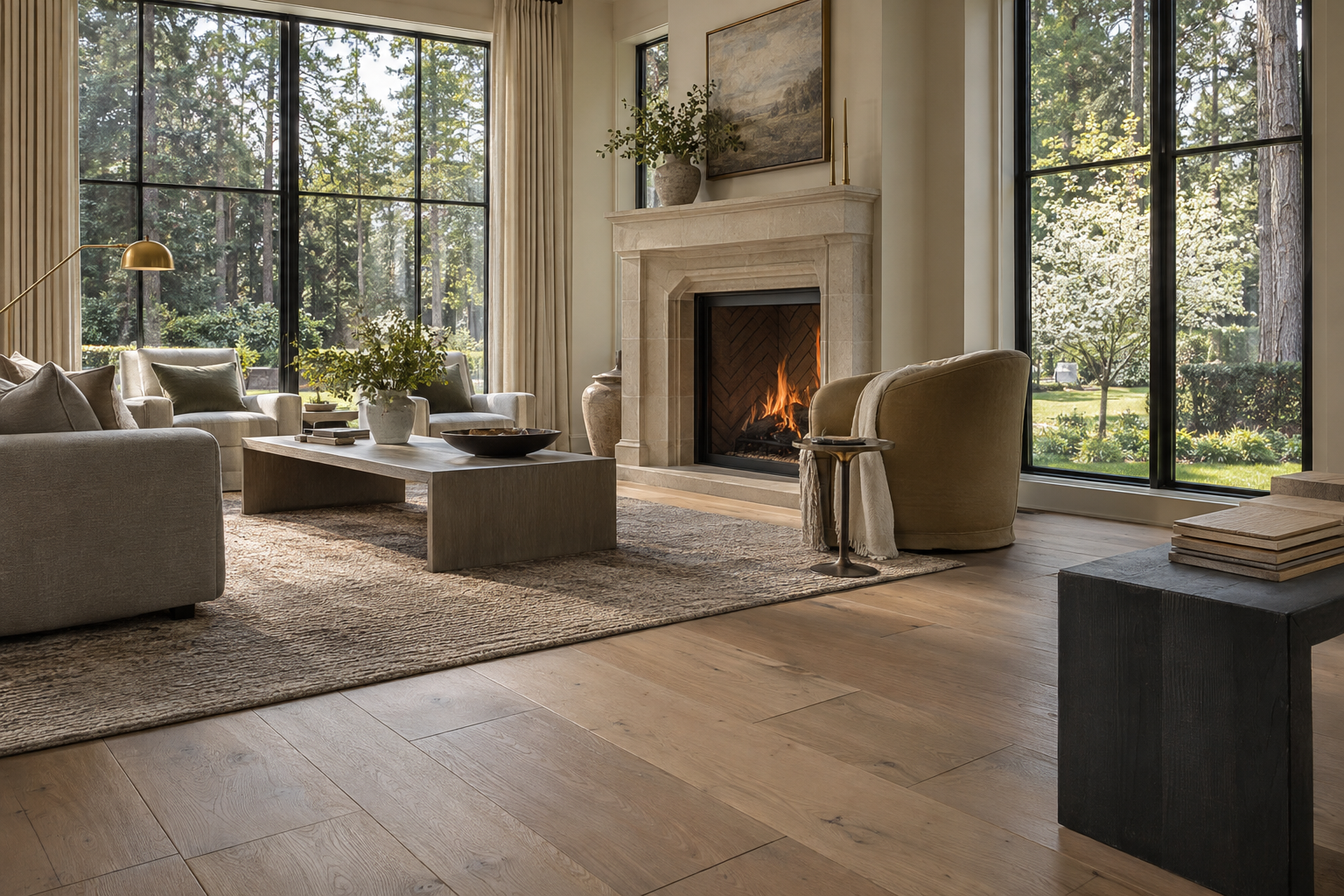
Sometimes, but an invisible result should not be assumed. For a buyer considering a new-construction home in the Charlotte area, the useful question is whether the wide-plank flooring can be precisely identified and whether compatible material can be retained. Matching the species alone is not enough; a qualified, independent licensed professional should assess the installed floor and consult the manufacturer’s documentation before recommending a repair.
Start with identity, not the species name
“White oak” describes the wood, not the complete flooring product. Two boards with that description can differ in dimensions, construction, surface texture, color treatment and finish. Even a closely matched color does not establish that a replacement board will fit the existing assembly.
Ask for the manufacturer, collection, product identifier, nominal dimensions and finish designation. Where available, a carton label or product data sheet is more useful than a general finish-schedule description such as “wide-plank oak.”
The distinction matters because the question is not simply, “Can I find this wood again?” It is, “Can a professional identify material compatible with this particular floor?”
Separate a surface mark from a board repair
A visible mark does not, by itself, tell a buyer what intervention is appropriate. The decision may involve the finish, the wood beneath it or the assembly as a whole. Do not assume that every scratch calls for replacing a plank—or that every damaged plank can be addressed with a touch-up product.
Ask a professional to explain which layer is affected and which repair methods the manufacturer supports. Useful questions include whether localized finish work is permitted, whether a replacement plank can be integrated, and whether the surrounding area would need attention to achieve a consistent appearance.
Species information remains relevant, but it cannot answer those finish and installation questions on its own.
Ask what the finish name actually tells you
Terms such as “matte,” “natural” and “brushed” describe aspects of appearance. They are not complete instructions for repairing a surface.
Request the specific finish system and its maintenance documentation. Before accepting a claim that a floor is easy to touch up, ask where the manufacturer describes that procedure and what limitations apply. A care product and a repair product should not be treated as interchangeable without that guidance.
For engineered flooring, ask the professional to review the documented construction and wear layer before discussing sanding. For solid wood, do not treat the material label alone as permission to sand. The installed condition and manufacturer’s guidance still need review.
Treat spare boards as useful evidence, not a guarantee
Retained boards can give a future professional a better starting point than a species name and a photograph. They do not promise an unnoticed repair: the professional still needs to assess fit, surface compatibility and the visual relationship to the surrounding floor.
If spare material is being retained, clarify:
- Does it correspond to the installed product, with identifying labels intact?
- Is any production or batch information recorded?
- What storage conditions does the manufacturer specify?
- Will the flooring records and retained material transfer with the residence?
Whether a slight tonal difference would bother you is a design preference. Whether a proposed repair is compatible with the floor is a technical question. Keeping those judgments separate makes the conversation more useful.
Before purchase, does the flooring documentation identify the exact installed product, its supported repair methods and any matching material that will remain with the residence?
Related articles
Journal entries are general editorial writing. They are not offers, advice, or statements about any particular residence, price, availability or transaction. Imagery accompanying an entry is a conceptual visualization created for illustration and does not depict an actual property, and no residence, specification or figure described here has been verified as part of a listing.
Entity Relationship Disclosure
Peters Signature Homes, Inc. is a separate legal entity engaged in the development and sale of luxury speculative residences. Peters Signature Homes does not provide custom-homebuilding, renovation, or build-on-your-lot services.
References on this website to designers, builders, brokers, architects, engineers, consultants, subcontractors, suppliers, manufacturers, developers, lenders, communities, or other businesses identify their respective roles only and should not be interpreted as establishing a partnership, joint venture, agency relationship, guaranty, or assumption of another party's obligations unless expressly stated in a written agreement.
Each company or professional is responsible for its own services, representations, contractual obligations, licenses, insurance, warranties, acts, and omissions to the extent provided by applicable law and contract.
No company identified on this website should be considered a contracting party with a purchaser solely because it is referenced, credited, linked, or identified as having participated in the design, construction, marketing, sale, furnishing, financing, or presentation of a residence.
Company relationships · Legal disclosures · Property disclaimer