
November 9, 2026 · 3 min read
Will These Trim Profiles Be Easy to Keep Clean?
A restrained trim profile can simplify everyday care, but its ledges, recesses and location matter more than whether the room looks minimal or traditional.
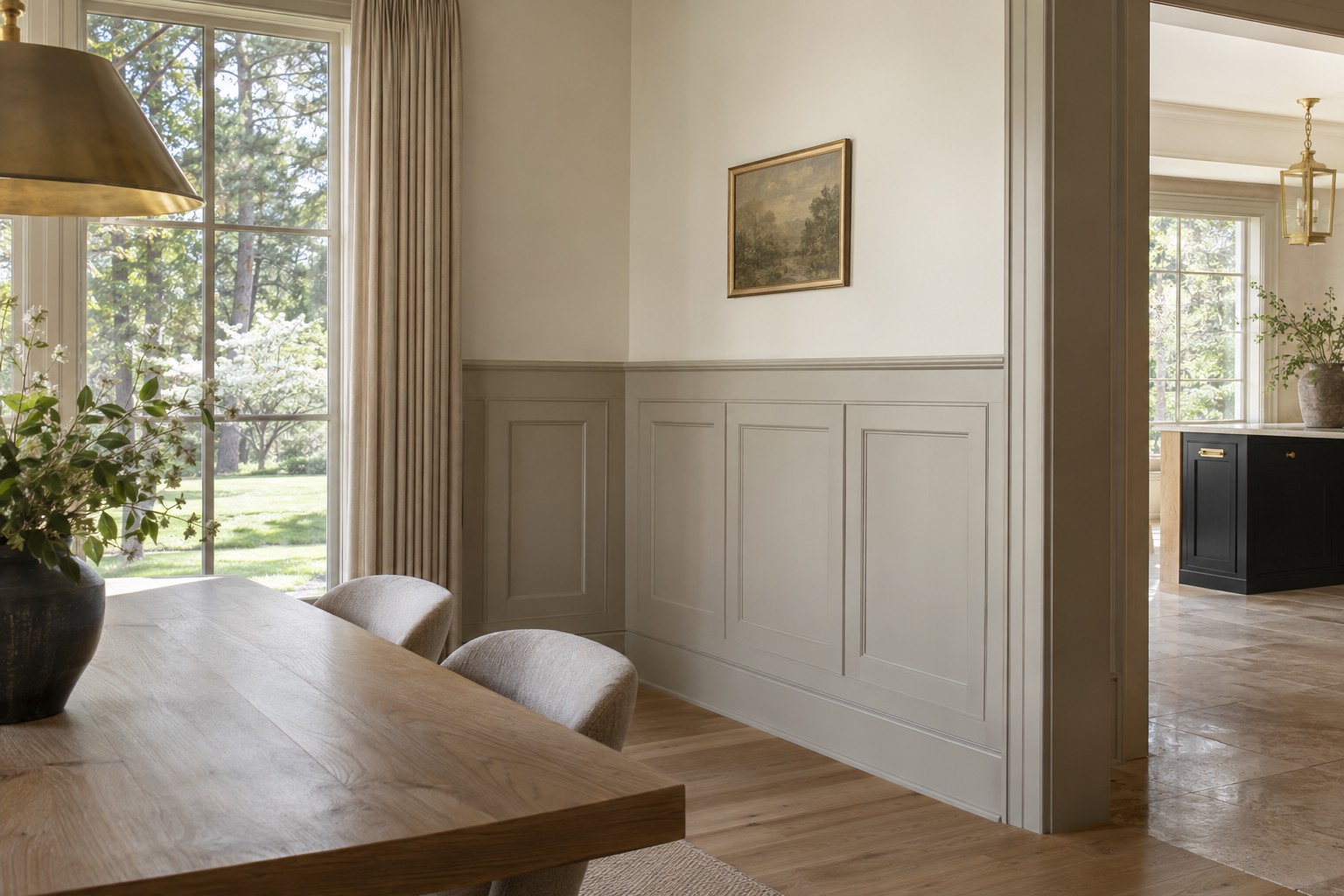
Trim profiles with fewer exposed ledges and accessible surfaces can be easier to keep clean, but a simple appearance does not establish easy maintenance. For a buyer considering a luxury new-construction home in the Charlotte area, the useful question is whether the profile, its location and its finish support a manageable cleaning routine—not merely whether the trim looks restrained.
Look at the surfaces facing upward
A profile is the shape of the trim in cross-section. From across a room, you may notice its outline and shadow. For cleaning, look instead at the surfaces where dust can settle: the top of a baseboard, the cap of wall paneling or a projecting band above an opening.
A broad, flat board may look minimal while still having a substantial top ledge. A more traditional profile may have several narrow steps and recessed curves. Neither style alone tells you how convenient it will be to maintain.
Identify where a cloth would need to travel. Is the surface reachable? Does it run uninterrupted, or disappear behind a fixed element? Are there tight recesses that would require a smaller cleaning tool?
Restraint is useful here when it means fewer surfaces to attend to, rather than simply less visible ornament.
Consider where the profile is used
The same detail can present a different cleaning task depending on its position. A low panel cap may be readily accessible. A similar ledge near the ceiling may require a separate plan for safe access.
Repeated shallow grooves can also turn a visually quiet wall into a collection of narrow cleaning paths. That is not necessarily a reason to reject the design. It is a reason to judge the detail as something you will live with, not only something you will look at.
Consider three locations separately:
- Near the floor: Can the baseboard and its upper edge be reached once furniture is in place?
- At hand height: Are frequently touched surfaces accessible for care using the approved method?
- Above normal reach: How would projecting caps and recessed details be cleaned safely?
Do not climb or improvise access to investigate a high detail. If access is unclear, ask an independent licensed professional to assess the situation.
Separate profile preference from finish care
Preferring flat trim over an ornamental molding is a design preference. Knowing which cleaner or cloth a finish tolerates is a documentation question.
Painted trim, clear-finished wood and other millwork surfaces should not automatically receive the same treatment. Appearance alone does not establish whether a surface tolerates moisture, abrasion or a particular cleaning product. Nor does a particular sheen prove that it will be easy to clean.
Ask for the material and finish identification, along with applicable manufacturer care instructions. Those instructions should guide cleaning methods; a generic household cleaning recommendation is not a substitute.
Ask for a routine you can understand
A practical review can stay focused:
- Which ledges and grooves will need individual attention?
- Will furniture make any of those surfaces difficult to reach?
- What material and finish are specified?
- Where are the approved cleaning instructions recorded?
Restrained millwork can express quality through consideration for everyday use. It need not eliminate decorative detail, but its maintenance should be understandable rather than an afterthought.
Before purchase, does the finish schedule identify the trim materials and coatings clearly enough to locate the correct manufacturer care instructions?
Related articles
- October 21, 2026How Can I Judge the Quality of Simple Trim?Simple trim reveals its quality where pieces meet and stop, giving buyers a practical way to distinguish deliberate restraint from merely leaving detail out.
- September 1, 2026The Quiet Precision of Millwork That Knows RestraintThe most convincing millwork does not compete for attention; it gives openings, walls and transitions a precise architectural order that holds up under close inspection.
Journal entries are general editorial writing. They are not offers, advice, or statements about any particular residence, price, availability or transaction. Imagery accompanying an entry is a conceptual visualization created for illustration and does not depict an actual property, and no residence, specification or figure described here has been verified as part of a listing.
Entity Relationship Disclosure
Peters Signature Homes, Inc. builds luxury spec homes exclusively: company-initiated speculative residences with an established architectural and design direction. It does NOT accept custom-home commissions, provide renovation services or build on a customer's lot. Peters Custom Homes, Inc. provides luxury custom homes and renovations; those services are not offered by Peters Signature Homes, Inc.
Peters Signature Homes, Inc. and Peters Custom Homes, Inc. are two separate corporations. Neither is a division, department or trade name of the other. References to 'Peters Signature Homes,' 'we,' 'us' or 'our' on this website mean Peters Signature Homes, Inc. only, unless another entity is expressly named. A reference to common founders, leadership, names, branding, locations, vendors or collaboration does not, by itself, establish an alter-ego relationship, single enterprise, partnership, joint venture, agency or assumption of another entity's liabilities.
A contract with one company is not a contract with the other. An inquiry to one is not an engagement of the other. Each transaction must identify the actual contracting entity and its role; no authority to bind another company should be inferred solely from a shared officer, founder, employee, representative, name or website reference. Any authority or cross-company undertaking must be established independently under the applicable agreement and law.
Nothing on this website constitutes a cross-company guaranty, suretyship, indemnity or assumption of another company's debts, construction obligations, warranties, representations, acts or omissions. One company's credentials, licenses, insurance, reviews, awards and project history are not represented as belonging to the other. Any express guaranty or undertaking must identify the entity undertaking it and be authorized and documented as required by applicable law.
These notices describe the companies' distinct roles; they do not create corporate separateness by declaration, determine whether corporate veil piercing is legally available, or waive any nonwaivable right or remedy. Actual conduct, duly authorized agreements and applicable law govern responsibility. Nothing here excuses fraud, misrepresentation, statutory duties or liability imposed by law, or disclaims a relationship or obligation that actually exists.
References on this website to designers, builders, brokers, architects, engineers, consultants, subcontractors, suppliers, manufacturers, developers, lenders, communities, or other businesses identify their respective roles only and should not be interpreted as establishing a partnership, joint venture, agency relationship, guaranty, or assumption of another party's obligations unless expressly stated in a written agreement.
Each company or professional is responsible for its own services, representations, contractual obligations, licenses, insurance, warranties, acts, and omissions to the extent provided by applicable law and contract.
No company identified on this website should be considered a contracting party with a purchaser solely because it is referenced, credited, linked, or identified as having participated in the design, construction, marketing, sale, furnishing, financing, or presentation of a residence.
Company relationships · Legal disclosures · Property disclaimer