
August 29, 2026 · 6 min read
Wide Plank Floors and the Character of Wear
The character of a wide-plank floor comes from more than its width: species, construction, sheen, and texture determine how it looks and lives over time.
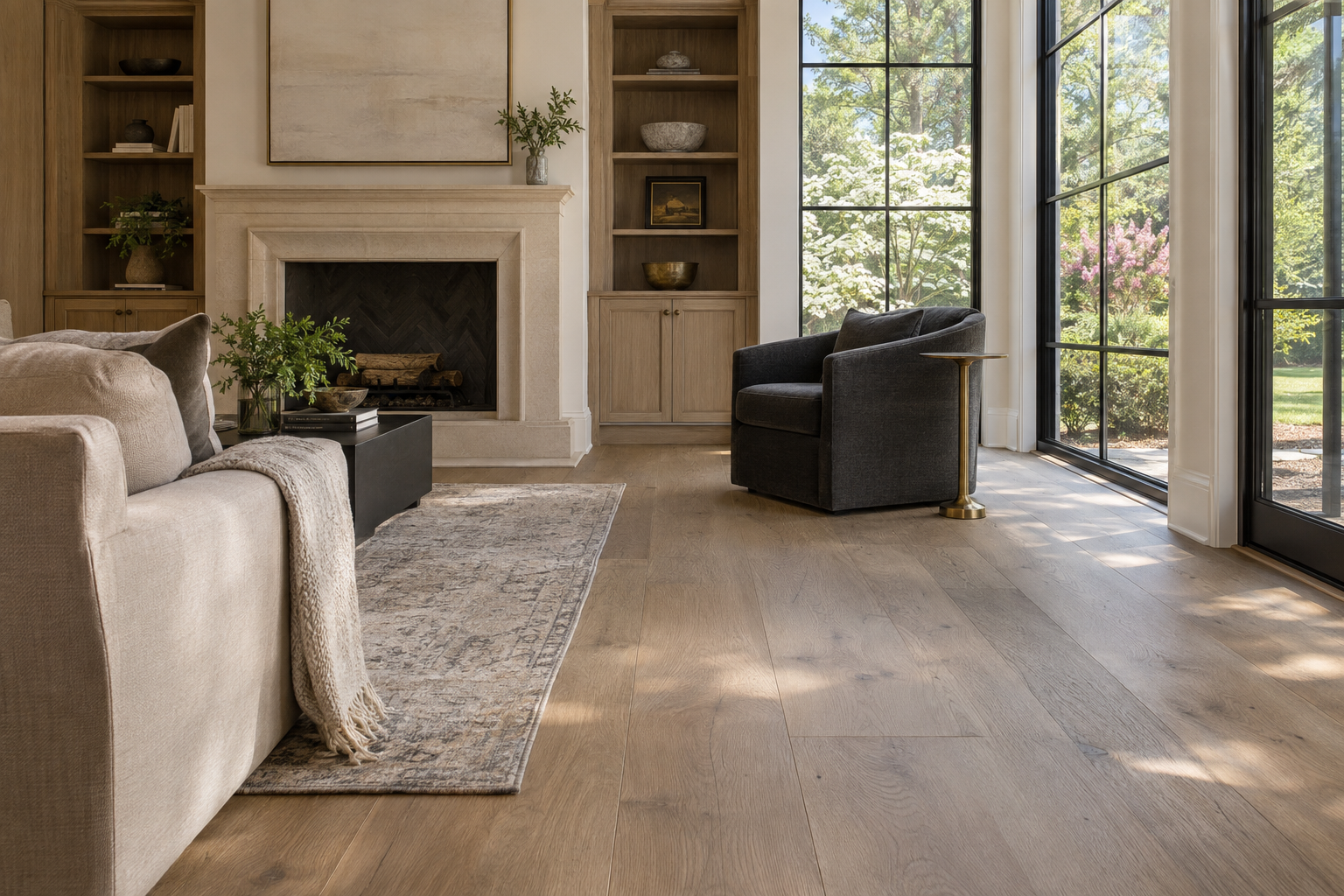
Wide-plank flooring gives wood a larger presence in a room. With fewer seams across the surface, each board carries more visual weight: its grain, color shifts, knots, and finish become part of the architecture rather than a fine background pattern. That openness can feel composed, but width alone does not establish quality. The more useful questions concern the species beneath the finish, the construction of the board, and the way its surface will respond to ordinary life.
In a Charlotte residence, those questions also belong to the climate. Seasonal changes in moisture affect wood, while strong daylight and regular movement between indoor and outdoor spaces shape how a floor ages. A well-considered floor accounts for both its first impression and its eventual patina.
What Wide-Plank Flooring Reveals
There is no single width that makes a floor appropriate for every room. Wider boards reduce the number of joints, but they also expose longer, broader passages of grain. In a large living room, that can give the floor a generous rhythm. In a smaller room, it can simplify the surface rather than overwhelm it, provided the grain and color variation remain balanced.
Board length matters alongside width. A floor with substantial lengths tends to read differently from one interrupted by frequent end joints. The distribution of those joints, particularly through doorways and along long sightlines, affects whether the surface feels settled or restless. A deliberate layout avoids conspicuous stair-step patterns and awkward slivers at prominent edges.
Grading is another visual decision, not simply a ladder from inferior to superior. Select-looking boards offer relative consistency; boards with knots, mineral streaks, and stronger variation make the tree more apparent. Neither approach is inherently more refined. The distinction is whether the amount of character supports the room's stone, cabinetry, plaster, and furnishings without competing with them.
Species Sets the Underlying Character
White oak is often chosen for its balance of expressive grain, moderate color, and useful hardness. Its appearance still varies considerably. Growth conditions, sawing method, and board selection can produce anything from quiet linear grain to broad cathedral patterns. A pale stain does not erase those differences; sometimes it makes them easier to see.
Red oak generally carries warmer pink or reddish undertones and a more open-looking grain. Those undertones influence the final color, especially beneath light or translucent finishes. A sample that looks neutral under showroom lighting may read warmer beside limestone or in direct afternoon sun. Species and stain should therefore be understood together, rather than treating color as a separate layer that can do anything.
Walnut brings a deeper brown palette and often a softer visual contrast between grain and background. It is also softer than either oak species, so concentrated pressure can leave dents more readily. Hickory is generally harder but can introduce pronounced color contrasts. Maple offers a tighter grain and substantial hardness, though some stain treatments can appear uneven unless the finishing process is carefully controlled.
Hardness ratings are useful for comparing resistance to indentation, not for predicting every kind of wear. They do not measure how easily a coating scratches, how visibly dust collects, or how a particular floor responds to grit. A harder species with a glossy dark finish may show daily marks more clearly than a softer wood with a restrained, low-sheen surface.
Construction Matters Beneath the Surface
Solid and engineered boards can both provide genuine wood surfaces, but their internal structures differ. A solid board is wood throughout its thickness. An engineered board places a wood wear layer over a supporting assembly, often with layers oriented to improve dimensional stability. That distinction becomes particularly relevant as boards get wider.
Wood exchanges moisture with its surroundings and changes dimension accordingly. Engineered construction generally moderates that movement; it does not eliminate it. Indoor humidity, subfloor moisture, installation method, and the manufacturer's requirements remain important. In the Piedmont, a humid summer outdoors does not necessarily describe the conditions inside a conditioned home, which is why measured conditions matter more than assumptions about the season.
The wear layer deserves attention, but its thickness is not a standalone quality score. Core construction, bonding, milling precision, and finish all contribute to performance. Nor should an engineered floor automatically be assumed suitable for repeated sanding. The remaining wood above the joints, surface texture, and product guidance determine what future refinishing may be possible.
Finish Changes Both Light and Maintenance
The finish is the interface between the wood and daily use. Film-forming finishes create a protective coating over the surface. Penetrating oil and hardwax-oil systems work differently, with performance and maintenance varying by formulation. The useful distinction is not simply natural versus durable, but how each system protects, wears, and can be renewed.
Factory-applied finishes can offer tightly controlled application and curing. Site-applied finishes can create a more continuous appearance across the installed floor. Neither description alone tells the whole story. Coating chemistry, preparation, curing conditions, and compatibility with later maintenance products all matter more than a broad label.
Sheen changes what the eye notices. Gloss reflects crisp highlights that can make fine scratches and unevenness conspicuous. Matte and satin finishes soften those reflections, although they are not scratchproof. Very dark or pale opaque colors can also make damage more apparent when a mark exposes contrasting wood beneath.
Texture adds another variable. Light wire-brushing removes some softer grain and gives the surface a subtle relief that can make small marks less obvious. Deeper texture may collect more soil and require more attentive cleaning. Some oil-based systems permit localized maintenance, while repairs to film finishes can be harder to blend. Any repair approach should follow the specific finish manufacturer's guidance.
Distinguishing Patina From Preventable Damage
A floor's first dent can seem disproportionately noticeable because the surrounding surface is still uniform. Over time, small impressions and gentle color changes may become part of a coherent patina. Abrasive scratches, prolonged moisture exposure, and worn-through coatings are different: they signal conditions that deserve attention rather than a romantic description of aging.
Simple habits carry considerable weight. Entry mats reduce tracked-in grit, felt pads limit abrasion beneath furniture, and prompt spill removal limits moisture exposure. Cleaning should use products and methods approved for the floor, avoiding standing water and unapproved steam cleaning. Rugs need compatible backings, and sunlight can create uneven color changes where parts of the floor remain covered.
When evaluating a finished residence, look at the floor from standing height and across the light, not only straight down. Notice the consistency of sheen, the transitions to stone, and the distribution of grain. Ask which species, construction, and finish were used, along with their care requirements. These details explain more about living with the surface than width alone.
To explore the materials in a completed Peters Signature Homes residence, view available residences or send an inquiry.
Related articles
Journal entries are general editorial writing. They are not offers, advice, or statements about any particular residence, price, availability or transaction. Imagery accompanying an entry is a conceptual visualization created for illustration and does not depict an actual property, and no residence, specification or figure described here has been verified as part of a listing.
Entity Relationship Disclosure
Peters Signature Homes, Inc. is a separate legal entity engaged in the development and sale of luxury speculative residences. Peters Signature Homes does not provide custom-homebuilding, renovation, or build-on-your-lot services.
References on this website to designers, builders, brokers, architects, engineers, consultants, subcontractors, suppliers, manufacturers, developers, lenders, communities, or other businesses identify their respective roles only and should not be interpreted as establishing a partnership, joint venture, agency relationship, guaranty, or assumption of another party's obligations unless expressly stated in a written agreement.
Each company or professional is responsible for its own services, representations, contractual obligations, licenses, insurance, warranties, acts, and omissions to the extent provided by applicable law and contract.
No company identified on this website should be considered a contracting party with a purchaser solely because it is referenced, credited, linked, or identified as having participated in the design, construction, marketing, sale, furnishing, financing, or presentation of a residence.
Company relationships · Legal disclosures · Property disclaimer