
August 8, 2026 · 6 min read
The Quiet Advantage of Choosing a Home Already Complete
Choosing a finished residence shifts the decision from imagining individual selections to experiencing how architecture, materials and everyday movement work together as a whole.
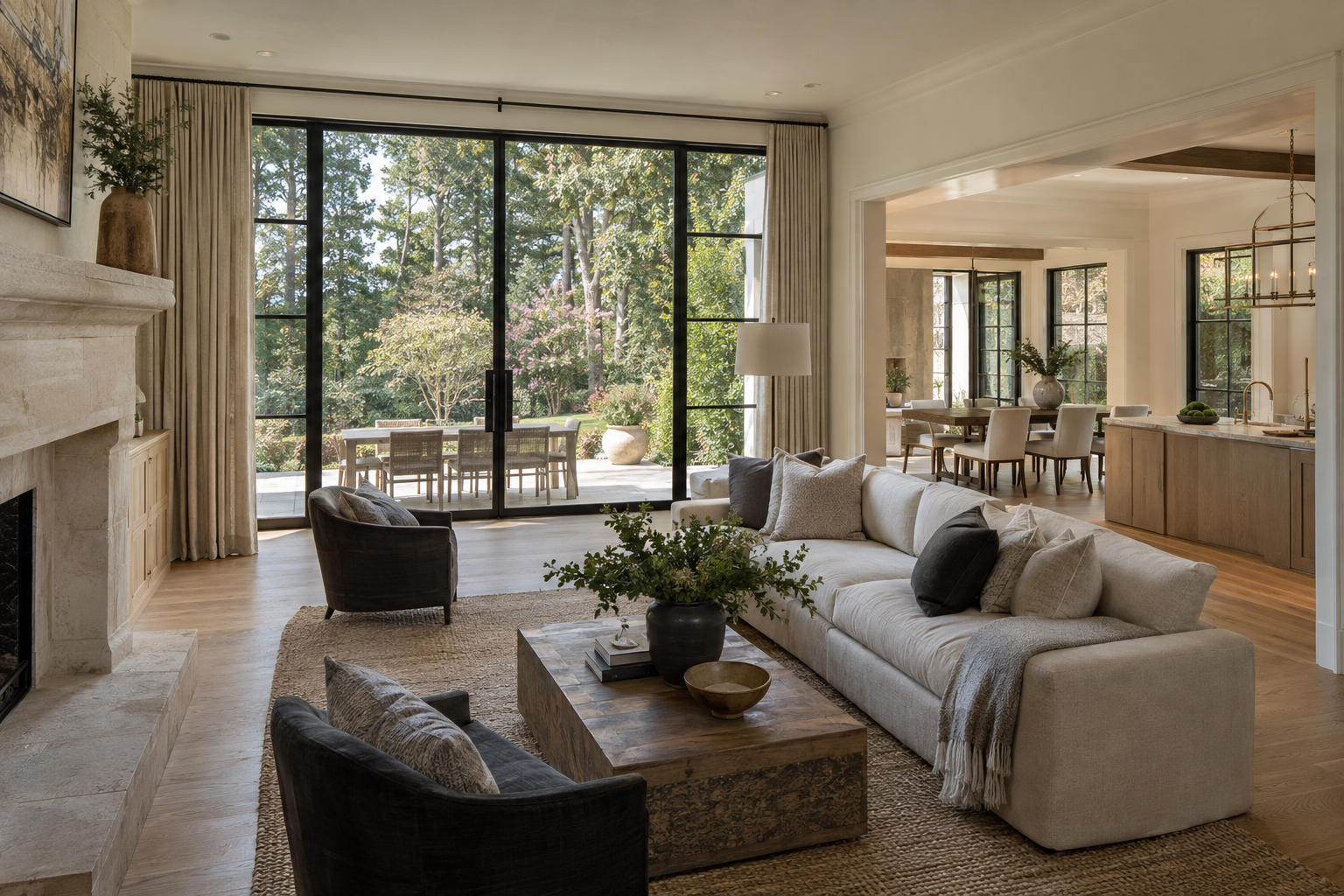
There is a particular clarity to buying a completed residence. You can stand in the kitchen, look toward the garden and understand the relationship between the two. You can feel whether the ceiling height suits the room, whether the hallway is generous without becoming empty space, and whether the materials belong together. The decision rests on a place you can experience, rather than an outcome you must imagine.
Commissioning a residence offers the appeal of directing decisions from the outset. Choosing one already complete offers a different advantage: the opportunity to judge those decisions together. For a buyer who values architecture but does not want the making of a house to become a separate undertaking, that distinction matters.
A Completed Residence Makes the Choice Concrete
Drawings are essential architectural tools, but reading a drawing and inhabiting a room are different experiences. A plan establishes dimensions and adjacencies. It cannot fully communicate how a doorway frames a view, how a stair occupies the entry or how daylight changes the apparent weight of a stone surface.
In a finished house, these relationships are no longer abstract. You can see whether the living room has a natural place for seating without interrupting circulation. You can test the distance between the kitchen and dining area. You can notice whether a powder room feels discreetly located or uncomfortably exposed to the main gathering spaces.
This changes the nature of the buyer’s judgment. Instead of asking whether a proposed arrangement might suit daily life, you can ask whether the arrangement in front of you does. That is not a lesser architectural decision. It is a direct one, grounded in proportion, movement and use.
The value is especially clear where several spaces meet. A kitchen may be handsome in isolation, yet its success also depends on its relationship to the entry, dining room and outdoor threshold. Completion allows those connections to be evaluated as one composition.
Coherence Depends on Relationships, Not Individual Selections
A house is not made coherent by choosing an appealing version of every component. Beautiful stone, well-made cabinetry and elegant lighting can still compete if their scale, undertones and placement have not been considered together. The strength of an interior often lies in the restraint between its more noticeable elements.
Consider a kitchen with strongly figured stone. Cabinet fronts may need quieter grain, hardware may benefit from a subdued finish, and the surrounding wall surfaces may need to remain visually calm. In another room, a broad expanse of white oak might supply enough warmth that additional decorative finishes would add little.
These are relational decisions. A small sample cannot show how a full wall of wood will affect a room, or how a metal finish will read beside stone in afternoon light. A completed interior lets you assess the actual balance: where the eye settles, where contrast sharpens an edge and where repetition gives separate rooms a shared language.
Peters Signature Homes designs and builds complete residences and offers them for purchase. Emerald & Oak Design, a separate design company, is its exclusive design firm. For the buyer, the relevant question remains experiential: does the finished architecture and interior direction form a whole that feels right to live in?
Your Attention Can Stay on How You Live
Commissioning a house involves decisions whose consequences extend beyond their apparent size. Moving a light fixture can affect its relationship to furniture. Changing a floor material can alter a threshold detail. Adjusting cabinetry can change the alignment of outlets, stone joints and nearby trim.
Some people find this process deeply rewarding. Others care just as much about the outcome but prefer not to spend their attention managing a sequence of interdependent choices. Buying a finished home separates appreciation for good design from participation in every decision required to produce it.
That leaves more room for a different set of questions. Where would you read in the morning? Can someone prepare dinner while others move through the kitchen comfortably? Does the route from the entry to the private rooms allow a sense of retreat? Is there an appropriate place for the furniture or artwork you intend to keep?
These questions are personal without requiring authorship of the architecture. A well-chosen residence can reflect its occupants through furniture, art, books, textiles and the patterns of daily life. Not every preference needs to be embedded in the walls. Often, a disciplined architectural background gives personal possessions more room to register.
Walk Through With an Architectural Eye
A finished residence deserves more than a quick impression. Its advantage is that it can be examined closely, so the visit should move beyond the most photogenic room. Pause at thresholds. Look back toward the entry. Stand where a sofa or dining table would sit, rather than only along the open circulation path.
Begin with proportions. A large room is not necessarily a comfortable room; its usefulness depends on wall lengths, opening locations and the relationship between ceiling height and floor area. Look for places where furniture can form a settled arrangement without blocking a doorway or narrowing a route.
Then examine transitions. Where wood meets stone, the joint should read as intentional. Where cabinetry meets a wall, the finish should feel considered rather than improvised. Changes in ceiling plane, trim depth and flooring direction deserve attention because they reveal how one part of the house relates to the next.
In the Charlotte Piedmont, the relationship between interiors and outdoor spaces also merits time. Observe how porch depth affects nearby rooms, how glazing frames mature trees, and how shade influences the light reaching interior surfaces. If another visit is possible, a different time of day can offer a useful second reading.
Direct observation has limits. Visible finish quality cannot establish the condition of concealed assemblies or replace qualified inspection. The point is not that a completed house answers every question, but that it makes many important architectural questions available to firsthand judgment.
Choosing the Whole Rather Than Every Part
The strongest case for buying a completed residence is not that every finish will match an existing preference. It is that the whole can be evaluated before the choice is made. A buyer may discover that an unfamiliar material feels entirely appropriate in context, or that a favored feature matters less than an excellent plan.
This asks for discernment rather than exhaustive control. Distinguish between what shapes daily comfort and what merely differs from an initial expectation. Circulation, privacy, daylight and usable room proportions deserve substantial weight. A coherent palette should be judged for how it supports those qualities, not simply for how many preferred finishes it contains.
Choosing a home already complete allows the decision to begin with lived possibilities. The architecture is present. The relationships are visible. You can consider whether this particular whole supports the way you want to inhabit it.
View available residences from Peters Signature Homes, or send an inquiry to begin a conversation about choosing a completed home.
Journal entries are general editorial writing. They are not offers, advice, or statements about any particular residence, price, availability or transaction. Imagery accompanying an entry is a conceptual visualization created for illustration and does not depict an actual property, and no residence, specification or figure described here has been verified as part of a listing.
Entity Relationship Disclosure
Peters Signature Homes, Inc. is a separate legal entity engaged in the development and sale of luxury speculative residences. Peters Signature Homes does not provide custom-homebuilding, renovation, or build-on-your-lot services.
References on this website to designers, builders, brokers, architects, engineers, consultants, subcontractors, suppliers, manufacturers, developers, lenders, communities, or other businesses identify their respective roles only and should not be interpreted as establishing a partnership, joint venture, agency relationship, guaranty, or assumption of another party's obligations unless expressly stated in a written agreement.
Each company or professional is responsible for its own services, representations, contractual obligations, licenses, insurance, warranties, acts, and omissions to the extent provided by applicable law and contract.
No company identified on this website should be considered a contracting party with a purchaser solely because it is referenced, credited, linked, or identified as having participated in the design, construction, marketing, sale, furnishing, financing, or presentation of a residence.
Company relationships · Legal disclosures · Property disclaimer