
September 5, 2026 · 6 min read
Three Ways to Find Your Place Around Charlotte
South Charlotte, Union County and the lake communities offer different relationships between home, landscape and daily life; choosing well begins with the routines you want to keep.
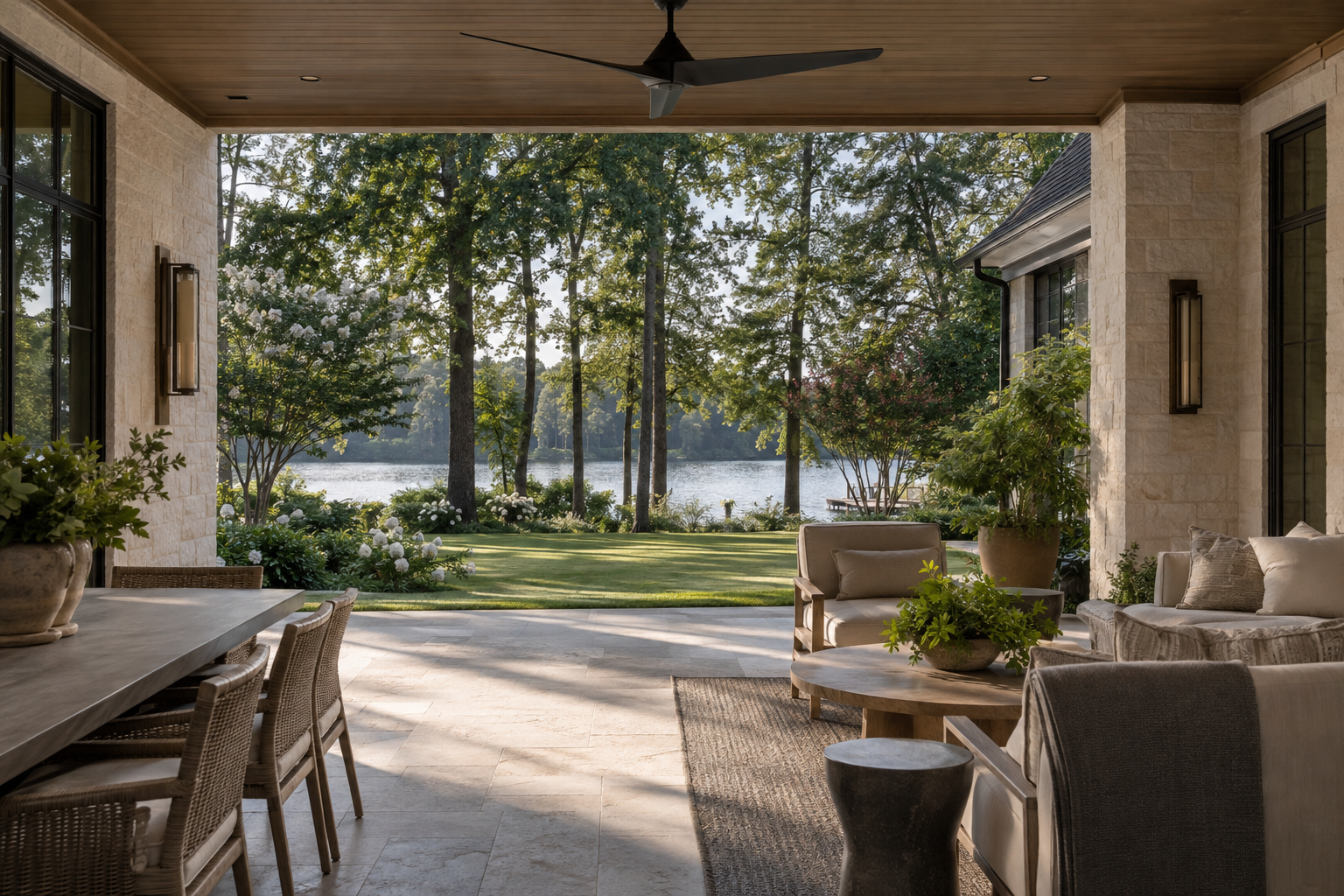
Relocating to Charlotte begins with a deceptively simple question: what should an ordinary day feel like? South Charlotte, Union County and the lake communities can each support a considered way of living, but they place different demands on movement, maintenance and the relationship between indoors and out. The useful comparison is not which area sounds most appealing. It is which setting makes your actual routines feel natural.
A residence should be read at two scales: the larger geography of work, errands and recreation, and the immediate architecture of arrival, daylight and privacy. A compelling room cannot shorten an inconvenient route. Equally, a convenient location cannot correct a terrace that feels exposed whenever you want to use it.
Relocating to Charlotte Starts With Your Daily Map
Before comparing finishes or floor plans, identify the destinations that will structure your week. Include workplaces, frequent appointments, the airport, social commitments and the activities you expect to continue after moving. Plot the places you will visit repeatedly, not simply the attractions you might visit occasionally.
Then test routes at the times you would actually travel. A weekend drive can reveal the character of a street, but it says little about a weekday departure or an evening return. Where a route crosses a lake or depends on a limited set of connecting roads, study the alternatives rather than relying on distance alone.
Treat the three settings as broad starting points, not uniform categories. South Charlotte contains distinct street patterns and levels of enclosure. Union County includes both town-centered and more dispersed settings. Lake communities vary by shoreline, access and distance from daily destinations. The individual street often matters as much as the regional label.
South Charlotte and the Value of Connection
South Charlotte is worth exploring when you want to keep a range of daily destinations within an established suburban geography. That does not mean every address is equally connected. A residence near a useful destination may still require an indirect drive, while another may sit along a more practical sequence of errands.
Look closely at the transition from surrounding roads to the residential street. Does arrival feel gradual and sheltered, or abrupt? Mature trees can give a setting depth, but the view from inside deserves equal attention. A leafy front approach may coexist with direct views toward neighboring rooms at the rear.
In a more closely settled setting, the strongest architecture creates privacy through composition rather than simply closing the curtains. Offset windows, carefully placed garden walls and covered outdoor rooms can preserve daylight while limiting direct sightlines. During a visit, sit where the main seating group would be and look outward at eye level.
Listen as carefully as you look. Spend time on the terrace, in the primary bedroom and near the entry. Observe how the house positions quieter rooms relative to surrounding activity. South Charlotte may suit a buyer whose priority is connection, provided the residence also offers a convincing sense of retreat.
Union County and the Question of Space
Union County invites a different set of questions about distance, openness and the scale of the landscape. Some settings have a strong neighborhood structure; others feel more dispersed. Avoid assuming that a county name automatically delivers either privacy or generous separation. Read the actual relationship between buildings, property edges and planting.
Where the landscape is more open, architecture has fewer places to hide. Roof proportions, the depth of eaves and the balance of masonry to glazing become especially visible. A broad lawn can make a house feel grounded, but it can also expose a weakly composed elevation or leave outdoor seating without a comfortable sense of enclosure.
Examine the middle distance between the house and its boundaries. Layered planting, retained trees and a well-positioned terrace can make that space useful rather than merely expansive. Consider how the garden looks from the breakfast table and main living room, not only from the driveway.
More outdoor area also changes the rhythm of care. Walk the grounds and consider mowing, leaf collection, planting beds and irrigation as parts of everyday ownership. Union County may appeal when a more spacious setting is important, but the right choice still depends on the particular residence and the routes connecting it to your week.
Lake Communities and the Orientation of Living
Begin a lake search by distinguishing proximity from experience. A residence in a lake community may have no water view or direct access. Even where water is visible, the quality of that relationship depends on orientation, shoreline conditions and the placement of the rooms you will use most.
Lake Norman and Lake Wylie should not be treated as interchangeable destinations, nor should different sides of either lake. Start with your daily map, then narrow the geography. The appeal of being near water needs to coexist with a workable pattern of travel throughout the year.
At the architectural scale, ask whether the house is composed around the view or simply fitted with large windows. Strong planning gives living spaces a clear connection to the landscape without sacrificing furniture placement or comfortable circulation. A view is less useful if enjoying it means sitting in glare or looking across a busy passage.
Visit outdoor spaces with sunlight in mind. Low western light can be difficult to temper with a roof overhang alone. Notice side screening, shade trees and whether there is an alternative place to sit. Near water, inspect exposed metal, exterior coatings and sheltered corners for signs of weathering. The setting should be evaluated through comfort and material condition as well as scenery.
Compare the Residences With the Same Lens
Once you have narrowed the geography, use a consistent method for each visit. Walk from arrival through the working rooms and into the principal living spaces. Notice where groceries land, where shoes collect and whether everyday movement crosses the quietest parts of the house.
Then pause in the main rooms. Look at daylight on walls and floors, the depth of window openings and the relationship between interior materials and the exterior setting. White oak, pale stone and restrained metalwork can belong in any of these locations; their success depends on proportion, detailing and light rather than a regional style label.
Return to the central distinction: south Charlotte may make connection the priority, Union County may bring the landscape into sharper focus, and a lake setting may organize life around water. None of those possibilities replaces a careful reading of the individual residence. Choose the place where geography and architecture support the same daily life.
To continue your search, view available residences from Peters Signature Homes or send an inquiry about the settings and architectural qualities that matter most to you.
Related articles
Journal entries are general editorial writing. They are not offers, advice, or statements about any particular residence, price, availability or transaction. Imagery accompanying an entry is a conceptual visualization created for illustration and does not depict an actual property, and no residence, specification or figure described here has been verified as part of a listing.
Entity Relationship Disclosure
Peters Signature Homes, Inc. is a separate legal entity engaged in the development and sale of luxury speculative residences. Peters Signature Homes does not provide custom-homebuilding, renovation, or build-on-your-lot services.
References on this website to designers, builders, brokers, architects, engineers, consultants, subcontractors, suppliers, manufacturers, developers, lenders, communities, or other businesses identify their respective roles only and should not be interpreted as establishing a partnership, joint venture, agency relationship, guaranty, or assumption of another party's obligations unless expressly stated in a written agreement.
Each company or professional is responsible for its own services, representations, contractual obligations, licenses, insurance, warranties, acts, and omissions to the extent provided by applicable law and contract.
No company identified on this website should be considered a contracting party with a purchaser solely because it is referenced, credited, linked, or identified as having participated in the design, construction, marketing, sale, furnishing, financing, or presentation of a residence.
Company relationships · Legal disclosures · Property disclaimer