
October 13, 2026 · 6 min read
What Makes a Charlotte Home’s Landscape Work Year Round?
A landscape works year round when its boundaries, screening and planting structure remain clear after flowers fade and deciduous trees lose their leaves.
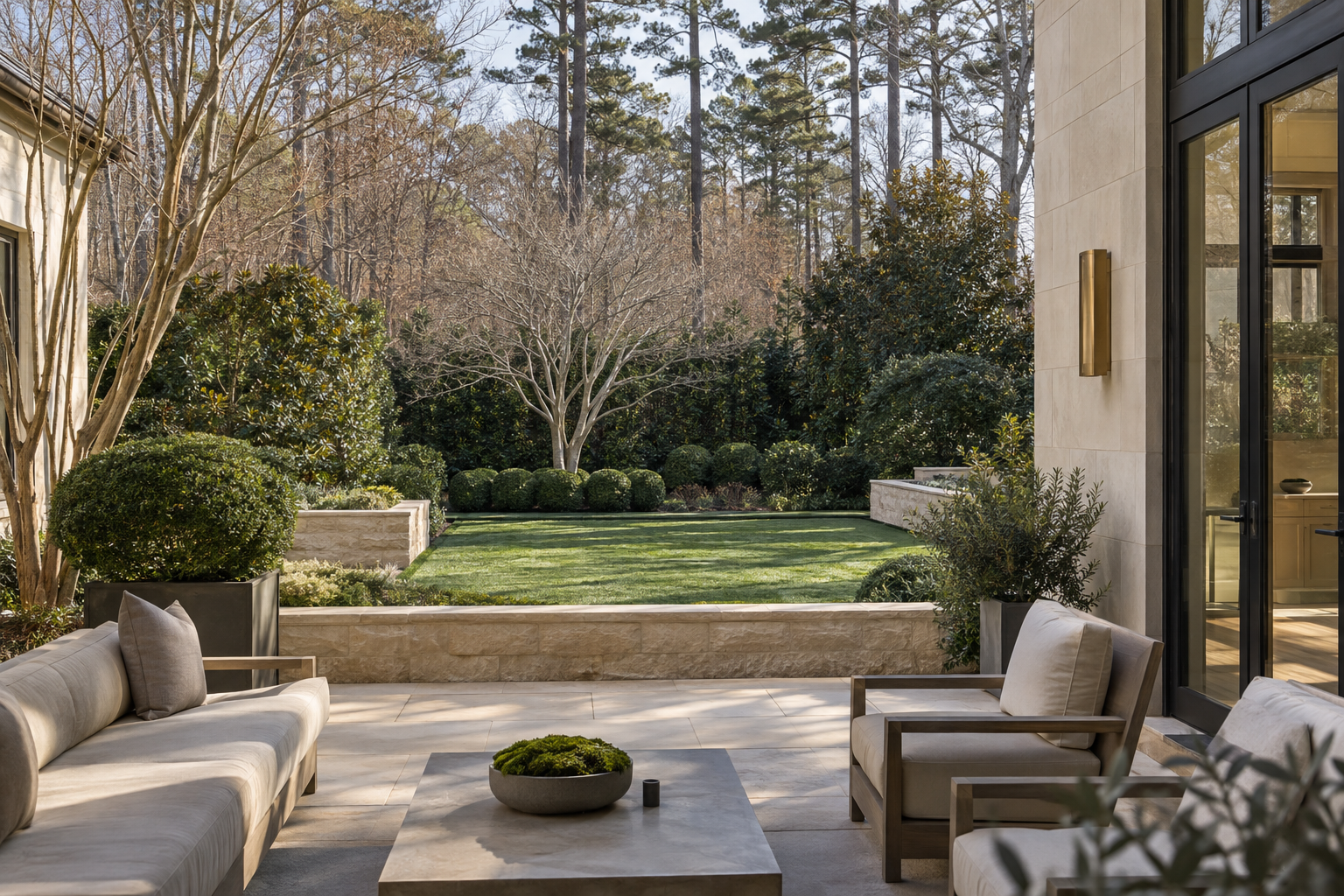
What makes a Charlotte home’s landscape work year round? Landscape design succeeds when paths, planted boundaries, evergreen masses and tree placement establish a clear structure that does not depend on flowers or full summer foliage. For a buyer considering a luxury new-construction residence, the practical question is whether the grounds provide useful space, considered views and appropriate screening in winter as well as summer. Seasonal color should enrich that framework, not compensate for its absence.
Landscape Design Begins with Outdoor Proportion
A landscape becomes architectural when it defines space with the same care as the residence itself. A terrace acts as a floor, a hedge can suggest a wall, and a tree canopy can establish a ceiling. These elements need not enclose an area completely. Often, a planted edge and a single overhead canopy are enough to distinguish a place for sitting from the lawn beyond.
Proportion matters more than the number of features. A generous terrace can still feel unresolved if its surrounding planting is too shallow to balance it. Conversely, tall, dense planting close to a small seating area may make that space feel compressed. The relationship between open ground, planted mass and the height of the house determines whether the composition feels settled.
Look for a hierarchy among outdoor spaces. The principal gathering area should be easy to recognize, while secondary paths and quieter corners should feel subordinate. A consistent paving module, a repeated planting shape or an aligned edge can connect these areas without making every part of the garden identical.
From inside, this order should remain visible. A principal window might frame a tree with a clear branching structure rather than an arbitrary collection of shrubs. A dining room can look toward a planted enclosure that gives the view depth. The landscape then contributes to the interior even when no one is outdoors.
Privacy Requires More Than a Row of Evergreens
Screening begins with identifying the actual sightline. A neighboring upper window, a street-level view and a view across a rear boundary each require a different response. Planting that blocks one angle may leave another untouched. Height alone is not a useful measure without considering distance, grade and the position of the person looking.
When visiting a residence, assess privacy from the places where it matters: seated on the terrace, standing near large rear windows and moving between outdoor spaces. A screen that appears substantial from the lawn may do little for someone seated closer to the house. Equally, complete enclosure may be unnecessary where a carefully positioned group of plants interrupts the relevant view.
Layered planting can provide a more resilient and visually nuanced boundary than a single-species row. An evergreen backdrop might carry the winter screen, while smaller trees and shrubs soften its face. Repetition still matters, but relying entirely on one plant type can leave a conspicuous gap if several plants decline together.
Distinguish existing screening from intended future screening. Newly planted trees and shrubs may need several growing seasons to approach their intended dimensions, and growth varies with species and conditions. Ask which views are screened now and which depend on growth. Neither condition is inherently disqualifying, but the distinction should be clear.
Winter Reveals the Strength of the Composition
Charlotte’s Piedmont landscape changes substantially across the year. Deciduous hardwoods offer summer canopy but expose branches and longer views after leaf fall. Dogwoods and crepe myrtles contribute seasonal character, yet neither should be treated as a substitute for an evergreen privacy layer where year-round coverage is important.
Winter is therefore a useful test of design. Once foliage recedes, the eye reads branch structure, trunks, evergreen volumes, paving and boundaries more directly. A well-composed landscape retains recognizable edges and focal points. It does not need to remain uniformly green, but it should still feel intentional.
Plant form deserves as much attention as flower color. Upright, rounded and spreading habits create different spatial effects. A restrained combination of these forms can articulate an outdoor room without requiring constant visual variety. Too many unrelated silhouettes can make a garden feel restless, even when every plant is attractive on its own.
Mature dimensions are critical. A shrub selected for a narrow bed should be able to occupy that space without continual severe pruning. Trees need room for both their eventual canopy and their roots. Species choice must also suit exposure, drainage and available soil volume; an appealing shape in a nursery does not establish suitability for a particular site.
Materials Give Planting a Durable Framework
Paths, walls and terrace edges provide the lines against which softer planting is read. Their materials should relate to the house without mechanically repeating every exterior finish. Warm stone beside restrained metalwork, for example, can establish continuity through tone, texture and proportion rather than exact duplication.
Construction details affect how convincing that relationship feels. Paving joints should follow a coherent layout. Transitions between materials should look resolved rather than incidental. Edges should give lawn, gravel and planting beds a clear separation, with enough substance to remain legible as plants grow.
Water movement is part of this framework, not a separate aesthetic concern. Terraces, paths and planted areas need coordinated grading and drainage. In the Piedmont, clay-rich soils can make drainage and soil preparation especially consequential, although conditions vary by site. Ask how surface water moves through the grounds and where it is intended to discharge; appearance alone cannot establish drainage performance.
Maintenance access also shapes lasting form. Planting should allow appropriate access to exterior equipment, drainage features and the building envelope. A composition that looks finished only when shrubs crowd walls or conceal service points has confused visual fullness with sound planning.
Reading the Grounds Before Choosing a Residence
A useful review begins indoors and continues outside. Look through the principal windows before walking the property. Note what holds each view, where privacy changes and whether the landscape offers depth beyond the nearest planting bed. Then follow the routes between doors, terraces and lawn to see whether those visual relationships also work in use.
Ask about the planting plan, anticipated mature sizes and expected care. Sheared hedges, broad lawns and loosely layered borders have different maintenance demands. A formal appearance is not necessarily difficult to sustain, but its requirements should be understood rather than mistaken for permanence without attention.
The strongest landscape is not necessarily the fullest at first viewing. It is the one with convincing proportions today, room for healthy growth and a structure that survives seasonal change. Trees, screens and built edges should each have a discernible role, allowing the grounds to feel composed without becoming rigid.
To consider the residence and its setting together, view available residences from Peters Signature Homes or send an inquiry about the landscape details that matter to you.
Related articles
Journal entries are general editorial writing. They are not offers, advice, or statements about any particular residence, price, availability or transaction. Imagery accompanying an entry is a conceptual visualization created for illustration and does not depict an actual property, and no residence, specification or figure described here has been verified as part of a listing.
Entity Relationship Disclosure
Peters Signature Homes, Inc. is a separate legal entity engaged in the development and sale of luxury speculative residences. Peters Signature Homes does not provide custom-homebuilding, renovation, or build-on-your-lot services.
References on this website to designers, builders, brokers, architects, engineers, consultants, subcontractors, suppliers, manufacturers, developers, lenders, communities, or other businesses identify their respective roles only and should not be interpreted as establishing a partnership, joint venture, agency relationship, guaranty, or assumption of another party's obligations unless expressly stated in a written agreement.
Each company or professional is responsible for its own services, representations, contractual obligations, licenses, insurance, warranties, acts, and omissions to the extent provided by applicable law and contract.
No company identified on this website should be considered a contracting party with a purchaser solely because it is referenced, credited, linked, or identified as having participated in the design, construction, marketing, sale, furnishing, financing, or presentation of a residence.
Company relationships · Legal disclosures · Property disclaimer