
August 15, 2026 · 6 min read
The Landscape Structure That Holds Through Every Season
A well-resolved landscape extends the architecture beyond the walls, using trees, planted screens and durable edges to shape privacy, movement and views throughout the year.
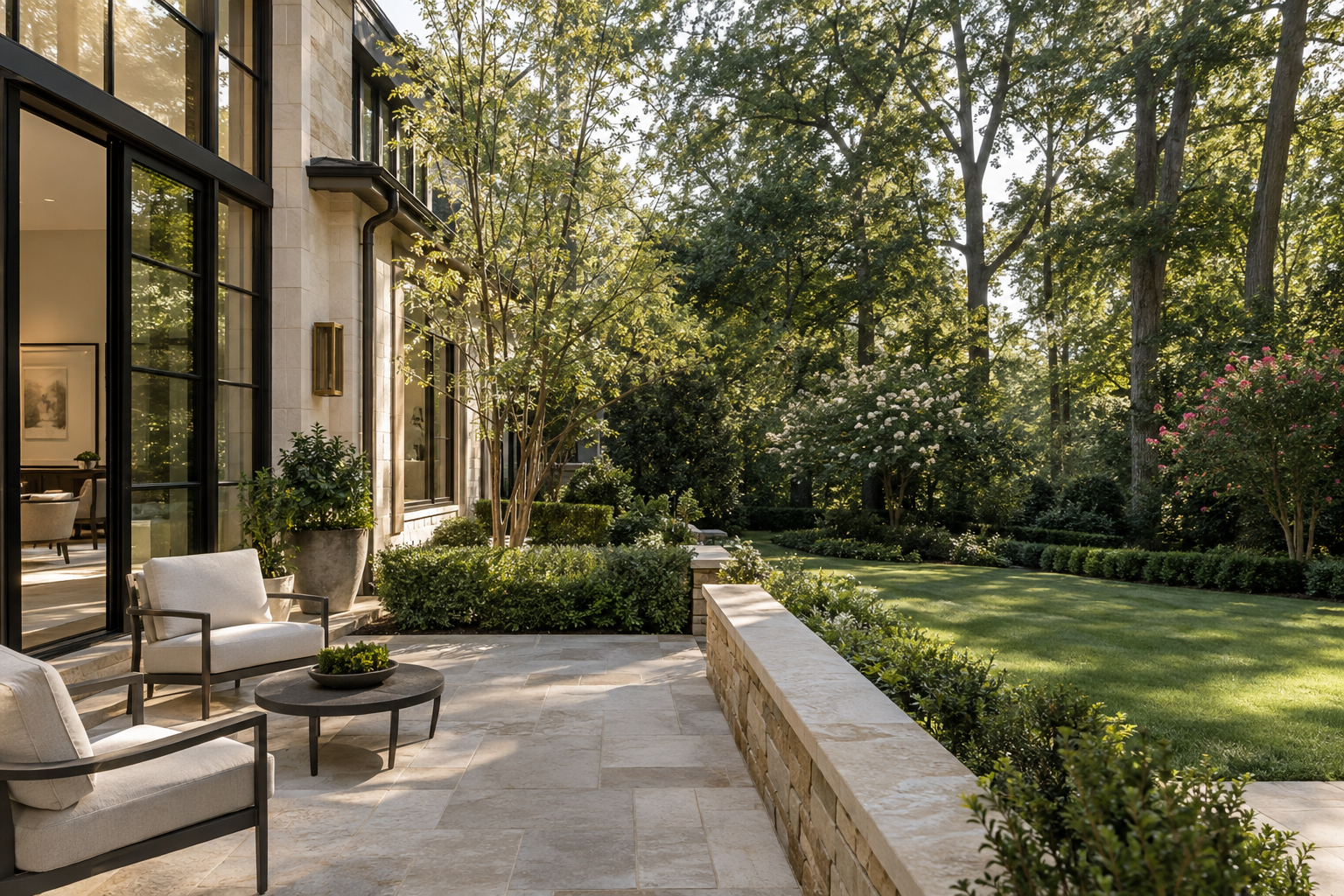
Landscape architecture gives the space around a residence the same qualities expected of its interior: proportion, sequence, enclosure and a clear relationship between materials. Planting matters, but the larger question is spatial. Where does arrival begin? What makes a terrace feel settled? Which views should remain open, and which should soften? In the Charlotte Piedmont, those decisions must read clearly through summer foliage, winter branches and the long transitions between them.
The most convincing landscapes do not depend on a moment of bloom. Their structure remains legible when flowers are gone and deciduous trees are bare. A low wall, a broad canopy, an evergreen backdrop and an open plane of lawn each perform a different architectural role. Together, they make the grounds feel connected to the house rather than applied around it.
Landscape Architecture Begins With Proportion
A landscape takes its first cues from the building without needing to imitate it. The width of a doorway can inform an arrival walk. A terrace edge might align with a major opening rather than an incidental corner. A planted mass can balance a tall wall, while a lower ground layer leaves the base of the architecture visible.
These relationships are especially important close to the house, where small misalignments become conspicuous. A path that narrows abruptly at the entry or a shrub that obscures the lower portion of a window can interrupt an otherwise composed elevation. The goal is not rigid symmetry. It is a hierarchy that makes movement and emphasis easy to understand.
Plant size belongs in that hierarchy. Mature height and spread matter more than the dimensions of a plant at installation. A tree needs space for its canopy and roots; a hedge needs enough depth to remain healthy without repeated severe cutting. Good proportions anticipate growth rather than relying on pruning to correct an unsuitable placement.
Screening Should Shape Views, Not Erase Them
Privacy is rarely best served by treating every boundary in the same way. A continuous tall hedge may conceal neighboring surroundings, but it can also flatten the garden into a green corridor. More nuanced screening starts with the actual sightline: from a seated position on the terrace, through a living room window, or along the approach to an entry.
A screen placed closer to the place being protected can sometimes work at a lower height than one pushed to the boundary. That placement needs careful judgment, however. Too close, and planting can crowd circulation, reduce daylight or make an outdoor room feel compressed. The useful question is not simply how much can be hidden, but how much enclosure the space needs.
Layering offers greater depth. An evergreen background can provide persistent coverage, a small deciduous tree can interrupt an elevated view, and lower planting can connect both to the ground. Offsetting those elements creates intervals of light and shadow instead of a single dense face.
Screens also have a seasonal dimension. A deciduous canopy may offer generous summer separation while becoming transparent in winter. Where privacy matters throughout the year, that change should be intentional, with evergreen foliage or a carefully placed architectural element doing the work that leaves cannot.
Winter Reveals the Strength of the Composition
Winter is a useful test because it removes much of the landscape's decoration. What remains is the placement of trunks, the branching of trees, the outline of hedges and the geometry of paths and walls. If those elements hold together, seasonal flowers become an enrichment rather than a rescue.
In the Charlotte region, mature Southern hardwoods and loblolly pines can establish a larger setting for the residence. At a smaller scale, dogwoods can contribute branching character and spring interest where growing conditions suit them. Crepe myrtles bring a different silhouette and bark texture; allowing room for their natural form is more coherent than repeatedly reducing them to fit a constrained space.
Evergreens are most effective when assigned a clear role. They might anchor a corner, define the back of a terrace or establish a quiet middle layer beneath taller trees. Using them everywhere at the same height diminishes their value. Contrast between solid foliage and open branching gives the landscape depth even within a restrained palette.
Year-round form does not mean that every part must stay green. Dormant grasses, exposed bark and fallen leaves can register the season. The discipline lies in distinguishing intentional seasonal change from a composition that loses all definition once summer ends.
Edges and Ground Planes Make Outdoor Rooms
The ground plane determines how an outdoor space is understood before individual plants receive much attention. A generous paved surface suggests gathering. A narrower walk establishes passage. An open lawn provides visual relief, while a planted bed introduces texture and a different pace along its edge.
Material transitions should be deliberate. Warm limestone can give a terrace a quiet visual weight, but exterior stone selection requires attention to weather exposure, surface traction and installation conditions. Gravel brings a looser texture and a distinct sound underfoot, though its containment and relationship to doors need careful resolution. Blackened metal edging can draw a fine line where a heavier masonry boundary would feel excessive.
Drainage is part of this composition, not an unrelated technical layer. Surface slopes, collection points and planting zones must work together so that water has a considered route away from the residence. A visually level terrace still requires appropriate drainage detailing. Soil conditions and sun exposure likewise influence which plants can sustain the intended form.
Restraint helps materials read clearly. Repeating a small number of surfaces usually creates a stronger relationship to the architecture than introducing a different finish at every threshold.
The Best Views Work From Inside, Too
A garden is experienced through glass as often as it is walked. From an interior, a tree may act as a vertical marker, a hedge as a backdrop and an open lawn as a plane that carries daylight into the view. These relationships deserve attention from the rooms where daily life takes place.
The most useful view is not always the longest one. A nearby courtyard tree can give a room intimacy, while an opening between planted masses can draw the eye toward a mature canopy beyond. Keeping selected areas open allows the landscape to breathe and prevents screening from becoming visual congestion.
Maintenance ultimately preserves this spatial intent. Pruning should support the intended habit of a plant, edges should remain legible, and growth should not gradually consume paths or windows. A landscape holds its architectural character when its long-term care reinforces the original proportions rather than continually fighting them.
To consider how a residence and its setting work together, view available residences from Peters Signature Homes or send an inquiry.
Related articles
Journal entries are general editorial writing. They are not offers, advice, or statements about any particular residence, price, availability or transaction. Imagery accompanying an entry is a conceptual visualization created for illustration and does not depict an actual property, and no residence, specification or figure described here has been verified as part of a listing.
Entity Relationship Disclosure
Peters Signature Homes, Inc. is a separate legal entity engaged in the development and sale of luxury speculative residences. Peters Signature Homes does not provide custom-homebuilding, renovation, or build-on-your-lot services.
References on this website to designers, builders, brokers, architects, engineers, consultants, subcontractors, suppliers, manufacturers, developers, lenders, communities, or other businesses identify their respective roles only and should not be interpreted as establishing a partnership, joint venture, agency relationship, guaranty, or assumption of another party's obligations unless expressly stated in a written agreement.
Each company or professional is responsible for its own services, representations, contractual obligations, licenses, insurance, warranties, acts, and omissions to the extent provided by applicable law and contract.
No company identified on this website should be considered a contracting party with a purchaser solely because it is referenced, credited, linked, or identified as having participated in the design, construction, marketing, sale, furnishing, financing, or presentation of a residence.
Company relationships · Legal disclosures · Property disclaimer