
November 15, 2026 · 3 min read
Can Daily Life Continue When the Elevator Is Unavailable?
An elevator can connect floors, but a separate question matters for aging in place: whether essential daily routines can continue when it is unavailable.
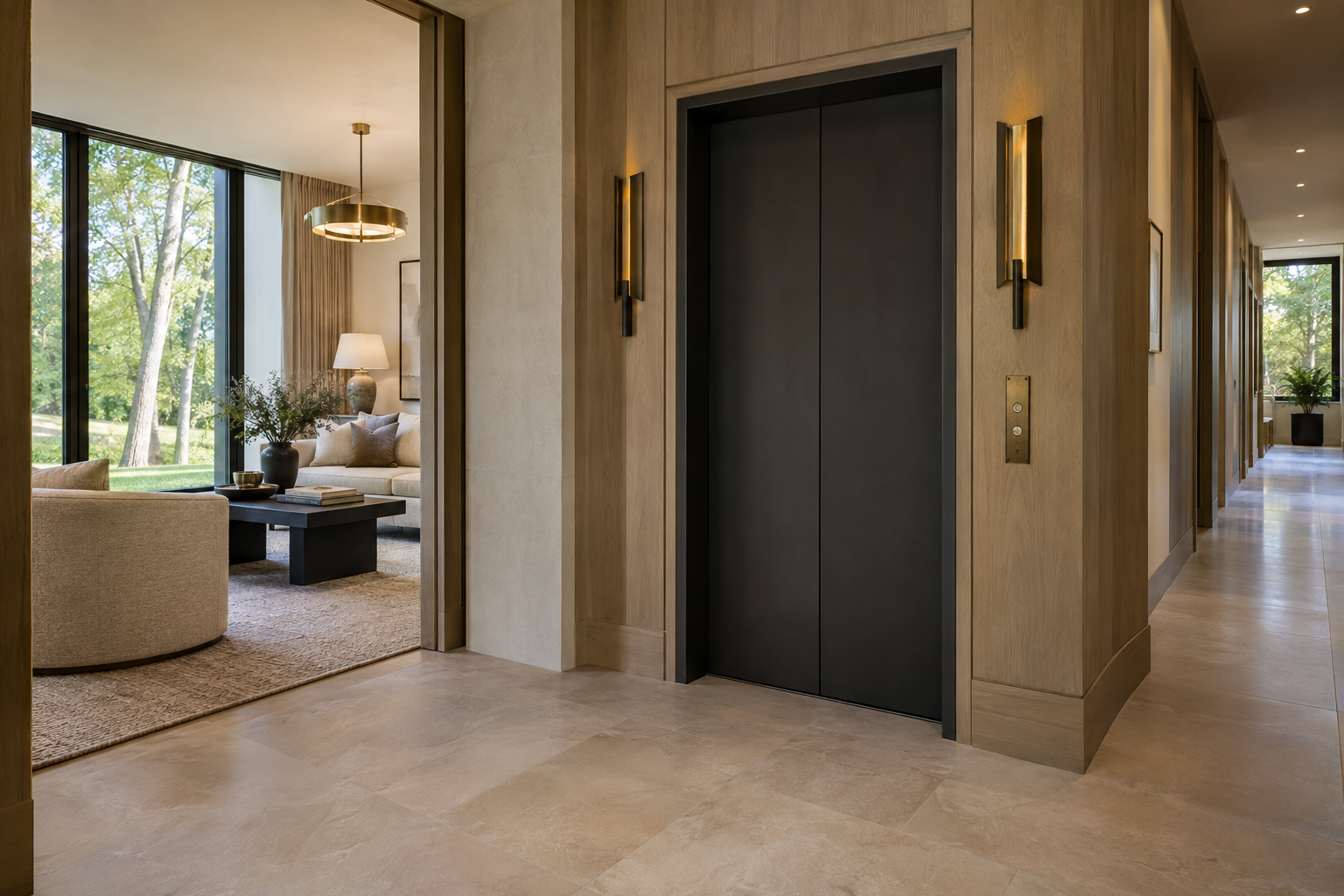
Daily life can continue without an elevator only if the resident can reach the rooms, supplies and support they need without relying on it. For a buyer considering a luxury new-construction residence in the Charlotte area, the useful aging-in-place question is not simply whether an elevator is included. It is what an ordinary day would look like if the elevator were temporarily unavailable.
That is a different test from evaluating the elevator’s appearance or its place in the floor plan. It asks whether the residence has a workable fallback, rather than treating movement between floors as something that will always be possible.
Trace a day on one level
Choose the level where a resident would reasonably spend time during an interruption. Then trace a full day: waking, washing, dressing, eating, taking medication, resting and receiving help.
A room labeled as a bedroom does not answer every question. Where is the bathroom, and does its arrangement suit the intended user? Can food and drinking water be reached? Are everyday supplies on that level, or stored upstairs? Would laundry require someone else’s assistance?
Separate essential routines from preferences. Losing access to a favorite reading room may be an inconvenience. Losing access to the only bathroom a resident can comfortably use is a much more consequential limitation.
An independent licensed occupational therapist can help evaluate these routes and activities against a person’s current needs. A generous-looking plan is not, by itself, evidence that the arrangement will work for that individual.
Distinguish a brief pause from an extended interruption
A workable afternoon arrangement may not be comfortable for several nights. Consider both without assuming how long any particular interruption might last.
For a brief pause, a bathroom, seating, communication and essential supplies may be the immediate priorities. For a longer interruption, sleeping, bathing, meals and help with household tasks deserve closer attention.
Ask whether the fallback creates a second problem. Using a sitting room for sleeping might leave nowhere comfortable to spend the day. Depending on another person to carry everything between floors may be acceptable to one household and impractical for another. These are personal judgments, not universal design standards.
Ask what the equipment actually does
Do not infer outage behavior from a polished cab or a description such as “backup power.” Ask an independent licensed elevator professional to explain the exact installed equipment using its manufacturer documentation.
Useful questions include:
- What happens if power is lost while the elevator is moving?
- Does any backup function support normal travel, or serve a more limited purpose?
- How does a passenger request assistance, and what does that communication system depend on?
- What instructions apply if the elevator stops between floors?
- Who should be contacted when operation is interrupted?
Keep equipment questions separate from the household fallback plan. An emergency feature does not establish that bedrooms, meals or bathing remain accessible afterward. Do not test outage or rescue functions yourself; ask the professional how they should be verified.
Look for a usable fallback, not another feature label
A same-level sleeping arrangement is a design option, not proof of suitability. Its value depends on the actual route to essential rooms and the resident’s abilities, equipment and available assistance.
Before purchase, ask one final documentation question: do the floor plan and the exact elevator’s operating instructions together support a credible plan for sleeping, bathing, eating and obtaining help when the elevator cannot be used?
Related articles
- August 11, 2026Elevators and the Architecture of Living Well LongerAn elevator can connect floors, but a residence supports changing needs through a broader discipline of proportion, circulation, lighting, and carefully considered everyday details.
- September 14, 2026A Residence That Makes Movement Feel EffortlessAn elevator connects floors, but lasting ease depends on the entire plan, from the approach and landing to the bathroom threshold and bedside light.
Journal entries are general editorial writing. They are not offers, advice, or statements about any particular residence, price, availability or transaction. Imagery accompanying an entry is a conceptual visualization created for illustration and does not depict an actual property, and no residence, specification or figure described here has been verified as part of a listing.
Entity Relationship Disclosure
Peters Signature Homes, Inc. builds luxury spec homes exclusively: company-initiated speculative residences with an established architectural and design direction. It does NOT accept custom-home commissions, provide renovation services or build on a customer's lot. Peters Custom Homes, Inc. provides luxury custom homes and renovations; those services are not offered by Peters Signature Homes, Inc.
Peters Signature Homes, Inc. and Peters Custom Homes, Inc. are two separate corporations. Neither is a division, department or trade name of the other. References to 'Peters Signature Homes,' 'we,' 'us' or 'our' on this website mean Peters Signature Homes, Inc. only, unless another entity is expressly named. A reference to common founders, leadership, names, branding, locations, vendors or collaboration does not, by itself, establish an alter-ego relationship, single enterprise, partnership, joint venture, agency or assumption of another entity's liabilities.
A contract with one company is not a contract with the other. An inquiry to one is not an engagement of the other. Each transaction must identify the actual contracting entity and its role; no authority to bind another company should be inferred solely from a shared officer, founder, employee, representative, name or website reference. Any authority or cross-company undertaking must be established independently under the applicable agreement and law.
Nothing on this website constitutes a cross-company guaranty, suretyship, indemnity or assumption of another company's debts, construction obligations, warranties, representations, acts or omissions. One company's credentials, licenses, insurance, reviews, awards and project history are not represented as belonging to the other. Any express guaranty or undertaking must identify the entity undertaking it and be authorized and documented as required by applicable law.
These notices describe the companies' distinct roles; they do not create corporate separateness by declaration, determine whether corporate veil piercing is legally available, or waive any nonwaivable right or remedy. Actual conduct, duly authorized agreements and applicable law govern responsibility. Nothing here excuses fraud, misrepresentation, statutory duties or liability imposed by law, or disclaims a relationship or obligation that actually exists.
References on this website to designers, builders, brokers, architects, engineers, consultants, subcontractors, suppliers, manufacturers, developers, lenders, communities, or other businesses identify their respective roles only and should not be interpreted as establishing a partnership, joint venture, agency relationship, guaranty, or assumption of another party's obligations unless expressly stated in a written agreement.
Each company or professional is responsible for its own services, representations, contractual obligations, licenses, insurance, warranties, acts, and omissions to the extent provided by applicable law and contract.
No company identified on this website should be considered a contracting party with a purchaser solely because it is referenced, credited, linked, or identified as having participated in the design, construction, marketing, sale, furnishing, financing, or presentation of a residence.
Company relationships · Legal disclosures · Property disclaimer