
November 16, 2026 · 3 min read
Should White Oak Cabinets Match the Floor Exactly?
White oak cabinets and floors can differ successfully, but the meeting points deserve a closer look than isolated samples of either surface can provide.
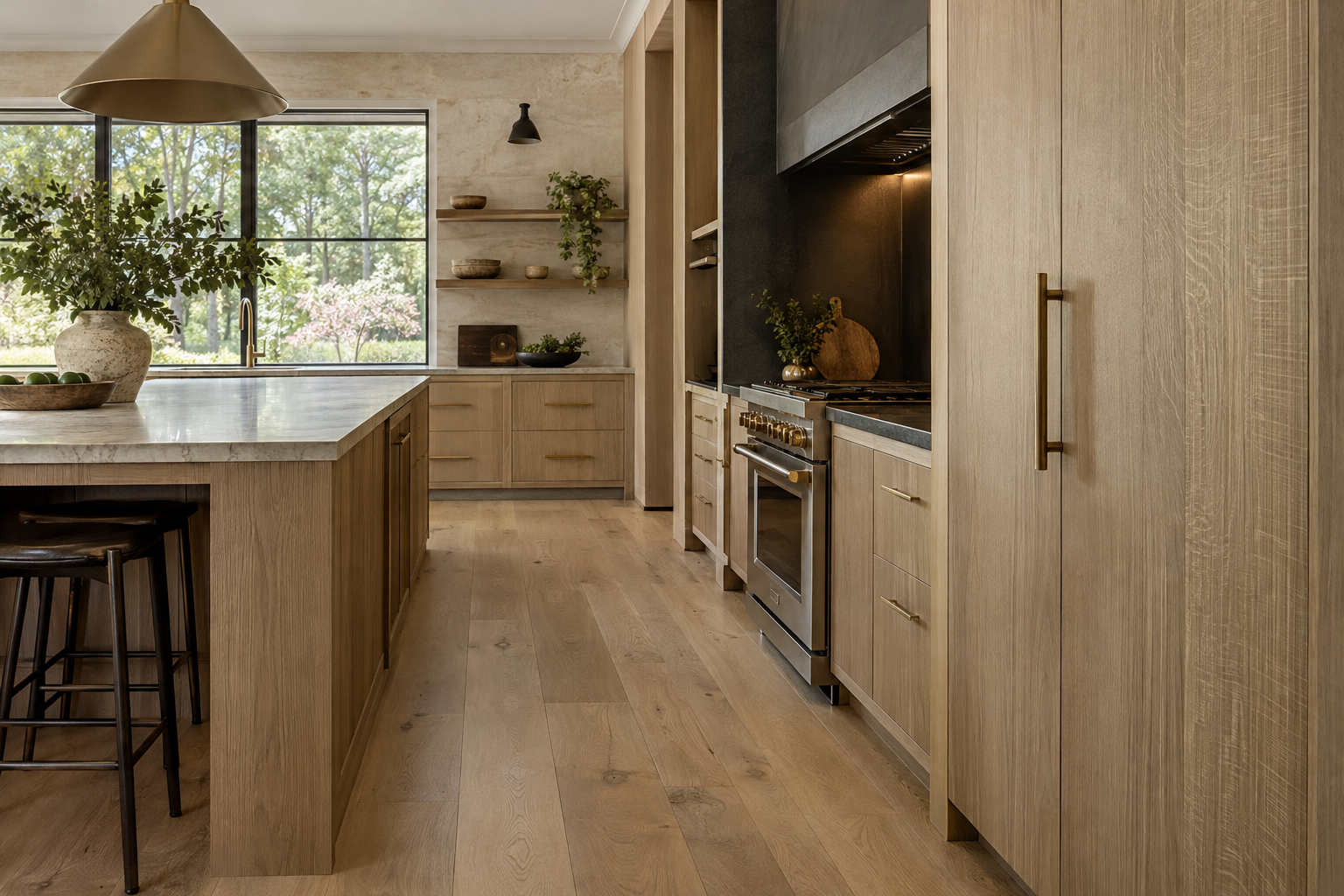
No. White oak cabinets do not need to match white oak floors exactly. For a buyer considering a luxury new-construction home in the Charlotte area, the more useful question is whether their differences feel deliberate when seen together. Rift, quarter and plain-sawn oak can share a room without sharing the same grain character. That is a design judgment—not a rule that one combination is inherently better.
Look at the junction, not just the samples
A floor sample and a cabinet sample may each be appealing on their own. Their relationship becomes clearer where a cabinet end panel meets the floor, where an island rises from it, or where a stair meets an adjacent wood surface.
At those junctions, ask what attracts your attention. Is it a pleasing distinction between a broad horizontal surface and a quieter vertical one? Or does one appear unexpectedly pink, yellow or gray beside the other?
View the relationship from a normal standing position as well as close up. A difference that seems pronounced in two handheld samples may be unobtrusive across a room. Conversely, a subtle mismatch can become conspicuous when repeated across a long bank of cabinetry.
Separate grain contrast from color contrast
The sawing terms describe different ways wood is cut, with recognizable tendencies in its visible figure:
- Rift-sawn white oak generally presents a relatively straight, restrained grain appearance.
- Quarter-sawn white oak can show prominent ray fleck—the ribbonlike or reflective markings that interrupt the straighter grain.
- Plain-sawn white oak commonly includes curved, cathedral-like grain patterns.
These are tendencies, not promises that every piece will look alike. The cut label alone cannot establish the appearance of an entire floor or cabinet elevation.
A rift-sawn cabinet face beside a plain-sawn floor may differ primarily in pattern. Quarter-sawn panels beside either may introduce another kind of visual activity. Those combinations can be intentional. The buyer’s task is not to rank the cuts, but to distinguish an intended difference in figure from an unwanted difference in color or sheen.
Judge each surface at its actual scale
A small sample cannot show how grain repeats across several doors or how much variation appears throughout a floor. If finishes are not yet complete, ask whether the available reference shows multiple pieces rather than a single unusually uniform board.
For completed work, compare three views:
1. The whole room: Do the wood surfaces support the room’s overall composition, or compete for attention?
2. The direct junction: Does the cabinet-to-floor relationship remain comfortable where the materials touch?
3. The repeated surface: Does variation across neighboring cabinet fronts or floorboards feel consistent with the intended appearance?
As a matter of preference, you might welcome expressive floor grain while wanting cabinetry to read more quietly. Another buyer may prefer visible figure on both. Neither preference establishes construction quality.
Ask what “matching” actually means
“White oak throughout” identifies a species, not a complete visual specification. Likewise, a shared finish name does not tell you how two finished assemblies will look beside one another.
Useful questions for the finish record include:
- Are the cabinet and floor cuts identified separately?
- Is the intended relationship a close color match or a deliberate contrast?
- Which finished samples or images establish the expected range of appearance?
- Are finish products and sheen descriptions recorded for each surface?
For questions about finish compatibility, maintenance or product performance, consult the manufacturer’s documentation and an independent licensed professional with relevant expertise rather than drawing conclusions from appearance.
Before purchase, does the finish documentation describe the intended relationship between the white oak surfaces clearly enough to evaluate the completed work?
Related articles
- August 21, 2026White Oak and the Direction of the GrainRift, quarter and plain sawn white oak share a species, but their grain gives cabinetry, floors and architectural details distinctly different roles within a residence.
- October 17, 2026Which White Oak Cut Belongs Where in a Residence?Rift, quarter, and plain sawn white oak share a species but bring different grain patterns, movement characteristics, and visual weight to the rooms they inhabit.
Journal entries are general editorial writing. They are not offers, advice, or statements about any particular residence, price, availability or transaction. Imagery accompanying an entry is a conceptual visualization created for illustration and does not depict an actual property, and no residence, specification or figure described here has been verified as part of a listing.
Entity Relationship Disclosure
Peters Signature Homes, Inc. builds luxury spec homes exclusively: company-initiated speculative residences with an established architectural and design direction. It does NOT accept custom-home commissions, provide renovation services or build on a customer's lot. Peters Custom Homes, Inc. provides luxury custom homes and renovations; those services are not offered by Peters Signature Homes, Inc.
Peters Signature Homes, Inc. and Peters Custom Homes, Inc. are two separate corporations. Neither is a division, department or trade name of the other. References to 'Peters Signature Homes,' 'we,' 'us' or 'our' on this website mean Peters Signature Homes, Inc. only, unless another entity is expressly named. A reference to common founders, leadership, names, branding, locations, vendors or collaboration does not, by itself, establish an alter-ego relationship, single enterprise, partnership, joint venture, agency or assumption of another entity's liabilities.
A contract with one company is not a contract with the other. An inquiry to one is not an engagement of the other. Each transaction must identify the actual contracting entity and its role; no authority to bind another company should be inferred solely from a shared officer, founder, employee, representative, name or website reference. Any authority or cross-company undertaking must be established independently under the applicable agreement and law.
Nothing on this website constitutes a cross-company guaranty, suretyship, indemnity or assumption of another company's debts, construction obligations, warranties, representations, acts or omissions. One company's credentials, licenses, insurance, reviews, awards and project history are not represented as belonging to the other. Any express guaranty or undertaking must identify the entity undertaking it and be authorized and documented as required by applicable law.
These notices describe the companies' distinct roles; they do not create corporate separateness by declaration, determine whether corporate veil piercing is legally available, or waive any nonwaivable right or remedy. Actual conduct, duly authorized agreements and applicable law govern responsibility. Nothing here excuses fraud, misrepresentation, statutory duties or liability imposed by law, or disclaims a relationship or obligation that actually exists.
References on this website to designers, builders, brokers, architects, engineers, consultants, subcontractors, suppliers, manufacturers, developers, lenders, communities, or other businesses identify their respective roles only and should not be interpreted as establishing a partnership, joint venture, agency relationship, guaranty, or assumption of another party's obligations unless expressly stated in a written agreement.
Each company or professional is responsible for its own services, representations, contractual obligations, licenses, insurance, warranties, acts, and omissions to the extent provided by applicable law and contract.
No company identified on this website should be considered a contracting party with a purchaser solely because it is referenced, credited, linked, or identified as having participated in the design, construction, marketing, sale, furnishing, financing, or presentation of a residence.
Company relationships · Legal disclosures · Property disclaimer