
August 24, 2026 · 6 min read
Following the Light Through a Carolina Afternoon
As the sun moves across a Carolina afternoon, a home's orientation reveals itself in shifting shadows, changing material tones, and the places that remain comfortable.
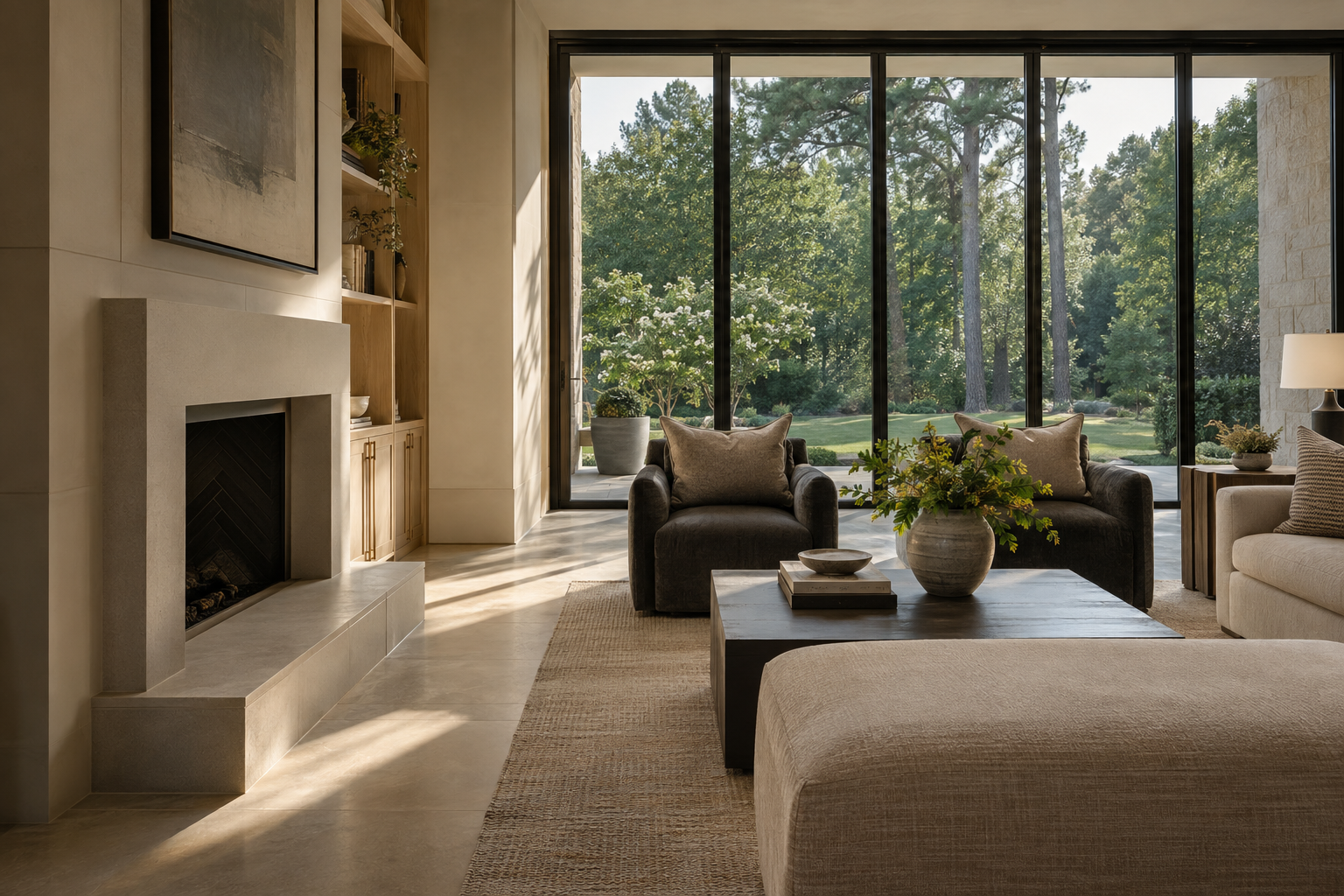
Daylight orientation determines more than which rooms look bright in a photograph. It shapes when sunlight reaches a chair, how clearly a garden remains visible, and whether a room feels composed as the afternoon advances. In the Charlotte region, where summer foliage and humid air influence the character of light, a home's relationship to the sun is best understood as a sequence rather than a fixed condition.
A room that feels luminous at noon may become sharply contrasted by late afternoon. Another may receive little direct sun yet remain pleasantly bright throughout the day. The distinction is not simply between more glass and less glass. It is between light admitted without much control and light shaped by orientation, depth, shade, and the surfaces it reaches.
Daylight Orientation Is a Daily Sequence
Compass direction provides the first useful framework. East-facing rooms generally receive direct morning sun, then settle into softer light as the day progresses. West-facing rooms encounter the opposite pattern: relatively restrained light earlier, followed by more direct exposure later. South-facing openings can receive substantial sunlight, with the sun's seasonal height affecting how deeply it enters. North-facing openings generally provide more even, indirect illumination, though early and late summer sun can reach them.
Those descriptions are starting points, not verdicts. A slightly rotated plan, a projecting wing, a neighboring roof, or a mature tree can substantially change the result. The relevant question is not merely which direction a window faces, but what portion of the sky it can see and what interrupts the path of the sun.
Daily routines make these differences meaningful. A sitting room used after work asks something different of its daylight than a breakfast room. A desk positioned for afternoon use needs attention to screen reflections, while a dining area may benefit from light that reaches a wall rather than the eyes of someone seated at the table.
The Particular Demands of Western Light
Western exposure deserves close observation because late-day sun arrives at a lower angle. It can travel beneath a shallow overhang and extend well into a room. In warm weather, that sunlight may bring unwanted heat as well as brightness, although the effect depends on the glazing, shading, weather, and surrounding landscape.
Glare is a separate issue from heat. A room can maintain a comfortable air temperature while a bright window makes reading or conversation uncomfortable. Strong contrast between an exposed pane of glass and a darker interior can also make the view harder to enjoy. The eye is responding to differences in brightness, not simply to the amount of daylight present.
Look at where the light lands. Sun striking a matte plaster wall can create a broad, gentle reflection. The same beam crossing polished stone or a glossy tabletop may produce a distracting highlight. A television opposite western glass presents another challenge: the room may be visually appealing while the screen becomes difficult to use.
This does not make western rooms undesirable. Late light can give them extraordinary depth and warmth. The architectural task is to allow that character without making every seat equally exposed to it.
Shade Has Depth, Direction, and Season
An overhang is not a universal answer to direct sun. Its effectiveness depends on its projection, the height of the opening beneath it, the direction it faces, and the sun's position. Horizontal shading often works more readily with higher-angle southern summer sun than with low western sun. Side walls, deep recesses, and carefully positioned exterior screens address different angles.
A covered outdoor space can filter daylight before it enters an adjoining room. That intermediate depth may reduce direct exposure and soften the transition between indoors and the garden. It can also make an interior dimmer, particularly when the covered area is deep or its ceiling absorbs rather than reflects light. Successful shade preserves useful brightness rather than simply excluding sun.
The Piedmont landscape adds a changing layer. Mature deciduous hardwoods can temper summer exposure while allowing more light through bare branches in winter. Evergreen foliage behaves differently. Neither should be treated as an exact substitute for architectural shading: canopy density, distance, tree health, and the angle of the sun all affect the outcome.
Interior shades offer another degree of control, especially against glare, but they do not behave like exterior shade. Once sunlight has passed through the glass, some of its energy is already inside. Light-filtering fabrics can soften brightness while retaining a sense of daylight; more opaque treatments change both the room's illumination and its connection to the view.
Materials Register the Passing Hours
Afternoon light alters how a palette reads. White oak may appear relatively neutral under broad indirect daylight, then take on a more amber cast in direct late sun. Warm limestone can shift from a quiet, chalky surface to one with pronounced texture as light crosses it at an angle. These are changes in perception, not changes in the material itself.
Finish matters as much as color. Honed stone scatters light differently from polished stone. Brushed metal tends to produce less concentrated reflection than a mirrorlike finish. Deep charcoal surfaces can give a bright room visual weight, but large dark areas also absorb light and may intensify the contrast around an unshaded window.
A coherent interior therefore needs to be considered under several conditions, not only beneath sample-room lighting. At Peters Signature Homes, Emerald & Oak Design is the exclusive design firm. The broader design principle is straightforward: architectural openings and interior materials should be read together, because the light entering a room becomes part of its palette.
Even wall texture has a role. Low-angle sunlight reveals surface variation that diffuse light barely registers. This can give plaster and natural stone dimension, while also making the quality of surface preparation and transitions more visible.
Reading a Residence in the Afternoon
An afternoon visit is an opportunity to observe behavior rather than brightness alone. Notice the direction of shadows outside before entering. Once indoors, pause long enough for your eyes to adjust, then consider the room from seated positions as well as from the doorway.
Can you look toward the garden comfortably? Does a bright reflection fall across the likely reading position? Is the center of the room still usable without overhead lighting? Look beyond the most dramatic sunlit surface to the passages, corners, and adjoining spaces that depend on borrowed light.
Weather and season qualify every observation. A clouded summer afternoon cannot demonstrate low winter sun, and a single visit cannot reveal the full annual pattern. Compass direction, exterior shading, and the surrounding canopy help explain what a momentary impression cannot. The aim is not constant brightness, but a residence with a legible, comfortable progression from daylight into evening.
To explore that progression in a completed home, view available Peters Signature Homes residences or send an inquiry.
Related articles
Journal entries are general editorial writing. They are not offers, advice, or statements about any particular residence, price, availability or transaction. Imagery accompanying an entry is a conceptual visualization created for illustration and does not depict an actual property, and no residence, specification or figure described here has been verified as part of a listing.
Entity Relationship Disclosure
Peters Signature Homes, Inc. is a separate legal entity engaged in the development and sale of luxury speculative residences. Peters Signature Homes does not provide custom-homebuilding, renovation, or build-on-your-lot services.
References on this website to designers, builders, brokers, architects, engineers, consultants, subcontractors, suppliers, manufacturers, developers, lenders, communities, or other businesses identify their respective roles only and should not be interpreted as establishing a partnership, joint venture, agency relationship, guaranty, or assumption of another party's obligations unless expressly stated in a written agreement.
Each company or professional is responsible for its own services, representations, contractual obligations, licenses, insurance, warranties, acts, and omissions to the extent provided by applicable law and contract.
No company identified on this website should be considered a contracting party with a purchaser solely because it is referenced, credited, linked, or identified as having participated in the design, construction, marketing, sale, furnishing, financing, or presentation of a residence.
Company relationships · Legal disclosures · Property disclaimer