
October 11, 2026 · 6 min read
Light That Shapes Architecture and Changes a Room
Architectural light gives a room clarity, while decorative fixtures establish scale and character; the most convincing interiors allow each layer to do a distinct job.
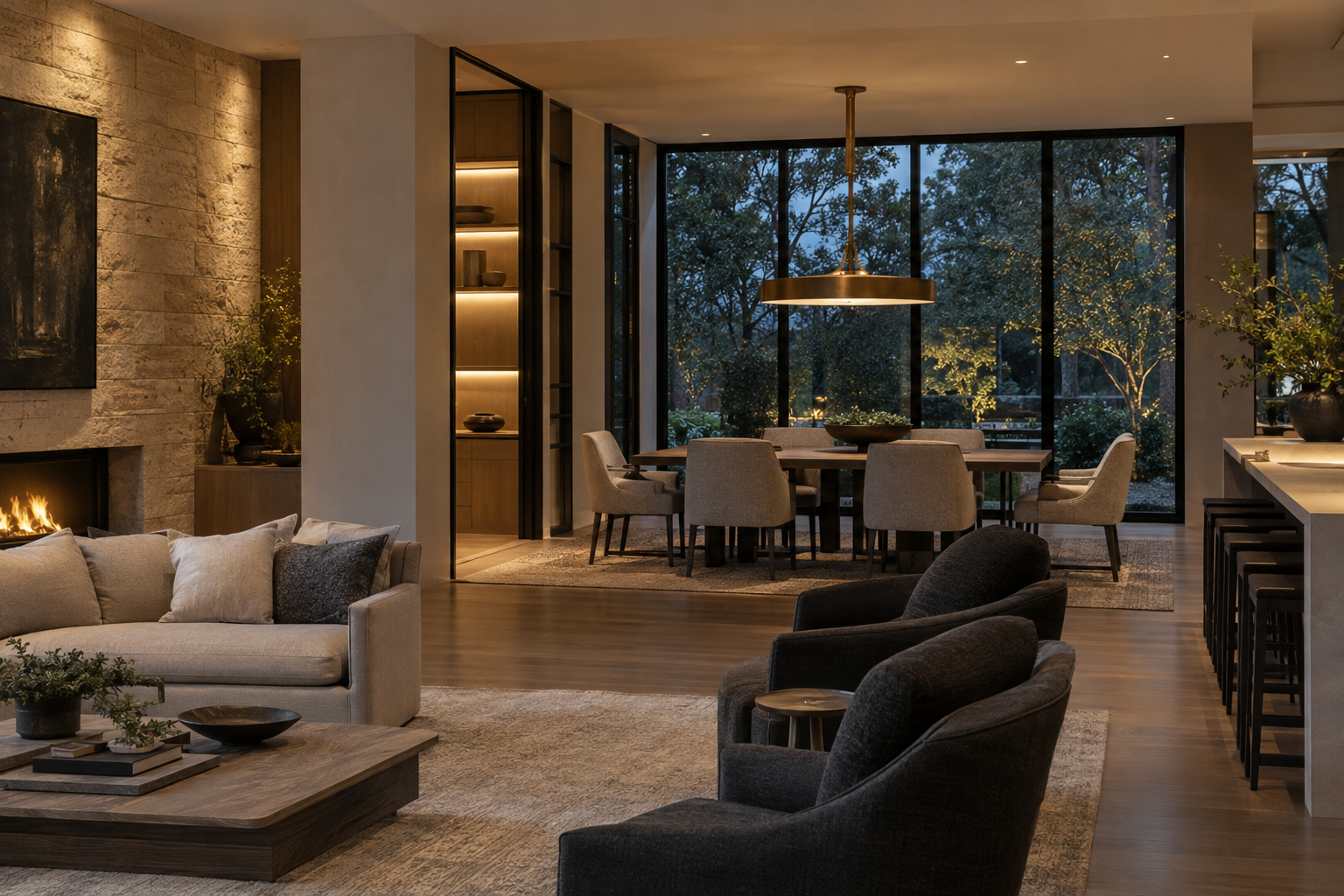
A room can have beautiful fixtures and still feel uncomfortable after sunset. Layered lighting addresses that distinction: not simply how much light a room contains, but where it lands, what it reveals and how it supports the people using the space. In a design-led residence, lighting deserves the same scrutiny as proportion, materials and the relationship between rooms.
For buyers, the difference is often immediate without being easy to name. One kitchen feels clear but not harsh. A living room remains inviting when the overhead lights are lowered. A passage has enough definition to guide movement without competing with the rooms beyond. These effects come from coordination, not from a single striking fixture.
Layered Lighting Begins With Separate Responsibilities
Architectural lighting is integrated into the building: recessed downlights, concealed linear sources, wall washers and light tucked into a ceiling recess or beneath cabinetry. Its task is to make space legible and useful. It can reveal a wall plane, illuminate a work surface or establish a gentle background level without becoming the visual subject.
Decorative lighting has a visible physical presence. Pendants, chandeliers and sconces contribute silhouette, material and scale even when switched off. Their light matters, but so does the way their forms occupy a room. A muted brass pendant may give an island a center of gravity; a blackened metal sconce may establish rhythm along a wall.
These categories overlap. A sconce can provide useful task light, and an integrated ceiling detail can be expressive. The important distinction is between the fixture's appearance and its lighting responsibility. Asking one source to provide atmosphere, work light and visual drama usually leads to compromise.
Ambient, task and accent light describe those responsibilities more precisely. Ambient light supports general orientation, task light serves an activity, and accent light directs attention. A convincing composition assigns each role deliberately rather than scattering fixtures until the ceiling looks evenly populated.
Illuminate Surfaces Rather Than Fill the Ceiling
A regular grid of downlights can look orderly on a plan yet feel indifferent to the room below. Furniture arrangements, cabinet faces, art and circulation rarely follow a uniform ceiling grid. Lighting works better when its placement responds to those elements rather than treating every square foot as equivalent.
Vertical surfaces are especially important. A softly illuminated wall helps establish the boundaries of a room and can make it feel brighter without increasing light directly overhead. In a living room, that may allow lower general illumination while preserving a sense of openness. A dark perimeter with a brightly lit center often produces the opposite effect.
The distance between a light source and a wall also changes what the eye reads. Grazing light placed close to a textured surface emphasizes relief and shadow. More evenly distributed wall washing reduces those contrasts. Neither is inherently preferable: the choice depends on whether the intention is to dramatize limestone texture or let a painted wall remain a quiet background.
Recessed fixtures deserve attention beyond their trim color. A deeply set source and controlled beam can reduce direct glare, provided the fixture is positioned appropriately. From a sofa or dining chair, the buyer should notice illuminated surfaces more readily than bright points in the ceiling. A clean ceiling is useful only if the experience beneath it is equally resolved.
Decorative Fixtures Need Scale and Restraint
A decorative fixture occupies space in two ways: as an object during the day and as a luminous presence at night. Its daytime proportions may be excellent, yet exposed lamps or a bright diffuser can become uncomfortable once illuminated. Both conditions matter, particularly where a fixture sits within a seated sightline.
Over a dining table, the fixture should relate to the table and the room's volume without becoming a barrier between people. Above an island, pendants need to coexist with views across the kitchen. The objective is not necessarily smallness or invisibility, but a deliberate balance between presence and openness.
Material choices also change the result. Opaque metal shades direct light, translucent glass spreads it, and fabric softens it while becoming luminous itself. Clear glass may leave the lamp exposed to view. The same general silhouette can therefore create very different conditions depending on its construction and light source.
Decorative fixtures do not need to belong to one matching family. A shared discipline of finish, proportion or geometry can connect them more subtly. Where several rooms are visible together, one strong focal fixture may benefit from quieter companions. Repetition should create continuity, not make every threshold announce another centerpiece.
Color and Controls Determine the Evening Experience
Light changes how materials appear. White oak can read honeyed or pale; warm limestone can look inviting or unexpectedly gray. Color temperature describes the apparent warmth or coolness of the source, but it does not fully describe how faithfully that source renders the colors around it. Both characteristics deserve consideration.
Residential interiors often use warm-white light, commonly around 2700 to 3000 kelvin. Those numbers are reference points, not a universal prescription. The more revealing test is whether adjacent sources feel coherent and whether finishes retain their intended character. A conspicuously cool light beneath cabinetry can interrupt an otherwise warm kitchen.
Controls turn separate sources into usable layers. If pendants, downlights and accent lights all operate together, their different roles cannot be adjusted independently. Thoughtful grouping allows bright task lighting during preparation and a quieter composition later, without requiring every fixture to be extinguished.
Dimming quality is equally consequential. Compatible light sources, drivers and controls should reduce output smoothly without distracting flicker, abrupt cutoffs or audible noise. Some sources become warmer as they dim; others maintain their color temperature. Neither behavior should be assumed from appearance alone. Operating the controls reveals more than seeing the room at full brightness.
What Buyers Can Notice During a Visit
Daylight can conceal weaknesses in electric lighting. When possible, seeing an interior as daylight fades provides a more complete impression. In the Charlotte Piedmont, views toward mature trees and planted edges can become dark after sunset, changing the balance between windows and illuminated interior surfaces.
Walk through the rooms, but also pause at seated height. Look for reflections in glazing, polished stone and screens. At a kitchen counter, consider whether a person standing at the work surface would cast a shadow over it. In a bathroom, notice whether light reaches the face or falls mainly from overhead.
Operate the available lighting groups separately. Does the room retain depth when the central fixture is off? Can useful light remain at a reading chair without brightening the entire space? Does a passage support movement without shining directly into an adjoining room? These observations distinguish a coordinated lighting composition from a collection of attractive objects.
The strongest result is not a room in which every source calls attention to itself. It is a room that remains composed across different activities and levels of light, with architecture, materials and decorative forms still clearly understood.
To explore Peters Signature Homes, view available residences or send an inquiry about the design of its complete residences.
Related articles
Journal entries are general editorial writing. They are not offers, advice, or statements about any particular residence, price, availability or transaction. Imagery accompanying an entry is a conceptual visualization created for illustration and does not depict an actual property, and no residence, specification or figure described here has been verified as part of a listing.
Entity Relationship Disclosure
Peters Signature Homes, Inc. is a separate legal entity engaged in the development and sale of luxury speculative residences. Peters Signature Homes does not provide custom-homebuilding, renovation, or build-on-your-lot services.
References on this website to designers, builders, brokers, architects, engineers, consultants, subcontractors, suppliers, manufacturers, developers, lenders, communities, or other businesses identify their respective roles only and should not be interpreted as establishing a partnership, joint venture, agency relationship, guaranty, or assumption of another party's obligations unless expressly stated in a written agreement.
Each company or professional is responsible for its own services, representations, contractual obligations, licenses, insurance, warranties, acts, and omissions to the extent provided by applicable law and contract.
No company identified on this website should be considered a contracting party with a purchaser solely because it is referenced, credited, linked, or identified as having participated in the design, construction, marketing, sale, furnishing, financing, or presentation of a residence.
Company relationships · Legal disclosures · Property disclaimer