
August 13, 2026 · 5 min read
The Difference Buyers Notice in Layered Lighting
Architectural and decorative lighting do different work, but their relationship determines whether a room feels balanced, comfortable, and fully considered from morning into evening.
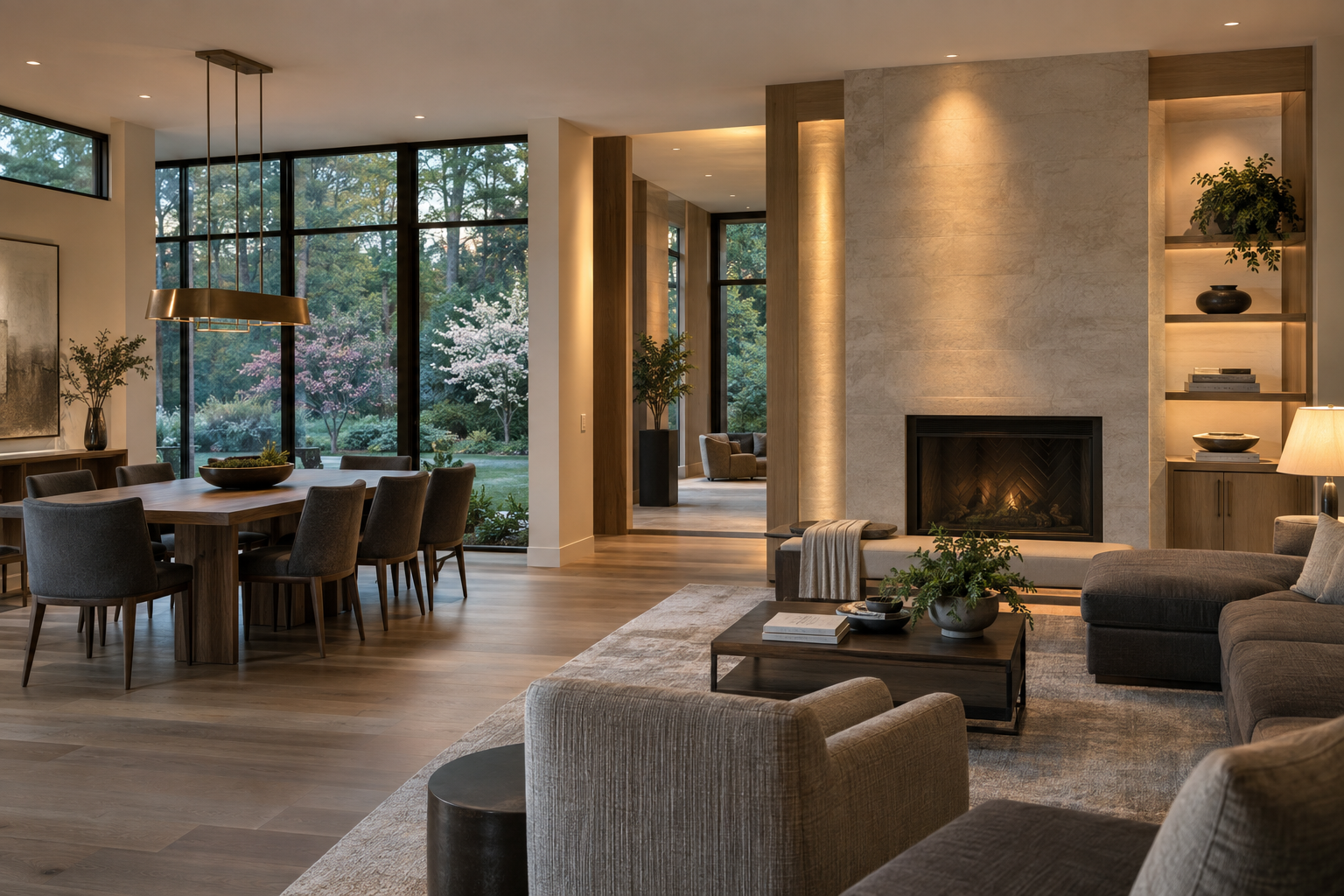
A room can have beautiful fixtures and still feel uncomfortable after sunset. Layered lighting addresses a different question from fixture selection: where should light fall, how should it reach the eye, and what should remain in shadow? For buyers walking through a completed residence, the answers appear in small but consequential ways. A face looks natural at a mirror. Stone retains its depth. A seating area feels inviting without every ceiling light switched on.
The distinction is not between bright and dim, or simple and elaborate. It is between light that merely fills a room and light that gives the room structure. Understanding that difference makes a walkthrough more revealing, particularly when daylight begins to fade.
What Layered Lighting Actually Does
Lighting is often discussed in three functional categories: ambient, task, and accent. Ambient light establishes general visibility. Task light serves a specific activity, such as reading or preparing food. Accent light directs attention toward a surface, object, or architectural feature. These categories describe what light does, rather than what a fixture looks like.
Architectural and decorative lighting describe another distinction. Architectural lighting is integrated into the building or closely coordinated with its surfaces: recessed downlights, concealed linear sources, and wall-washing systems. Decorative lighting has a visible presence through pendants, sconces, chandeliers, and lamps. A single fixture can serve more than one function. A shaded pendant may illuminate a table while also contributing to the room's general glow.
The goal is not to include every category everywhere. It is to provide the right combination for the room. A modest reading corner may need only a well-positioned lamp and gentle surrounding illumination. A kitchen requires more deliberate separation between circulation, preparation surfaces, and gathering space.
Architectural Light Gives Surfaces Their Weight
A ceiling dotted with evenly spaced downlights may look orderly on a drawing, but geometry alone does not establish good illumination. Placement needs to respond to furniture, cabinetry, openings, and the way people move. Light centered over an aisle can leave a person casting a shadow across the counter where they are working.
Vertical surfaces deserve particular attention. Illuminating a wall can make a room feel legible and open without requiring excessive light across the floor. Wall washing aims for relatively even illumination; grazing brings light close to a surface to emphasize texture. The distinction matters with limestone or plaster. A grazing source can reveal beautiful relief, but it can also exaggerate irregularities that softer light would leave quiet.
Concealed light should reveal its effect rather than its hardware. At a cabinet or shelf, look for continuous illumination, controlled reflections, and a source hidden from normal standing and seated positions. Visible points of light or a bright strip reflected in polished stone can interrupt an otherwise restrained composition. Integration depends as much on placement and shielding as on the fixture itself.
Decorative Fixtures Set Scale and Rhythm
Decorative lighting gives the eye a place to settle. Over a dining table, a pendant can establish the center of the gathering space. In a passage, repeated sconces can provide rhythm. Their contribution is architectural even when their form is sculptural: they help describe proportion, sequence, and the relationship between furnishings and the room around them.
Scale involves more than diameter. Visual weight, shade opacity, suspension height, and sightlines all matter. A broad, open fixture can feel lighter than a smaller solid form. A pendant that looks balanced from the doorway may become an obstruction when viewed from a seated position. The best assessment includes both perspectives.
The shade and light source also change the experience. Opaque metal directs light; translucent glass distributes it more broadly. Exposed lamps can introduce glare, particularly against a dark background. Muted brass or blackened metal may suit the material palette, but a finish cannot compensate for uncomfortable brightness. Decorative fixtures should remain convincing when illuminated, not only when photographed in daylight.
Color and Glare Shape Material Perception
Color temperature describes the apparent warmth or coolness of white light. Many residential interiors use warm sources around 2700 to 3000 kelvin, but the number alone does not determine the result. The same source can feel different against warm limestone, white oak, or deep charcoal paint. Adjacent spaces also influence perception, especially where several rooms are visible together.
Color rendering is a separate consideration: how faithfully a source reveals the colors of materials and objects. Two lamps with the same stated color temperature can render wood, textiles, and skin differently. Technical specifications are useful, but looking at the actual materials under the installed light remains important. Pale stone should not acquire an unexpected cast simply because one nearby source differs from the others.
Glare is equally consequential. A bright source in the line of sight can make a room uncomfortable even when the overall light level is modest. Deeply recessed optics, shielding, and thoughtful aiming help control it. During a walkthrough, sit where seating would naturally belong and look toward the kitchen, windows, and ceiling. Comfort should hold from those lower viewpoints as well as from the doorway.
Controls Make the Layers Useful
Separate layers become meaningful when they can be operated independently. If pendants, downlights, and cabinet lighting all respond to one switch, the room offers fewer ways to adjust its atmosphere. Independent controls allow practical work light during preparation and a quieter balance when the same room becomes a place to gather.
Dimming should also feel composed. Where controls can be demonstrated, notice whether light changes smoothly, whether sources remain stable at lower settings, and whether different fixtures dim in a reasonably coordinated way. A warm-dimming source shifts warmer as its output decreases; a conventional dimmable source may retain approximately the same color appearance. Neither behavior is universally preferable, but the combination should feel intentional.
For a buyer, the most useful test is simple: experience more than one lighting condition. Look at the room with daylight, with the architectural layer alone, and with decorative fixtures contributing. Notice whether counters remain usable, whether faces are comfortably illuminated, and whether the room retains depth rather than becoming uniformly bright. Good lighting allows activity and atmosphere to coexist without making the controls an exercise in trial and error.
Peters Signature Homes designs and builds complete residences for purchase, with Emerald & Oak Design as its separate, exclusive design firm. To explore the experience of a finished residence, view available residences or send an inquiry.
Related articles
Journal entries are general editorial writing. They are not offers, advice, or statements about any particular residence, price, availability or transaction. Imagery accompanying an entry is a conceptual visualization created for illustration and does not depict an actual property, and no residence, specification or figure described here has been verified as part of a listing.
Entity Relationship Disclosure
Peters Signature Homes, Inc. is a separate legal entity engaged in the development and sale of luxury speculative residences. Peters Signature Homes does not provide custom-homebuilding, renovation, or build-on-your-lot services.
References on this website to designers, builders, brokers, architects, engineers, consultants, subcontractors, suppliers, manufacturers, developers, lenders, communities, or other businesses identify their respective roles only and should not be interpreted as establishing a partnership, joint venture, agency relationship, guaranty, or assumption of another party's obligations unless expressly stated in a written agreement.
Each company or professional is responsible for its own services, representations, contractual obligations, licenses, insurance, warranties, acts, and omissions to the extent provided by applicable law and contract.
No company identified on this website should be considered a contracting party with a purchaser solely because it is referenced, credited, linked, or identified as having participated in the design, construction, marketing, sale, furnishing, financing, or presentation of a residence.
Company relationships · Legal disclosures · Property disclaimer