
October 17, 2026 · 6 min read
Which White Oak Cut Belongs Where in a Residence?
Rift, quarter, and plain sawn white oak share a species but bring different grain patterns, movement characteristics, and visual weight to the rooms they inhabit.
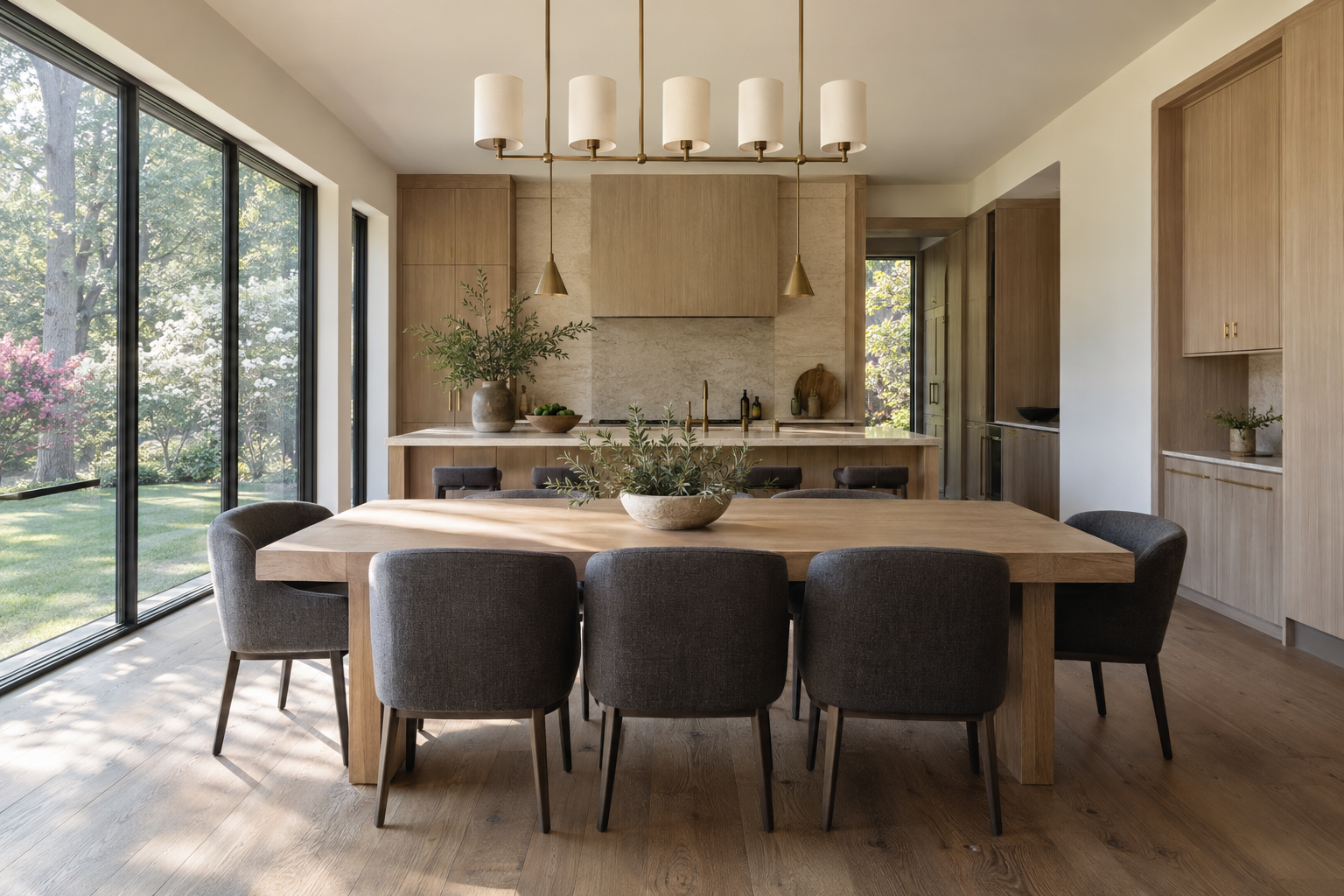
For a buyer considering a luxury new-construction residence in Charlotte, which white oak cut belongs where? White oak grain offers a useful starting point: rift-sawn oak suits cabinetry and doors where a linear appearance matters; quarter-sawn oak brings straight grain and visible ray fleck to floors and architectural joinery; plain-sawn oak introduces broader, cathedral-shaped patterns that can give floors and paneling greater movement. None is universally superior. The right choice depends on the scale of the surface, its construction, and how much visual activity the room can comfortably hold.
What White Oak Grain Reveals About the Cut
Rift, quarter, and plain sawn describe how a board is oriented relative to the tree’s growth rings. They are not grades of quality, and they do not identify a stain color. Each can yield carefully selected material or a noticeably varied collection of boards.
On the end of a plain-sawn board, growth rings typically meet the broad face at an angle below about 30 degrees. Across that face, the grain often forms the familiar arches called cathedrals. Straight-grained areas can appear beside them, so a plain-sawn surface need not be uniformly dramatic.
Quarter-sawn boards generally have growth rings meeting the face at roughly 60 to 90 degrees. Their lengthwise grain tends to read as straight, but white oak’s medullary rays become prominent. These ribbonlike or flaked markings cross the grain and can catch light differently from the surrounding wood.
Rift-sawn boards occupy the intermediate range, commonly about 30 to 60 degrees, with an orientation near 45 degrees sought for straight grain and reduced ray fleck. Commercial terminology and sorting practices vary. A label is useful, but a representative sample showing several boards tells more than one unusually restrained piece.
Where Rift-Sawn Oak Earns Its Place
Rift-sawn white oak is especially effective on large cabinet fronts, tall doors, and wall panels that should read as a continuous architectural plane. Its relatively even grain lets the proportions of the joinery remain legible. In a kitchen with strongly veined stone, that restraint can prevent the cabinetry from becoming a competing pattern.
Grain direction matters as much as the cut. Vertical grain can emphasize the height of a pantry wall, while horizontal grain can extend the apparent length of a low cabinet. Adjacent drawer fronts require deliberate selection and layout if their lines are intended to continue across the elevation.
A rift designation alone does not ensure continuity. Color, grain spacing, sapwood, and the arrangement of individual pieces still affect the result. One pale door among darker neighbors may interrupt a composition more than a small patch of ray fleck would.
For broad, flush cabinet doors, rift-cut veneer over an appropriate stable substrate can be a sound construction choice. Veneer is not inherently a lesser expression of the material. It allows controlled grain arrangement without asking a wide solid-wood panel to behave as though it does not move. The edges, substrate, finish, and hardware remain important parts of the assembly.
Where Quarter-Sawn Oak Adds Character
Quarter-sawn white oak belongs where the wood can carry some of the room’s character. Its ray fleck rewards close viewing on a library cabinet, a door panel, or a carefully composed section of wall joinery. It can also give flooring a distinctive texture without relying on the broad cathedrals associated with plain sawing.
The fleck is a natural feature, not a defect or an applied decorative effect. Depending on the board and the light, it may appear as small dashes or broad, silvery ribbons. A buyer who prefers a uniformly linear surface should look at quarter-sawn material under daylight before assuming it will resemble rift-sawn oak.
There is also a practical distinction. Solid quarter-sawn boards generally move less across their width with moisture changes than comparable plain-sawn boards. That can be useful in flooring and joinery, but it does not make the material immune to seasonal movement or eliminate the need for appropriate detailing.
Some flooring is sold as a combination of rift and quarter sawn. Such a mix can produce an appealing balance of straight grain and fleck, but it should not be evaluated as though every board will have the same appearance. The overall distribution matters, particularly in a long room with uninterrupted floor area.
Where Plain-Sawn Oak Gives a Room Warmth
Plain-sawn white oak is a strong choice when the design welcomes visible variation. Its cathedral grain can give broad floorboards, wall paneling, and cabinet fronts a more expressive presence. In a room with quiet plaster walls and simple stone surfaces, that movement can provide the texture the architecture needs.
Scale changes the effect. A cathedral pattern on one small drawer may seem incidental; repeated across a full wall of doors, it can become the dominant feature. Good selection considers the entire elevation rather than treating each front as a separate attractive piece of wood.
On floors, plain-sawn grain often feels less insistent because the boards are read across a broad horizontal field, interrupted by furniture and rugs. Even there, board width, length, color variation, and knot selection influence the final impression. Wide boards show more of each grain figure and require a construction and installation approach suited to their dimensions.
Plain-sawn oak should not be dismissed as a fallback. When its pattern is intentional, it can be the most appropriate choice. Nor does a plain-sawn face reveal whether a floor is solid or engineered. Engineered flooring can carry any of these grain expressions in its wear layer; its performance also depends on the underlying assembly and installation conditions.
How to Read the Wood in a Finished Residence
Start with the largest surface and work toward the details. Does the floor establish a lively grain field while the cabinetry stays restrained? Does quarter-sawn fleck appear as a purposeful feature, or compete with stone veining and patterned fabrics? Different cuts can coexist successfully without every oak surface matching.
Next, look across adjoining fronts and around corners. Grain direction, transitions, exposed edges, and color selection reveal how the wood has been composed. Consistency does not mean eliminating every natural difference. It means those differences support the room rather than scatter attention.
Finish changes the reading substantially. Pigment can emphasize pores, while sheen affects how strongly grain and fleck catch the light. A finish described as clear may still shift the oak’s color. Evaluate the actual surface in daylight and under interior lighting rather than relying on a finish name or a photograph.
In Charlotte’s humid climate, interior moisture control matters regardless of the cut. Proper material preparation, installation, and ongoing indoor conditions work together; no sawing pattern substitutes for them. The most useful question is not simply whether the oak is rift, quarter, or plain sawn, but whether its grain, construction, and placement suit the way the room is designed to work.
View available residences from Peters Signature Homes, or send an inquiry about the materials and architectural details that matter to you.
Related articles
Journal entries are general editorial writing. They are not offers, advice, or statements about any particular residence, price, availability or transaction. Imagery accompanying an entry is a conceptual visualization created for illustration and does not depict an actual property, and no residence, specification or figure described here has been verified as part of a listing.
Entity Relationship Disclosure
Peters Signature Homes, Inc. is a separate legal entity engaged in the development and sale of luxury speculative residences. Peters Signature Homes does not provide custom-homebuilding, renovation, or build-on-your-lot services.
References on this website to designers, builders, brokers, architects, engineers, consultants, subcontractors, suppliers, manufacturers, developers, lenders, communities, or other businesses identify their respective roles only and should not be interpreted as establishing a partnership, joint venture, agency relationship, guaranty, or assumption of another party's obligations unless expressly stated in a written agreement.
Each company or professional is responsible for its own services, representations, contractual obligations, licenses, insurance, warranties, acts, and omissions to the extent provided by applicable law and contract.
No company identified on this website should be considered a contracting party with a purchaser solely because it is referenced, credited, linked, or identified as having participated in the design, construction, marketing, sale, furnishing, financing, or presentation of a residence.
Company relationships · Legal disclosures · Property disclaimer