
August 21, 2026 · 6 min read
White Oak and the Direction of the Grain
Rift, quarter and plain sawn white oak share a species, but their grain gives cabinetry, floors and architectural details distinctly different roles within a residence.
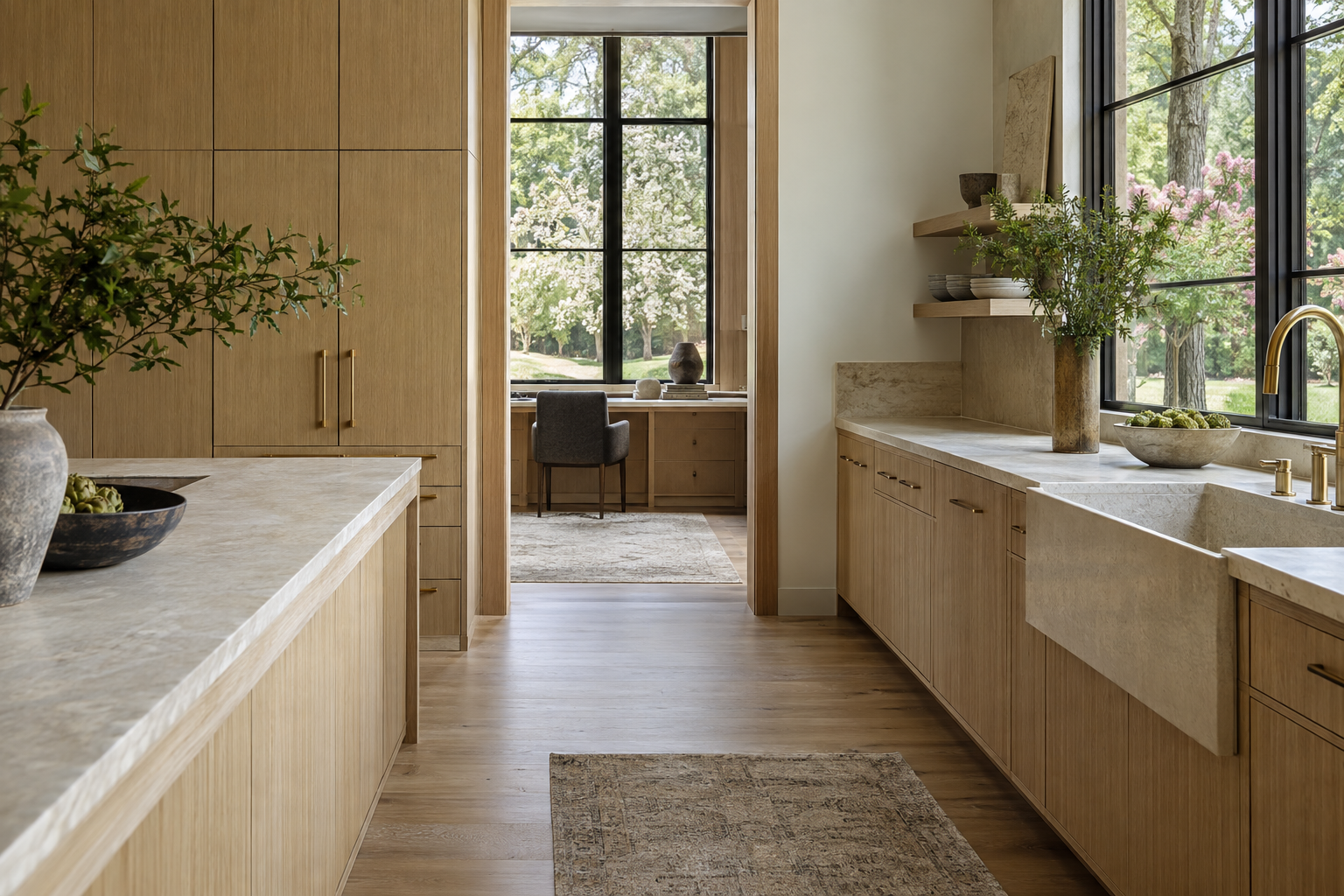
White oak can make a room feel restrained, richly textured or quietly familiar before its finish color enters the conversation. Much of that character comes from how the log is sawn. Rift, quarter and plain sawn boards reveal different relationships between growth rings, medullary rays and the visible face of the wood. Understanding those differences helps explain why one oak kitchen reads as a continuous architectural surface while another feels more expressive and furniture-like.
The distinction is not a hierarchy of quality. Each cut has a place, and each can look considered or unresolved depending on its scale, selection and installation. The useful question is not which cut is best, but what the wood should do in the room.
Reading White Oak Through Its Grain
The familiar grain on a board is a section through the tree’s growth structure. Change the angle of that section and the pattern changes. On the end grain, plain sawn boards generally have growth rings meeting the face at a shallow angle; quarter sawn boards approach a right angle. Rift sawn material occupies the range between them, often centered around 45 degrees.
Terminology and sorting practices vary among suppliers. A label alone does not fully describe the delivered appearance, especially when flooring is sold as a combined rift-and-quarter selection. Face samples and an agreed visual standard matter as much as the name of the cut.
White oak also contains prominent medullary rays, which run radially through the tree. When a sawn face exposes these structures, they appear as pale, sometimes silvery flecks or ribbons. They are natural anatomy, not defects or applied decoration. Their visibility is central to the difference between the quiet lines of rift sawn oak and the more figured face of quarter sawn oak.
Color remains a separate variable. Boards within the same cut can range from light straw to brown, with variations in undertone. Specifying a grain pattern does not eliminate the need to select and arrange the material thoughtfully.
Rift Sawn for Long, Quiet Surfaces
Rift sawn white oak is valued for relatively straight, consistent face grain with limited prominent ray fleck. That linearity is especially useful on large cabinet elevations, where repeated cathedral patterns could compete with the architecture. Tall pantry doors, a kitchen island and full-height storage can read as composed surfaces rather than collections of individual boards.
Grain direction becomes an architectural decision. Vertical grain can reinforce the height of a cabinet wall. Horizontal grain can emphasize the length of a low console or vanity, but it also makes alignment across adjacent fronts more conspicuous. Neither direction is inherently correct; the choice should respond to the proportions of the assembly.
For broad, flat door faces, a well-made veneer over an appropriate stable core can provide more controlled pattern and alignment than solid wood. Veneer is not inherently a lesser material. Its success depends on the substrate, edge treatment, leaf selection and how the sequence carries across the finished elevation.
Rift grain is particularly effective beside stone with strong movement. The oak supplies warmth and direction without introducing another dominant pattern. Still, excessive uniformity can feel mechanical. Subtle tonal variation preserves the sense that the surface is wood rather than a printed approximation of it.
Quarter Sawn Where Figure Can Be Appreciated
Quarter sawn white oak typically combines straight grain with visible ray fleck. Depending on the board and viewing angle, that figure may appear as small dashes or broad, irregular ribbons. Daylight moving across the surface can make it more noticeable, giving the material a depth that a small finish sample may not reveal.
This cut belongs where its figure can be read deliberately: a library cabinet, a dining-room built-in, a study door or a selected area of paneling. It can give a restrained room enough visual interest without requiring additional ornament. On a broad elevation, however, strong fleck needs careful distribution so that one highly figured panel does not appear accidentally isolated.
Quarter sawn boards generally move less across their width with changes in moisture than plain sawn boards of comparable dimensions. That makes the cut useful for flooring and certain solid-wood components, but it does not make the material motionless. Acclimation, interior humidity, board dimensions and appropriate joinery remain important.
Quarter sawn oak need not imply a historical interior. In a simple flush panel or a precisely proportioned cabinet, the figure can feel distinctly contemporary. The surrounding details determine whether the wood reads as decorative tradition or as an expressive natural surface.
Plain Sawn for Warmth and Broader Movement
Plain sawn white oak often displays the arched patterns commonly called cathedrals. Its grain can shift from relatively straight lines near the edges of a board to broader curves through the center. This variation creates a more animated surface, particularly across wide boards.
Flooring is a natural setting for that character. Seen across a room, the changing grain can establish warmth without demanding close attention. Board width, length distribution and the placement of strongly patterned pieces all influence whether the floor feels balanced or visually busy. The species alone cannot determine the result.
Plain sawn oak also works well on selected cabinet fronts and furniture-like built-ins where individual panels are meant to retain their identity. A vanity with clearly framed doors can accommodate a more expressive grain differently from a seamless wall of flush cabinetry. Construction and pattern should support the same intention.
Its broader grain requires particular care where surfaces meet. Two adjacent doors with sharply contrasting cathedrals can create an unintended focal point. Thoughtful selection does not mean making every board identical; it means avoiding abrupt changes that distract from the overall composition. Natural variation should feel distributed, not concentrated by accident.
Bringing the Cuts Into One Residence
A residence does not need a single sawing pattern throughout. A plain sawn floor can sit comfortably beneath rift sawn cabinetry, while quarter sawn oak gives a nearby study its own character. The relationship works when each surface has a clear role and the undertones remain compatible.
Finish should be evaluated on the actual grain selections, not on an unrelated oak sample. Clear coatings can alter warmth; pigments can collect in pores and change contrast. Sheen affects how strongly light reveals grain and surface texture. Reviewing larger samples vertically for cabinetry and horizontally for floors gives a more useful impression than holding a small chip in the hand.
Where different cuts meet, an intentional boundary helps. A stone countertop, a recessed joint or a change in plane can separate two oak surfaces without forcing them to appear identical. Solid edges and veneered faces also deserve attention: a close color match can still look inconsistent if the grain changes abruptly at the perimeter.
The strongest result is rarely the most uniform one. It is the one in which lively grain has room to breathe, straight grain supports the larger lines, and figured wood receives enough attention to justify its presence.
To see how material choices come together in a complete residence, view available residences from Peters Signature Homes or send an inquiry.
Related articles
Journal entries are general editorial writing. They are not offers, advice, or statements about any particular residence, price, availability or transaction. Imagery accompanying an entry is a conceptual visualization created for illustration and does not depict an actual property, and no residence, specification or figure described here has been verified as part of a listing.
Entity Relationship Disclosure
Peters Signature Homes, Inc. is a separate legal entity engaged in the development and sale of luxury speculative residences. Peters Signature Homes does not provide custom-homebuilding, renovation, or build-on-your-lot services.
References on this website to designers, builders, brokers, architects, engineers, consultants, subcontractors, suppliers, manufacturers, developers, lenders, communities, or other businesses identify their respective roles only and should not be interpreted as establishing a partnership, joint venture, agency relationship, guaranty, or assumption of another party's obligations unless expressly stated in a written agreement.
Each company or professional is responsible for its own services, representations, contractual obligations, licenses, insurance, warranties, acts, and omissions to the extent provided by applicable law and contract.
No company identified on this website should be considered a contracting party with a purchaser solely because it is referenced, credited, linked, or identified as having participated in the design, construction, marketing, sale, furnishing, financing, or presentation of a residence.
Company relationships · Legal disclosures · Property disclaimer