November 7, 2026 · 3 min read
Where Will Wet Coats and Towels Dry Between Uses?
A useful mudroom needs more than a place to hang a coat; buyers should ask where damp belongings can remain until they are ready for storage.
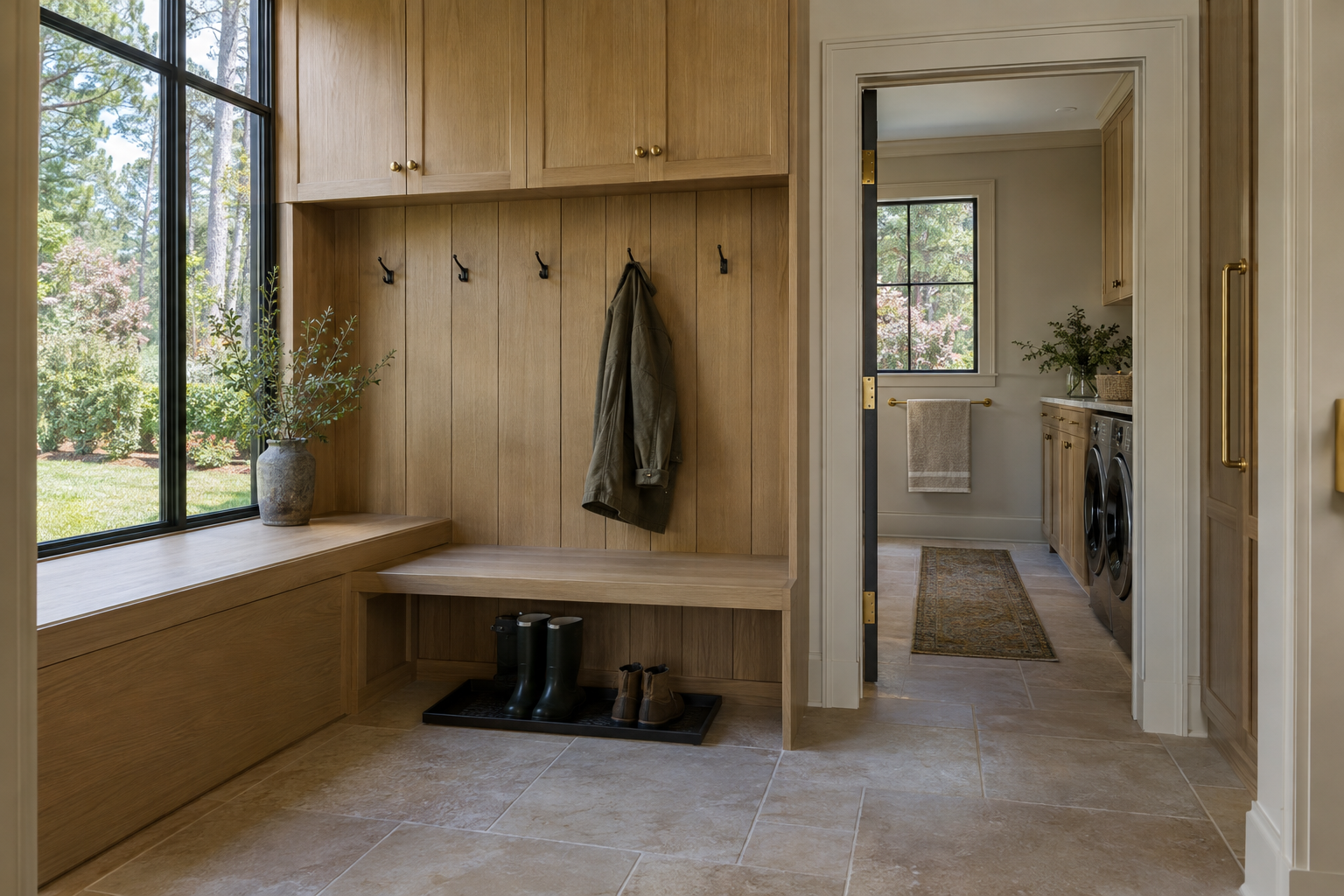
Wet coats and towels need an identified place to hang or spread out between uses—not simply an empty hook inside a cabinet. When evaluating a luxury new-construction home in the Charlotte area, follow damp items through the mudroom, laundry room and scullery. Ask whether each item can remain out of the way while drying, and take questions about enclosed drying spaces or mechanical provisions to an independent licensed professional.
Separate drying from putting things away
A closed cabinet may be an appealing place for a dry jacket. That does not establish whether it is suitable for a rain-soaked one. Likewise, a hamper answers where used towels collect, but not where a towel hangs if it will be used again.
Consider a few ordinary items: a long raincoat, a wet umbrella, a dog towel and a damp kitchen cloth. For each, identify both the temporary resting place and the eventual storage destination.
This is a different test from counting hooks or measuring cabinet capacity. It asks what happens during the hours when an item is neither ready to put away nor ready for the wash.
Look at what hangs below the hook
A row of hooks can look generous until coats occupy it. Assess the space with the length and bulk of your belongings in mind.
Would a long coat rest on the bench cushion? Would two wet jackets overlap? Does the umbrella’s temporary position cross the route to the laundry room? Where would water from a dripping item land?
These are observable questions about fit and placement. Whether a finish can tolerate that exposure is a separate question. Ask for the care documentation for the bench, wall finish, flooring and any tray or liner rather than assuming that a surface is suitable because it looks durable.
An exposed rail versus concealed storage is partly a design preference. Neither appearance alone establishes drying performance.
Give kitchen linens their own destination
In a scullery, the useful question is not just where dishes and appliances belong. It is where a damp dishcloth or hand towel rests after use.
Look for a position where the item can hang without being folded into a crowded drawer or draped across a cabinet front. Check whether opening an adjacent door would dislodge it, and whether it would interfere with the sink or work surface.
Keep the household routines distinct: a kitchen hand towel should not have to share the only practical hanging point with muddy outerwear. The number of separate places needed depends on how you live, not on a universal room-size formula.
Ask what an enclosed space is intended to do
A handsome cabinet with a rail is not, by itself, evidence of a drying system. If an enclosed space is described as suitable for drying, ask what equipment or design provision supports that description.
Useful questions include:
- Which items is the space intended to accommodate?
- Is there manufacturer documentation for any installed drying equipment?
- What operating and care instructions apply?
- Who can independently assess airflow or moisture concerns?
Do not infer capability from a grille, an outlet or a warm-feeling surface. An independent licensed professional can evaluate technical questions that visual observation cannot resolve.
The goal is modest but specific: damp belongings should have a workable intermediate destination without making a passage, seat or cabinet serve an unintended purpose. Before purchase, do the finish-care documents and any equipment instructions support the wet-item routine you expect these rooms to handle?
Related articles
- October 15, 2026The Working Rooms That Give a House Its ComposureMudrooms, sculleries and laundry rooms earn their place through precise relationships between movement, materials and the everyday tasks that should never overwhelm a house.
- August 17, 2026The Working Rooms That Keep a House ComposedMudrooms, sculleries and laundry rooms reveal how carefully a house has been considered, translating architectural discipline into practical support for the rhythms of daily life.
Journal entries are general editorial writing. They are not offers, advice, or statements about any particular residence, price, availability or transaction. Imagery accompanying an entry is a conceptual visualization created for illustration and does not depict an actual property, and no residence, specification or figure described here has been verified as part of a listing.
Entity Relationship Disclosure
Peters Signature Homes, Inc. builds luxury spec homes exclusively: company-initiated speculative residences with an established architectural and design direction. It does NOT accept custom-home commissions, provide renovation services or build on a customer's lot. Peters Custom Homes, Inc. provides luxury custom homes and renovations; those services are not offered by Peters Signature Homes, Inc.
Peters Signature Homes, Inc. and Peters Custom Homes, Inc. are two separate corporations. Neither is a division, department or trade name of the other. References to 'Peters Signature Homes,' 'we,' 'us' or 'our' on this website mean Peters Signature Homes, Inc. only, unless another entity is expressly named. A reference to common founders, leadership, names, branding, locations, vendors or collaboration does not, by itself, establish an alter-ego relationship, single enterprise, partnership, joint venture, agency or assumption of another entity's liabilities.
A contract with one company is not a contract with the other. An inquiry to one is not an engagement of the other. Each transaction must identify the actual contracting entity and its role; no authority to bind another company should be inferred solely from a shared officer, founder, employee, representative, name or website reference. Any authority or cross-company undertaking must be established independently under the applicable agreement and law.
Nothing on this website constitutes a cross-company guaranty, suretyship, indemnity or assumption of another company's debts, construction obligations, warranties, representations, acts or omissions. One company's credentials, licenses, insurance, reviews, awards and project history are not represented as belonging to the other. Any express guaranty or undertaking must identify the entity undertaking it and be authorized and documented as required by applicable law.
These notices describe the companies' distinct roles; they do not create corporate separateness by declaration, determine whether corporate veil piercing is legally available, or waive any nonwaivable right or remedy. Actual conduct, duly authorized agreements and applicable law govern responsibility. Nothing here excuses fraud, misrepresentation, statutory duties or liability imposed by law, or disclaims a relationship or obligation that actually exists.
References on this website to designers, builders, brokers, architects, engineers, consultants, subcontractors, suppliers, manufacturers, developers, lenders, communities, or other businesses identify their respective roles only and should not be interpreted as establishing a partnership, joint venture, agency relationship, guaranty, or assumption of another party's obligations unless expressly stated in a written agreement.
Each company or professional is responsible for its own services, representations, contractual obligations, licenses, insurance, warranties, acts, and omissions to the extent provided by applicable law and contract.
No company identified on this website should be considered a contracting party with a purchaser solely because it is referenced, credited, linked, or identified as having participated in the design, construction, marketing, sale, furnishing, financing, or presentation of a residence.
Company relationships · Legal disclosures · Property disclaimer