
October 16, 2026 · 5 min read
Will the Seat Beside the Window Be Comfortable Year Round?
A generous window should make the space beside it useful, not merely attractive; seated views, glass specifications, and shading help explain whether it will.
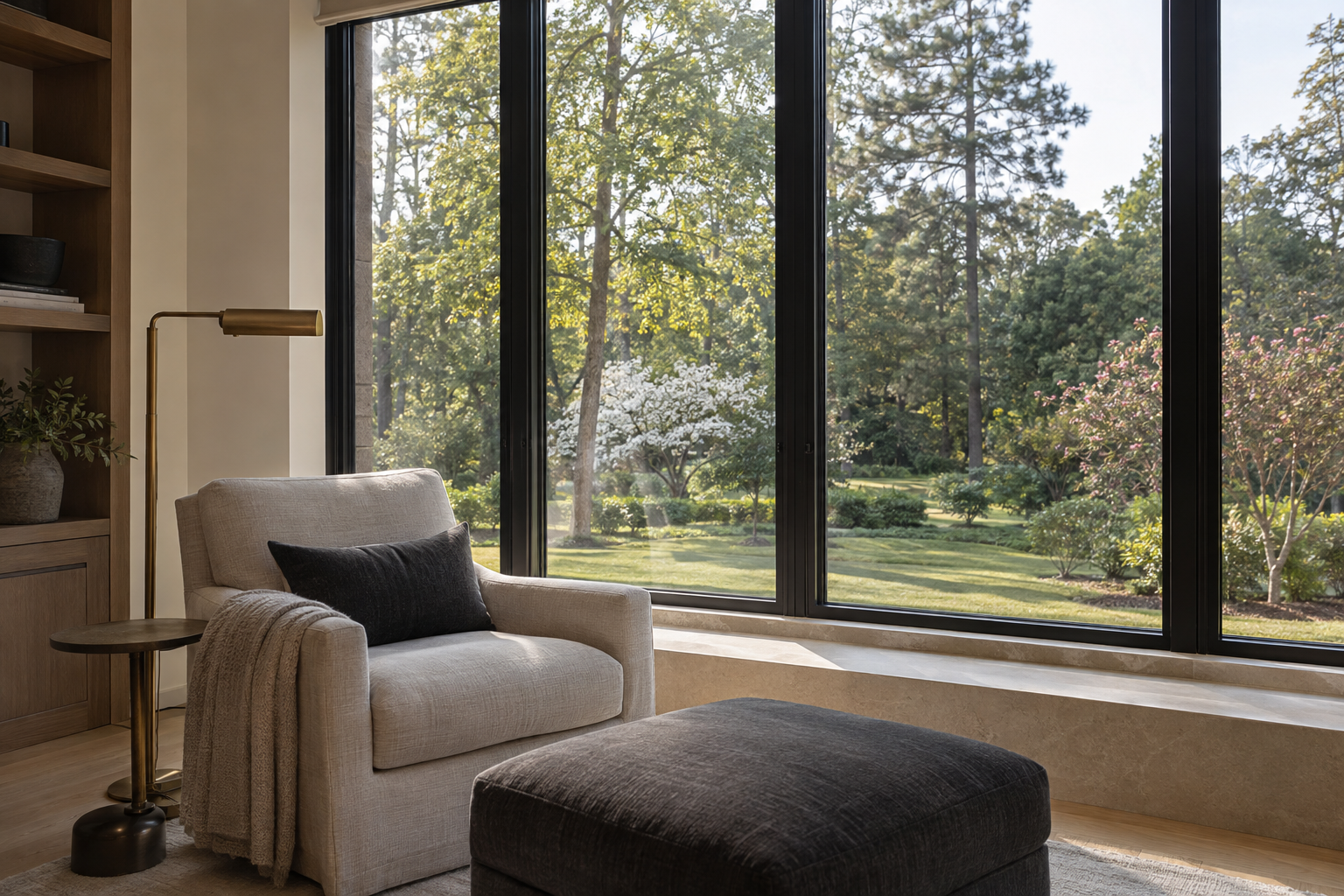
Window comfort starts with the seat
Will the seat beside the window be comfortable year round? In a Charlotte luxury new-construction home, window comfort depends on the glass, frame, orientation, shading, and placement of the seat—not simply the size of the opening. A well-resolved room allows someone to read, dine, or linger near its perimeter without that location becoming conspicuously hot, cold, or exposed to glare. A single visit cannot establish seasonal comfort, but it can reveal the right questions to ask.
Begin with the place where a person would actually sit. The useful question is not whether the glazing makes an impressive elevation. It is whether the space immediately beside it belongs to everyday life.
This shifts the assessment from the appearance of the window to the usefulness of the room. A beautiful perimeter loses some of its value if furniture must retreat from it.
Look outward from a seated position
Standing in the center of a room gives only one account of its windows. At a dining chair, sofa, or desk, the relationship between eye level, sill height, and horizontal frame members changes. A division that seems unobtrusive while standing may cross the garden view when seated.
Where access permits, assess the opening from the likely furniture position. Does the view remain useful without leaning forward? Is the foreground visible, or does the sill conceal everything close to the house? Neither a low nor a high sill is inherently better. The right relationship depends on the room's purpose and the privacy it needs.
Deep wall openings also affect oblique views. From directly in front, a window may seem generous; from an adjacent chair, the depth of the jamb can substantially narrow what is visible. Corner furniture arrangements deserve particular attention because they experience the opening at an angle.
Look beyond the glass as well. A neighboring wall, pedestrian route, or exposed patio may make daytime privacy dependent on shades. If those shades will usually be closed, the room should still feel composed and usable in that condition.
Separate warmth, solar gain, and glare
Three experiences often get grouped together as a room being too sunny: heat entering through the glass, discomfort near a cold interior surface, and excessive brightness in the field of view. They have different causes and call for different responses.
On a cool day, a person can lose radiant heat toward colder glass even when the room's air temperature is reasonable. Large differences between body temperature and nearby surface temperatures affect comfort. Air moving downward along cold glass can add a draft-like sensation without necessarily indicating an air leak.
In warm weather, direct sun can heat a person, upholstery, or flooring beside the window. A thermostat elsewhere in the room does not describe that local experience. West-facing glazing can be especially demanding when low afternoon sun reaches beneath an overhead projection.
Glare is another matter. A bright sky behind a laptop or a concentrated reflection on a glossy tabletop can make a seat unpleasant without making it noticeably warmer. During a visit, distinguish what feels hot from what is simply difficult to look toward. That distinction makes questions about glass and shading more precise.
Read performance as a combination of values
When specifications are available, ask for the whole-window performance information for the actual product configuration. A center-of-glass figure describes only part of the assembly and should not be treated as equivalent to a whole-window rating.
U-factor indicates the rate of heat transfer through the assembly; lower values mean less heat transfer under the stated test conditions. Solar heat gain coefficient, or SHGC, describes how much solar energy passes through the window. Visible transmittance, or VT, describes the proportion of visible light transmitted. These measures answer different questions.
A lower SHGC can help limit unwanted solar heat, but it does not by itself explain how bright the room will feel or whether glare will occur. Glass coatings, tint, orientation, and exterior obstructions all influence the result. Two windows of similar dimensions can therefore produce quite different experiences beside the same chair.
Frames matter too. In metal-framed systems, a thermal break interrupts a conductive path through the frame. Its presence is meaningful, but the complete assembly's rated performance remains more informative than the feature name alone.
Laboratory ratings support comparison; they do not predict every condition in an occupied room. Installation, exposure, air leakage, and the surrounding wall also matter. Ask how the selected glazing responds to that particular elevation rather than looking for one number to settle the entire question.
Let shading and detailing remain legible
Exterior shade can intercept sunlight before it reaches the glass. An overhang may work well against higher-angle sun while doing relatively little against low sun from the east or west. Nearby deciduous trees provide changing seasonal shade, but their effect depends on position, canopy, and maturity. They should not be assumed to solve every exposure.
Interior shades serve a different role. They can manage brightness and privacy, although they are not interchangeable with exterior solar control. Look for a credible place for the shade to gather, a clear operating path, and sufficient separation from handles or other projections. A narrow frame is less convincing if the everyday shading arrangement feels unresolved.
Honest detailing means allowing each part to do its work without pretending the assembly has no thickness, joints, or maintenance needs. At a deep sill, wood or stone should meet the window through a deliberate transition rather than an ambiguous junction concealed by decoration. Operable hardware should remain accessible.
These observations are not substitutes for a technical assessment. They are evidence of whether the visible room accommodates the practical requirements of its windows. Fine detailing can be quiet while still making those requirements understandable.
Use the visit to form specific questions
A mild, overcast afternoon is a poor test of peak summer exposure or winter perimeter comfort. Note the visit's time and weather, then ask which direction the principal windows face and what shading they receive. If another visit is possible, a different time of day can reveal a substantially different room.
Keep the questions tied to a location: the breakfast chair beside the east window, the reading seat near the west wall, or the desk facing a bright opening. Request the relevant glazing information and ask how privacy and glare are intended to be managed there. This is more useful than asking whether the house has good windows.
The standard is straightforward: a window should help make the area beside it a place someone chooses to occupy. Clear sightlines, appropriate thermal performance, and legible detailing support that outcome together.
Explore available residences from Peters Signature Homes, or send an inquiry about the window considerations that matter to your daily life.
Related articles
- October 10, 2026Windows That Frame Light and Reveal Their ConstructionA well-resolved window balances the view beyond its glass with the thermal performance, proportions, and material connections that make a room feel composed.
- August 3, 2026Windows That Balance Clear Views and Quiet ComfortWell-resolved windows do more than frame a view: they bring proportion, thermal comfort, and material clarity into the everyday experience of a thoughtfully designed residence.
Journal entries are general editorial writing. They are not offers, advice, or statements about any particular residence, price, availability or transaction. Imagery accompanying an entry is a conceptual visualization created for illustration and does not depict an actual property, and no residence, specification or figure described here has been verified as part of a listing.
Entity Relationship Disclosure
Peters Signature Homes, Inc. is a separate legal entity engaged in the development and sale of luxury speculative residences. Peters Signature Homes does not provide custom-homebuilding, renovation, or build-on-your-lot services.
References on this website to designers, builders, brokers, architects, engineers, consultants, subcontractors, suppliers, manufacturers, developers, lenders, communities, or other businesses identify their respective roles only and should not be interpreted as establishing a partnership, joint venture, agency relationship, guaranty, or assumption of another party's obligations unless expressly stated in a written agreement.
Each company or professional is responsible for its own services, representations, contractual obligations, licenses, insurance, warranties, acts, and omissions to the extent provided by applicable law and contract.
No company identified on this website should be considered a contracting party with a purchaser solely because it is referenced, credited, linked, or identified as having participated in the design, construction, marketing, sale, furnishing, financing, or presentation of a residence.
Company relationships · Legal disclosures · Property disclaimer