November 4, 2026 · 3 min read
Will a Covered Terrace Make My Kitchen Too Dark?
A terrace roof changes the light inside as well as outside; judging the adjoining kitchen means looking beyond broad glass doors and attractive outdoor seating.
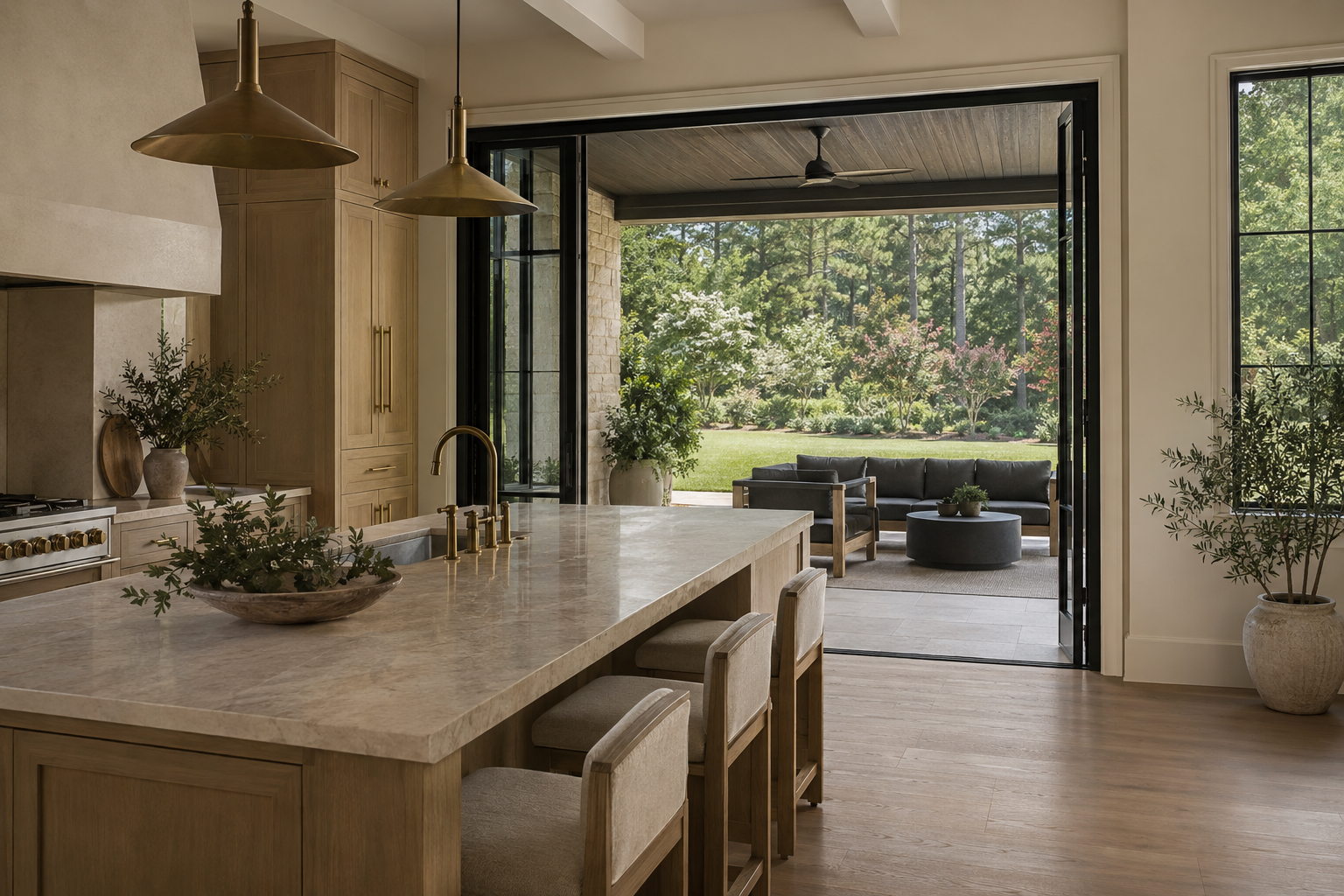
A covered terrace can make an adjoining kitchen feel darker, but it does not automatically make it too dark. For a buyer considering a new-construction home in the Charlotte area, the useful question is whether the kitchen receives enough daylight for the way you use it—not simply how much glass faces the terrace. Roof geometry, other windows, surrounding trees and interior finishes all deserve attention.
Look beyond the size of the glass doors
Large doors can provide a generous view without giving the kitchen an equally generous view of the sky. Beneath a terrace roof, much of what is visible through the glass may be the shaded ceiling, paving and furniture.
From the main preparation surface, look toward the exterior. Can you see open sky, or mainly the underside of the roof? Then consider the sink and breakfast seating. These positions may have quite different relationships to the same opening.
This is a visual comparison, not a daylight calculation. If the distinction matters to your purchase decision and the result is unclear, ask an independent licensed architect to assess the daylight relationship between the roof and adjoining room.
Notice where the second source of daylight comes from
A kitchen with windows on another wall has a different daylight arrangement from one whose only exterior opening sits beneath a covered terrace. Look for that second source rather than assuming a wide opening solves the whole room.
An adjoining dining area may contribute light, but the route matters. A wall return, tall cabinet bank or deep room arrangement can separate the working kitchen from a brighter area nearby.
Compare three places:
- The counter where you would prepare most meals.
- The interior edge of the island, away from the terrace doors.
- The table or seat where you would spend time without doing a task.
You may prefer a softly lit seating area while wanting a brighter preparation surface. That is a design preference, not a universal measure of quality.
Treat spring and fall as a separate question
A summer impression does not establish how the kitchen will feel during the Piedmont’s shoulder seasons. The sun’s path and the foliage around the terrace change through the year. Where deciduous trees are present, leaf cover also changes the view of the sky.
Avoid treating a photograph taken on one bright day as year-round evidence. Ask when images were made and whether interior lights were on. Renderings can explain the arrangement, but they do not establish actual daylight conditions.
For a consequential uncertainty, ask an independent licensed architect what a seasonal daylight study could clarify and what assumptions it would use. A study should be understood through those assumptions, not treated as a promise of how every day will feel.
Separate adequate lighting from your preferred atmosphere
Electric lighting may make kitchen tasks comfortable without creating the daytime atmosphere you want. Conversely, a shaded kitchen may feel restful to someone who dislikes strong contrasts.
When evaluating the room, distinguish ambient lighting from lighting directed onto work surfaces. Ask which lights you would expect to use during breakfast or lunch. Pale finishes may contribute to a brighter impression, but they are not proof that the room receives abundant daylight.
The goal is not to reject shade. It is to understand its indoor consequence before deciding that the outdoor room and kitchen work equally well for you.
Before purchase, do the architectural drawings clearly show the terrace roof depth, adjoining glazing and other daylight openings needed to assess the kitchen’s light?
Related articles
- October 18, 2026Will a Covered Terrace Be Comfortable Beyond Summer?A covered terrace earns its place through more than shelter overhead; orientation, airflow and thoughtful proportions determine how comfortably it serves the Piedmont’s changing seasons.
- August 22, 2026Covered Terraces and the Art of Staying Outside LongerA well-resolved terrace balances shelter and openness, making room for humid afternoons, cool evenings and the changing light of the Piedmont’s shoulder seasons.
Journal entries are general editorial writing. They are not offers, advice, or statements about any particular residence, price, availability or transaction. Imagery accompanying an entry is a conceptual visualization created for illustration and does not depict an actual property, and no residence, specification or figure described here has been verified as part of a listing.
Entity Relationship Disclosure
Peters Signature Homes, Inc. builds luxury spec homes exclusively: company-initiated speculative residences with an established architectural and design direction. It does NOT accept custom-home commissions, provide renovation services or build on a customer's lot. Peters Custom Homes, Inc. provides luxury custom homes and renovations; those services are not offered by Peters Signature Homes, Inc.
Peters Signature Homes, Inc. and Peters Custom Homes, Inc. are two separate corporations. Neither is a division, department or trade name of the other. References to 'Peters Signature Homes,' 'we,' 'us' or 'our' on this website mean Peters Signature Homes, Inc. only, unless another entity is expressly named. A reference to common founders, leadership, names, branding, locations, vendors or collaboration does not, by itself, establish an alter-ego relationship, single enterprise, partnership, joint venture, agency or assumption of another entity's liabilities.
A contract with one company is not a contract with the other. An inquiry to one is not an engagement of the other. Each transaction must identify the actual contracting entity and its role; no authority to bind another company should be inferred solely from a shared officer, founder, employee, representative, name or website reference. Any authority or cross-company undertaking must be established independently under the applicable agreement and law.
Nothing on this website constitutes a cross-company guaranty, suretyship, indemnity or assumption of another company's debts, construction obligations, warranties, representations, acts or omissions. One company's credentials, licenses, insurance, reviews, awards and project history are not represented as belonging to the other. Any express guaranty or undertaking must identify the entity undertaking it and be authorized and documented as required by applicable law.
These notices describe the companies' distinct roles; they do not create corporate separateness by declaration, determine whether corporate veil piercing is legally available, or waive any nonwaivable right or remedy. Actual conduct, duly authorized agreements and applicable law govern responsibility. Nothing here excuses fraud, misrepresentation, statutory duties or liability imposed by law, or disclaims a relationship or obligation that actually exists.
References on this website to designers, builders, brokers, architects, engineers, consultants, subcontractors, suppliers, manufacturers, developers, lenders, communities, or other businesses identify their respective roles only and should not be interpreted as establishing a partnership, joint venture, agency relationship, guaranty, or assumption of another party's obligations unless expressly stated in a written agreement.
Each company or professional is responsible for its own services, representations, contractual obligations, licenses, insurance, warranties, acts, and omissions to the extent provided by applicable law and contract.
No company identified on this website should be considered a contracting party with a purchaser solely because it is referenced, credited, linked, or identified as having participated in the design, construction, marketing, sale, furnishing, financing, or presentation of a residence.
Company relationships · Legal disclosures · Property disclaimer