
November 3, 2026 · 3 min read
Can Concealed Cabinet Hardware Be Replaced Without Damaging Millwork?
Before judging concealed cabinetry by its closed appearance, ask how its moving parts can be identified, accessed and replaced without disturbing the surrounding finish.
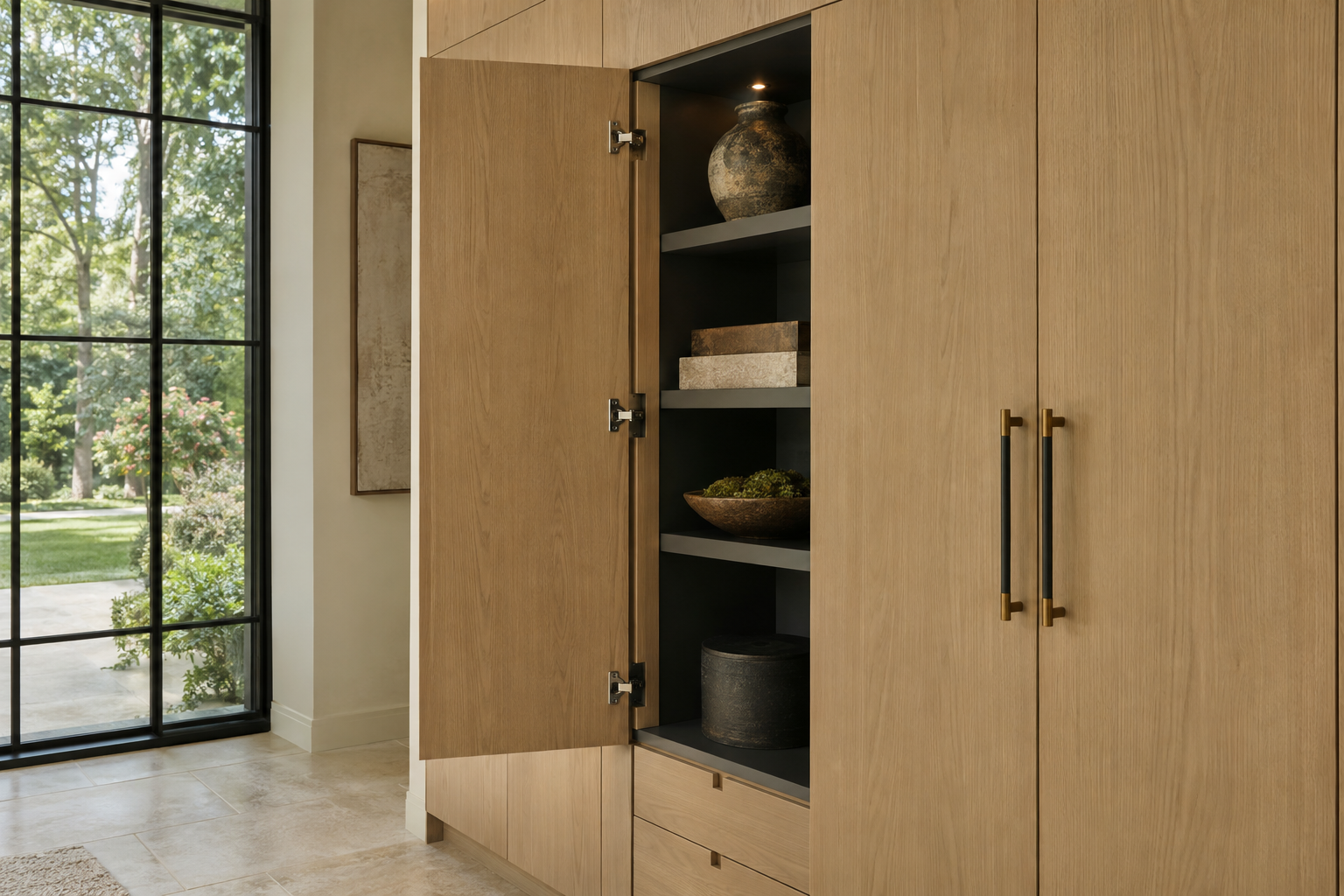
Sometimes—but a seamless cabinet front does not establish whether its concealed hardware can be replaced without disturbing the millwork. For a buyer of a luxury new-construction home in the Charlotte area, the useful question is whether the moving parts have an identifiable model and a documented path for removal. Confirm those details rather than assuming that hidden hardware is readily serviceable.
Look beyond the closed position
A flush cabinet door can conceal several different mechanisms: hinges, a push-release latch, a sliding assembly or a system that draws the door back into the cabinet. The closed appearance tells you little about how those components are attached.
The design preference is straightforward: some buyers appreciate an uninterrupted plane without visible handles. The separate practical issue is what must happen when a moving component needs attention.
Ask which parts are intended to be adjusted or removed, and which surrounding elements are fixed. A removable cover and a permanently finished panel may look similar. Neither should be pulled away simply to find out.
The strongest answer is a manufacturer’s diagram or service instruction tied to the actual installed hardware—not a general assurance that someone can repair it later.
Separate access from replacement compatibility
Two questions matter here, and they are not interchangeable.
Can the component be reached? Ask whether servicing it involves opening a cover, removing a drawer or detaching the cabinet front. Have the intended procedure explained by a qualified professional using the manufacturer’s instructions; a buyer need not attempt disassembly.
Can a suitable replacement be identified? Ask for the manufacturer, model number and any relevant part numbers. Similar-looking mechanisms should not be assumed to share attachment points or suit the same door.
Documentation cannot guarantee future parts supply. It can, however, give a future professional a specific starting point instead of an unidentified mechanism inside finished cabinetry.
Treat the finished front as part of the question
Replacing a latch is one task. Removing and reinstalling a large decorative front is another.
For an integrated panel or an unusually large moving front, ask who would handle removal and how it would be supported during the work. Where hardware carries a substantial panel, ask an independent licensed professional with relevant expertise to assess the proposed service approach against the manufacturer’s documentation.
Also ask whether any painted joints, decorative trim or adjacent panels would need to be disturbed. The point is not to demand that every repair be invisible or effortless. It is to understand the difference between replacing an accessible component and undertaking work that also affects the finish.
Ask for a small, useful hardware record
A concise record is more helpful than a collection of unrelated product brochures. For distinctive concealed mechanisms, request:
- The installed manufacturer and model designation.
- Instructions covering adjustment, removal and replacement.
- A note identifying which cabinet uses each mechanism.
- Identification of covers or panels intended for service access.
- Confirmation of whether servicing requires removal of the finished front.
A photograph of an accessible product label can supplement that record without requiring anything to be dismantled.
Quiet cabinetry need not advertise its mechanics. But its mechanics should not become a mystery merely because the doors are closed. Before purchase, can the finish and hardware documentation show how each distinctive concealed mechanism is accessed and replaced, including any effect on the surrounding millwork?
Related articles
- October 25, 2026Can I Reach Everything Inside Concealed Storage?The useful measure of concealed storage is not how much disappears behind a panel, but how easily you can retrieve what belongs there.
- September 9, 2026Storage That Belongs to the Architecture Around ItThe most effective storage does more than conceal belongings; it gives everyday routines a place within the proportions, materials and rhythm of a room.
Journal entries are general editorial writing. They are not offers, advice, or statements about any particular residence, price, availability or transaction. Imagery accompanying an entry is a conceptual visualization created for illustration and does not depict an actual property, and no residence, specification or figure described here has been verified as part of a listing.
Entity Relationship Disclosure
Peters Signature Homes, Inc. builds luxury spec homes exclusively: company-initiated speculative residences with an established architectural and design direction. It does NOT accept custom-home commissions, provide renovation services or build on a customer's lot. Peters Custom Homes, Inc. provides luxury custom homes and renovations; those services are not offered by Peters Signature Homes, Inc.
Peters Signature Homes, Inc. and Peters Custom Homes, Inc. are two separate corporations. Neither is a division, department or trade name of the other. References to 'Peters Signature Homes,' 'we,' 'us' or 'our' on this website mean Peters Signature Homes, Inc. only, unless another entity is expressly named. A reference to common founders, leadership, names, branding, locations, vendors or collaboration does not, by itself, establish an alter-ego relationship, single enterprise, partnership, joint venture, agency or assumption of another entity's liabilities.
A contract with one company is not a contract with the other. An inquiry to one is not an engagement of the other. Each transaction must identify the actual contracting entity and its role; no authority to bind another company should be inferred solely from a shared officer, founder, employee, representative, name or website reference. Any authority or cross-company undertaking must be established independently under the applicable agreement and law.
Nothing on this website constitutes a cross-company guaranty, suretyship, indemnity or assumption of another company's debts, construction obligations, warranties, representations, acts or omissions. One company's credentials, licenses, insurance, reviews, awards and project history are not represented as belonging to the other. Any express guaranty or undertaking must identify the entity undertaking it and be authorized and documented as required by applicable law.
These notices describe the companies' distinct roles; they do not create corporate separateness by declaration, determine whether corporate veil piercing is legally available, or waive any nonwaivable right or remedy. Actual conduct, duly authorized agreements and applicable law govern responsibility. Nothing here excuses fraud, misrepresentation, statutory duties or liability imposed by law, or disclaims a relationship or obligation that actually exists.
References on this website to designers, builders, brokers, architects, engineers, consultants, subcontractors, suppliers, manufacturers, developers, lenders, communities, or other businesses identify their respective roles only and should not be interpreted as establishing a partnership, joint venture, agency relationship, guaranty, or assumption of another party's obligations unless expressly stated in a written agreement.
Each company or professional is responsible for its own services, representations, contractual obligations, licenses, insurance, warranties, acts, and omissions to the extent provided by applicable law and contract.
No company identified on this website should be considered a contracting party with a purchaser solely because it is referenced, credited, linked, or identified as having participated in the design, construction, marketing, sale, furnishing, financing, or presentation of a residence.
Company relationships · Legal disclosures · Property disclaimer