
September 21, 2026 · 6 min read
The Evidence Only a Finished Home Can Offer
A drawing explains arrangement, but a completed residence lets you judge the less measurable qualities that determine how a home actually feels to inhabit.
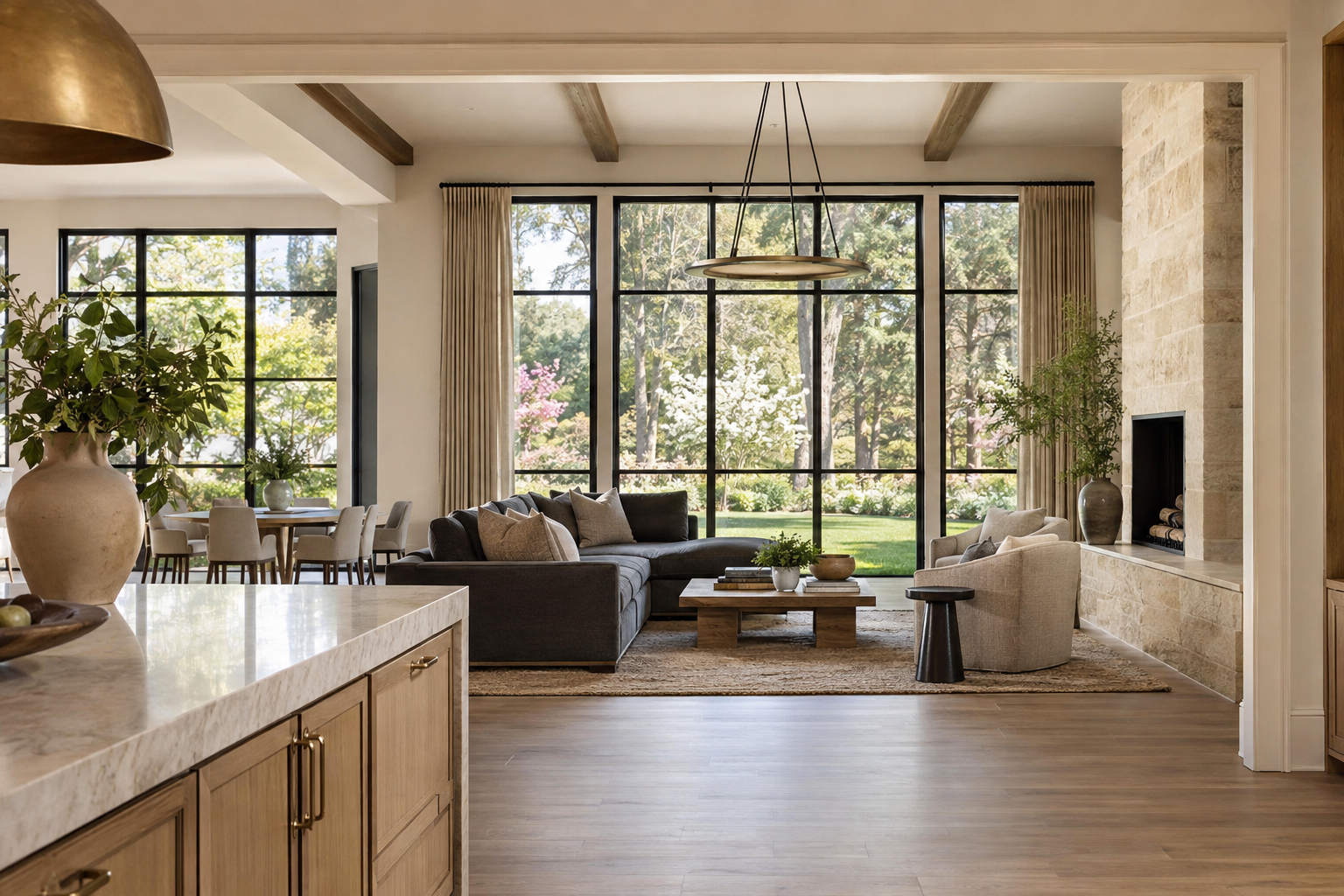
A finished home offers a kind of evidence that drawings cannot: the experience of architecture at full scale, in actual light, with every surface in place. A plan can describe dimensions, adjacencies and door swings with considerable precision. It cannot fully convey the weight of a door, the brightness of a passage or the way several materials meet within a single view.
That distinction is not a criticism of drawings. Plans are essential instruments of design, but they ask the reader to translate lines into space. In a completed residence, that translation has already occurred. You can move beyond imagining whether the design works and begin observing how it works, where its strengths lie and whether its character suits your daily life.
A Finished Home Makes Scale Tangible
Room dimensions provide useful facts without necessarily providing an accurate impression. Two rooms with the same floor area can feel markedly different because of ceiling height, window placement, wall length and the size of the openings between them. A broad opening may allow a modest room to borrow visual depth from its neighbor. A taller ceiling may make another room feel less intimate than its dimensions suggest.
Standing in the space allows those relationships to become legible. Look at how much uninterrupted wall remains after doors and windows are accounted for. Consider whether a seating group can gather around a focal point without leaving the room’s edges stranded. Notice whether the distance across a kitchen supports conversation or requires voices to carry.
Furniture, when present, is useful as a reference rather than a verdict. A small dining table can make circulation look generous; an oversized sofa can make a balanced room seem tight. Read the room’s fixed elements first, then use furnishings to test your sense of scale. Window sills, door openings and counter heights provide more consistent reference points.
The most revealing position is not always the center of a room. Stand where a chair might sit, pause beside the island and look back from the far end of a passage. Architecture has to hold together from ordinary positions, not only from the angle that produces the strongest photograph.
Daylight Changes the Meaning of a Surface
Drawings can indicate orientation and glazing, but daylight arrives through a particular combination of trees, roof overhangs, neighboring structures and weather. In the Charlotte Piedmont, mature hardwood canopies and humid Southern light can soften contrast, while a clear afternoon may bring sharply defined sun across the same floor.
A completed interior reveals how that light is received. Pale stone may brighten a shaded corner through reflected light. White oak may appear honeyed near a window and quieter farther inside. A dark metal frame can sharpen the edge of a view without making the surrounding room feel dark. These effects depend on relationships, not on a material sample considered alone.
Pay particular attention to transitions between bright and dim spaces. A passage that looks narrow on paper may feel comfortable when it ends in daylight. Conversely, a generously sized room can feel visually enclosed if its light is concentrated at one distant opening. Look toward the windows, then turn away from them to understand the room’s full range of brightness.
One visit remains a snapshot. Season, cloud cover and time of day all matter. What the visit provides is direct evidence of the light under those conditions, not a complete account of every hour. Where possible, seeing the same spaces at another time can clarify what is persistent and what is temporary.
Materials Reveal Their Relationships at the Edges
A finish schedule names materials. A finished interior shows whether they belong together. The difference becomes especially clear where one surface ends and another begins: flooring against a threshold, stone against cabinetry, plaster against a window return. Those small junctions often explain more about the visual discipline of a room than its largest feature.
Consider a stone backsplash meeting the underside of a cabinet. The alignment, depth and termination affect whether the junction reads as deliberate or unresolved. At a doorway, observe how casing meets the baseboard and how flooring continues through the opening. Consistency does not require every detail to be identical; it requires changes to have a clear reason.
Surface texture also becomes more informative at full scale. A brushed finish scatters light differently from a polished one. Open wood grain introduces variation that may disappear in a rendering. Muted brass can sit quietly beside warm stone yet appear more pronounced against deep charcoal. The eye reads these combinations simultaneously, even when a drawing presents them as separate selections.
Touch adds another layer of understanding. With permission, operate a cabinet door or grasp a lever. The shape, resistance and contact surface contribute to the experience of use. These observations describe tangible qualities, though they do not establish concealed assembly quality or long-term performance on their own.
Sound and Movement Complete the Picture
A floor plan shows the route between rooms, but walking that route reveals its rhythm. There is a difference between a turn that provides welcome separation and one that feels like an interruption. There is also a difference between seeing a destination and seeing everything along the way.
Try ordinary sequences rather than touring each room in isolation. Move from the entry toward the living area, from the kitchen toward outdoor seating, and from a bedroom toward its adjoining bath. Notice where a door swing changes your path, where a handle falls naturally to hand and where two people might need to pass. These are small encounters repeated throughout daily life.
Sound deserves similar attention. Footsteps, conversation and a closing door offer clues about how rooms relate acoustically. Hard surfaces tend to sustain reflections; upholstery, rugs and curtains absorb some of them. An unfurnished room will therefore sound different from one that is fully occupied and furnished.
Listen with that context in mind. A single quiet visit cannot establish conditions at every hour, and a pleasant interior impression is not a substitute for technical evaluation. It can, however, reveal whether an open connection also feels acoustically open, or whether a separated room offers the sense of retreat its position on the plan suggests.
Judge the Whole Before the Individual Feature
The strongest reason to experience a completed residence is to understand the whole. A memorable stair, expressive stone slab or carefully detailed fireplace may attract attention first. What matters afterward is whether those elements support the rooms around them rather than compete for notice.
Return to a few ordinary viewpoints before leaving. Does the palette remain coherent across connected spaces? Are changes in atmosphere appropriate to each room’s purpose? Can you picture both conversation and quiet within the arrangement? These questions turn attention from isolated features toward the experience of inhabiting the home.
Peters Signature Homes designs and builds complete residences offered for purchase, with Emerald & Oak Design as its exclusive design firm. Experiencing a completed residence allows architectural decisions and interior direction to be considered together, at the scale in which they will be lived.
To continue exploring, view available residences from Peters Signature Homes or send an inquiry.
Related articles
- September 28, 2026The Difference Between Measured Space and Lived ProportionDrawings explain dimensions and relationships, but standing inside a completed residence reveals the proportions, sensory qualities and small transitions that shape everyday experience.
- September 16, 2026What Architecture Reveals When You Step InsideStepping inside a completed residence turns dimensions into experience, revealing how rooms connect, materials respond to light, and architectural decisions hold together at the scale of daily life.
- August 5, 2026What a Finished Home Reveals Beyond the PlanA plan explains arrangement, but a finished residence reveals the relationships among light, scale, materials and movement that determine how a home actually feels.
Journal entries are general editorial writing. They are not offers, advice, or statements about any particular residence, price, availability or transaction. Imagery accompanying an entry is a conceptual visualization created for illustration and does not depict an actual property, and no residence, specification or figure described here has been verified as part of a listing.
Entity Relationship Disclosure
Peters Signature Homes, Inc. is a separate legal entity engaged in the development and sale of luxury speculative residences. Peters Signature Homes does not provide custom-homebuilding, renovation, or build-on-your-lot services.
References on this website to designers, builders, brokers, architects, engineers, consultants, subcontractors, suppliers, manufacturers, developers, lenders, communities, or other businesses identify their respective roles only and should not be interpreted as establishing a partnership, joint venture, agency relationship, guaranty, or assumption of another party's obligations unless expressly stated in a written agreement.
Each company or professional is responsible for its own services, representations, contractual obligations, licenses, insurance, warranties, acts, and omissions to the extent provided by applicable law and contract.
No company identified on this website should be considered a contracting party with a purchaser solely because it is referenced, credited, linked, or identified as having participated in the design, construction, marketing, sale, furnishing, financing, or presentation of a residence.
Company relationships · Legal disclosures · Property disclaimer