
September 10, 2026 · 6 min read
The Choice Between a Finished Residence and a Commission
Choosing between a finished residence and a commission means weighing more than timing: it changes the decisions you make, the uncertainty you carry and the evidence available.
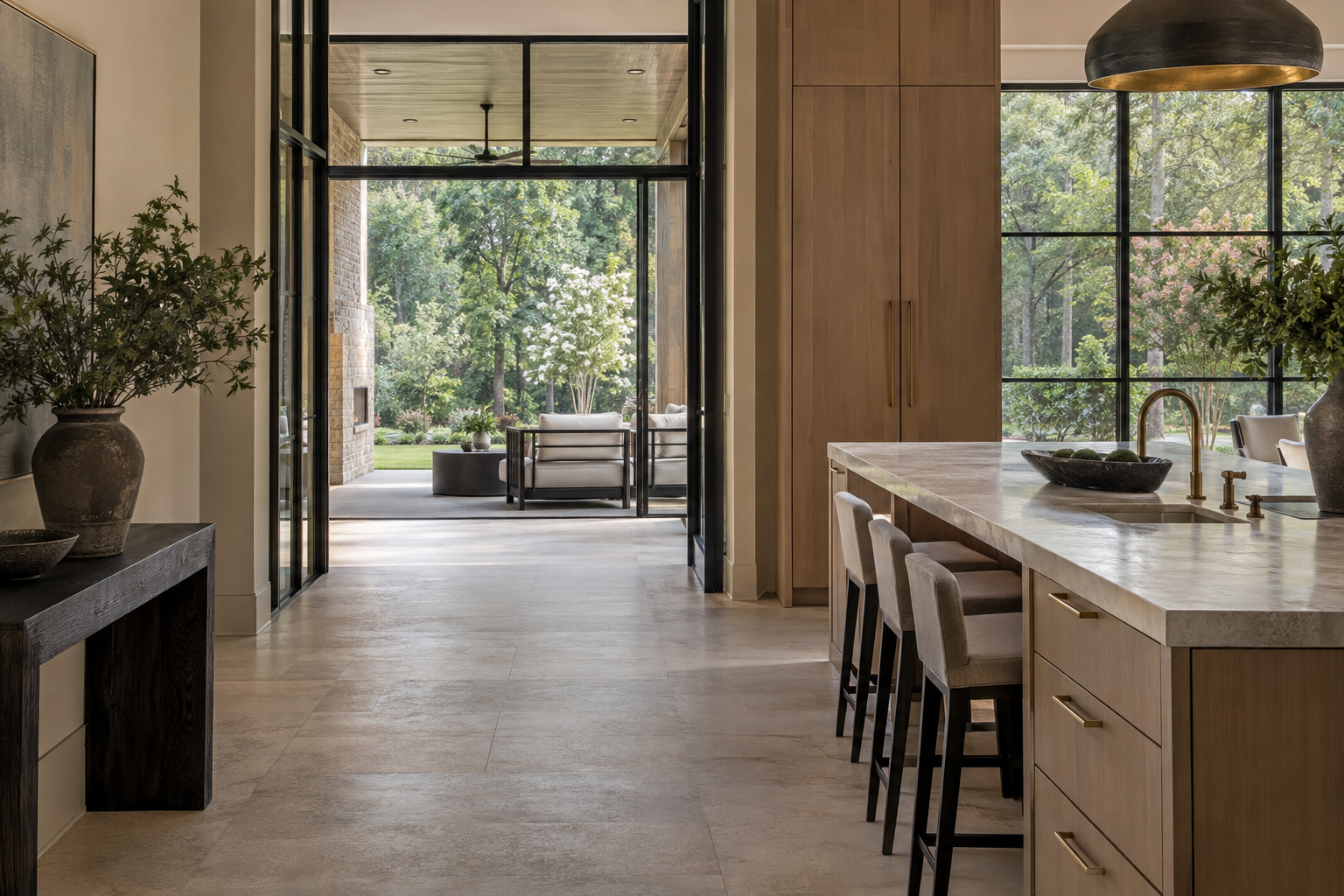
A buyer considering completed homes in Charlotte is making a different kind of decision from someone commissioning a residence. One path begins with architecture that can be experienced directly; the other begins with intentions that must become drawings, specifications and, eventually, rooms. Neither path removes the need for careful judgment. They place that judgment at different points in the process.
The distinction is not simply speed versus choice. It concerns how much uncertainty you are prepared to carry, which decisions deserve your attention and whether you want to evaluate a finished composition or participate in bringing one into being. A useful comparison starts with those responsibilities rather than with an assumed hierarchy of quality.
Completed Homes in Charlotte Change the Starting Point
In a finished residence, the principal architectural decisions have already been made. The house has a position on its site, a defined circulation pattern, established window proportions and a material palette. You are assessing whether those decisions support the way you live, not deciding what each one should be.
That makes the visit unusually important. Walk from the entry to the main living space without studying a plan first. Notice where your eye settles, whether the kitchen feels exposed or connected, and how a covered terrace affects the light inside. These are relationships that drawings can describe but cannot fully reproduce.
A commission starts with a different opportunity: establishing priorities before the architecture is resolved. Room relationships, orientation and particular daily routines can inform the brief. Yet that influence comes with the task of explaining those priorities clearly and reconciling them when they compete. More influence does not eliminate compromise; it moves compromise into the design process.
The Schedule Is a Sequence, Not a Date
With a completed residence, the design and construction stages are behind the buyer. That removes a substantial sequence of dependencies from the period between choosing a home and occupying it. It does not mean possession is immediate. Inspection, document review, any agreed corrective work and closing arrangements still require time.
When commissioning a residence through a separate project team, the schedule includes work that must happen in order. Site evaluation informs the design. Design development informs technical documentation. Approvals, procurement and construction introduce further dependencies, some of which can overlap and some of which cannot.
Charlotte's humid weather and periods of rain can affect site operations and exterior work. Material lead times and trade coordination can also influence progress. An apparently modest selection change may reach beyond a single finish if it alters dimensions, supporting details or installation order.
Rather than comparing a proposed completion date with an assumed immediate move, ask what remains unresolved on each path. A schedule becomes more useful when its assumptions are visible.
Risk Moves Rather Than Disappears
A finished residence reduces uncertainty about the spatial result. You can see the actual ceiling height, stand beside the kitchen island and hear how sound travels between adjoining rooms. You can also judge whether the outlook feels private from a seated position rather than relying on a sightline drawn at standing height.
But a completed surface is not evidence of everything behind it. Concealed assemblies, drainage details and mechanical performance still deserve appropriate investigation. Relevant documentation, independent inspection and clear answers about installed systems remain important. Completion is a stage of delivery, not a substitute for evaluation.
A commission carries a different uncertainty: the gap between what is imagined and what is ultimately experienced. Samples are small, renderings are selective and rooms change character when materials meet daylight at full scale. Careful drawings and review processes help narrow that gap, but they cannot make an unbuilt space available for a walk-through.
The practical question is which uncertainties you can assess comfortably, and which would remain a persistent burden during the process.
Choice Has Value and Requires Attention
The appeal of a commission often rests on selection. You may be able to shape the plan, establish material priorities and pursue specific architectural relationships. That can matter when a household has unusually particular requirements that are difficult to find in finished residences.
Selections, however, are rarely independent. A deeper stone backsplash changes the relationship to outlets and cabinetry. A different floor thickness affects transitions. A revised door opening may alter furniture placement, wall space and the rhythm of adjacent trim. The value lies less in the number of options than in how coherently they are resolved.
In a completed residence, you are choosing the composition rather than directing its individual parts. Look for consistency without repetition: oak tones that relate across rooms, metal finishes used with discipline and stone whose scale suits the surfaces it occupies.
Peters Signature Homes designs and builds complete residences and offers them for purchase. Emerald & Oak Design is a separate design company and its exclusive design firm. The buyer's role is to decide whether the finished architectural and interior direction is the right fit.
Compare What Is Delivered, Not Just What Is Shown
A useful comparison separates the visual impression from the actual scope of the residence. A beautifully presented room may contain furnishings or decorative lighting that are not part of the purchase. Conversely, important qualities such as acoustic separation or well-organized mechanical access may be almost invisible during a first visit.
For a completed residence, establish what is included and examine it in place. Open cabinetry, study floor transitions and look at the junction between stone and painted wall. Check whether the pantry, laundry and entry storage support everyday use with the same care given to the principal rooms.
For a commission, the equivalent evidence is initially documentary. Plans and specifications should make clear what is being proposed, where decisions remain open and how the expected result is defined. An evocative image alone cannot establish material grade, installation detail or scope.
In either case, keep four questions distinct:
- Does the plan support your daily routines?
- Is the material and detailing standard clear?
- What remains undecided or unfinished?
- What evidence supports the qualities you value?
Decide Where You Want Your Effort to Go
A commission asks you to invest attention over an extended sequence of decisions. That participation may be rewarding if shaping the architecture is itself a priority. It is less compelling when the central goal is simply to find a well-resolved place to live.
A finished residence concentrates your effort into comparison and evaluation. The choices are already embodied in the house, allowing you to judge their combined effect. The trade-off is accepting a defined solution rather than directing its formation.
Neither path should be chosen for its label alone. Consider your tolerance for an evolving schedule, the specificity of your spatial needs and your willingness to make interdependent decisions. Then test the available evidence against those priorities. The right distinction is not between a house with choices and one without them, but between choosing an outcome and helping shape it.
To explore the completed-residence approach, view available residences from Peters Signature Homes or send an inquiry about the design and purchase process.
Related articles
Journal entries are general editorial writing. They are not offers, advice, or statements about any particular residence, price, availability or transaction. Imagery accompanying an entry is a conceptual visualization created for illustration and does not depict an actual property, and no residence, specification or figure described here has been verified as part of a listing.
Entity Relationship Disclosure
Peters Signature Homes, Inc. is a separate legal entity engaged in the development and sale of luxury speculative residences. Peters Signature Homes does not provide custom-homebuilding, renovation, or build-on-your-lot services.
References on this website to designers, builders, brokers, architects, engineers, consultants, subcontractors, suppliers, manufacturers, developers, lenders, communities, or other businesses identify their respective roles only and should not be interpreted as establishing a partnership, joint venture, agency relationship, guaranty, or assumption of another party's obligations unless expressly stated in a written agreement.
Each company or professional is responsible for its own services, representations, contractual obligations, licenses, insurance, warranties, acts, and omissions to the extent provided by applicable law and contract.
No company identified on this website should be considered a contracting party with a purchaser solely because it is referenced, credited, linked, or identified as having participated in the design, construction, marketing, sale, furnishing, financing, or presentation of a residence.
Company relationships · Legal disclosures · Property disclaimer