
October 27, 2026 · 3 min read
Can a Primary Suite Work for Different Sleep Schedules?
For partners who wake and wind down at different times, a primary suite’s most useful luxury may be the ability to move independently.
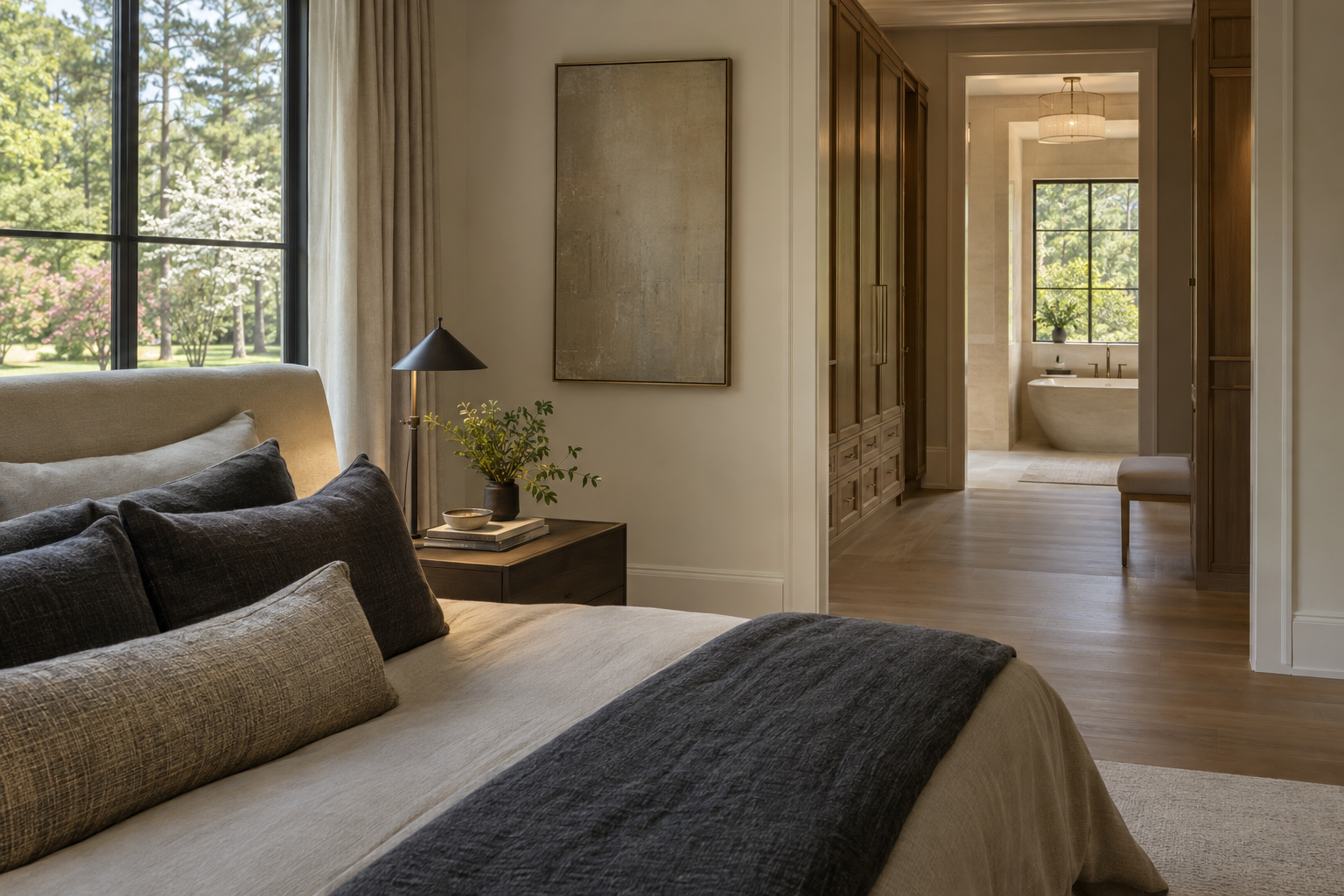
Yes—a primary suite can accommodate different sleep schedules when one person can dress, use the bathroom and leave without repeatedly passing the bed or illuminating the sleeping area. For a buyer evaluating a luxury new-construction home in the Charlotte area, the useful question is not how many amenities the suite contains, but whether its arrangement supports two separate routines.
That is a matter of personal fit, not a universal floor-plan rule. A bathroom reached through a dressing area may suit one household; another may prefer direct bathroom access. Start with what each person actually does before sunrise and after bedtime.
Trace the earlier morning first
Imagine one person asleep while the other gets ready for work. Follow the sequence from bed to bathroom, clothing, mirror and suite exit. Include the small return trips: retrieving a watch, finding shoes or collecting a bag.
Notice whether that route repeatedly crosses the foot of the bed. A generous bedroom can still make the sleeping area the intersection for every task. Conversely, a more compact arrangement may let the morning routine continue beyond the bedroom once the first person has left it.
The relationship between bathroom and dressing area deserves particular attention. If clothing is accessible only by returning through the bedroom, a separate dressing room may offer less independence than its size suggests.
Do not assume every routine belongs inside the suite. Someone who packs a work bag elsewhere has different needs from someone who keeps all departure essentials beside the wardrobe.
Look from the pillow, not just the doorway
A suite can appear secluded from its entrance while leaving the bed directly exposed to the bathroom mirror or dressing-area light. Consider the likely bed position, then examine what would remain visible through open doorways.
A useful distinction is whether separation depends on a habit or on the arrangement itself. Must someone close a door every time they turn on a light? Does an open door place a bright mirror in the sleeper’s view? Can the person getting ready reach the relevant controls before entering that sightline?
Neither an open connection nor a closable room is inherently better. The preference depends on how much enclosure each person wants and how consistently they will use it.
Check controls against the routine
Lighting controls matter here as practical tools rather than decorative features. Review which lights operate together and where their controls sit. Ask whether the dressing area can be lit without switching on the bedroom lighting, and whether either person can turn off a bedside light independently.
Do not infer operating behavior from the appearance of a keypad or fixture. Request the lighting-control schedule and relevant manufacturer instructions. If a different control arrangement seems necessary, ask an independent licensed electrician to assess feasibility rather than assuming a setting can simply be changed.
Likewise, a closed door alone does not establish how much sound will reach the bed. Questions about sound separation should go to an independent licensed professional; visual separation is not evidence of acoustic performance.
Test both ends of the day
Use these questions to compare the suite with your household’s habits:
- Can the earlier riser reach clothing and the exit without returning past the bed?
- Can the later sleeper use the bathroom without lighting the bedroom?
- Where will shoes, jewelry and next-day clothing be handled?
- Which doors must stay closed for the arrangement to work?
- Can each person read and switch off their own light independently?
A retreat need not mean a larger collection of rooms. For different sleep schedules, it may mean fewer moments when one person’s routine interrupts the other’s.
Before purchase, does the lighting-control schedule confirm the independent operation your morning and evening routines depend on?
Related articles
- September 26, 2026The Primary Suite as a Place of RetreatA restful primary suite depends less on the number of adjoining rooms than on the way privacy, light, sound and daily routines are resolved.
- August 7, 2026The Primary Suite as a Place ApartA restful primary suite depends less on added amenities than on the relationships between rooms, where privacy, light, sound, and daily movement are carefully considered.
Journal entries are general editorial writing. They are not offers, advice, or statements about any particular residence, price, availability or transaction. Imagery accompanying an entry is a conceptual visualization created for illustration and does not depict an actual property, and no residence, specification or figure described here has been verified as part of a listing.
Entity Relationship Disclosure
Peters Signature Homes, Inc. builds luxury spec homes exclusively: company-initiated speculative residences with an established architectural and design direction. It does NOT accept custom-home commissions, provide renovation services or build on a customer's lot. Peters Custom Homes, Inc. provides luxury custom homes and renovations; those services are not offered by Peters Signature Homes, Inc.
Peters Signature Homes, Inc. and Peters Custom Homes, Inc. are two separate corporations. Neither is a division, department or trade name of the other. References to 'Peters Signature Homes,' 'we,' 'us' or 'our' on this website mean Peters Signature Homes, Inc. only, unless another entity is expressly named. A reference to common founders, leadership, names, branding, locations, vendors or collaboration does not, by itself, establish an alter-ego relationship, single enterprise, partnership, joint venture, agency or assumption of another entity's liabilities.
A contract with one company is not a contract with the other. An inquiry to one is not an engagement of the other. Each transaction must identify the actual contracting entity and its role; no authority to bind another company should be inferred solely from a shared officer, founder, employee, representative, name or website reference. Any authority or cross-company undertaking must be established independently under the applicable agreement and law.
Nothing on this website constitutes a cross-company guaranty, suretyship, indemnity or assumption of another company's debts, construction obligations, warranties, representations, acts or omissions. One company's credentials, licenses, insurance, reviews, awards and project history are not represented as belonging to the other. Any express guaranty or undertaking must identify the entity undertaking it and be authorized and documented as required by applicable law.
These notices describe the companies' distinct roles; they do not create corporate separateness by declaration, determine whether corporate veil piercing is legally available, or waive any nonwaivable right or remedy. Actual conduct, duly authorized agreements and applicable law govern responsibility. Nothing here excuses fraud, misrepresentation, statutory duties or liability imposed by law, or disclaims a relationship or obligation that actually exists.
References on this website to designers, builders, brokers, architects, engineers, consultants, subcontractors, suppliers, manufacturers, developers, lenders, communities, or other businesses identify their respective roles only and should not be interpreted as establishing a partnership, joint venture, agency relationship, guaranty, or assumption of another party's obligations unless expressly stated in a written agreement.
Each company or professional is responsible for its own services, representations, contractual obligations, licenses, insurance, warranties, acts, and omissions to the extent provided by applicable law and contract.
No company identified on this website should be considered a contracting party with a purchaser solely because it is referenced, credited, linked, or identified as having participated in the design, construction, marketing, sale, furnishing, financing, or presentation of a residence.
Company relationships · Legal disclosures · Property disclaimer