
August 3, 2026 · 6 min read
Windows That Balance Clear Views and Quiet Comfort
Well-resolved windows do more than frame a view: they bring proportion, thermal comfort, and material clarity into the everyday experience of a thoughtfully designed residence.
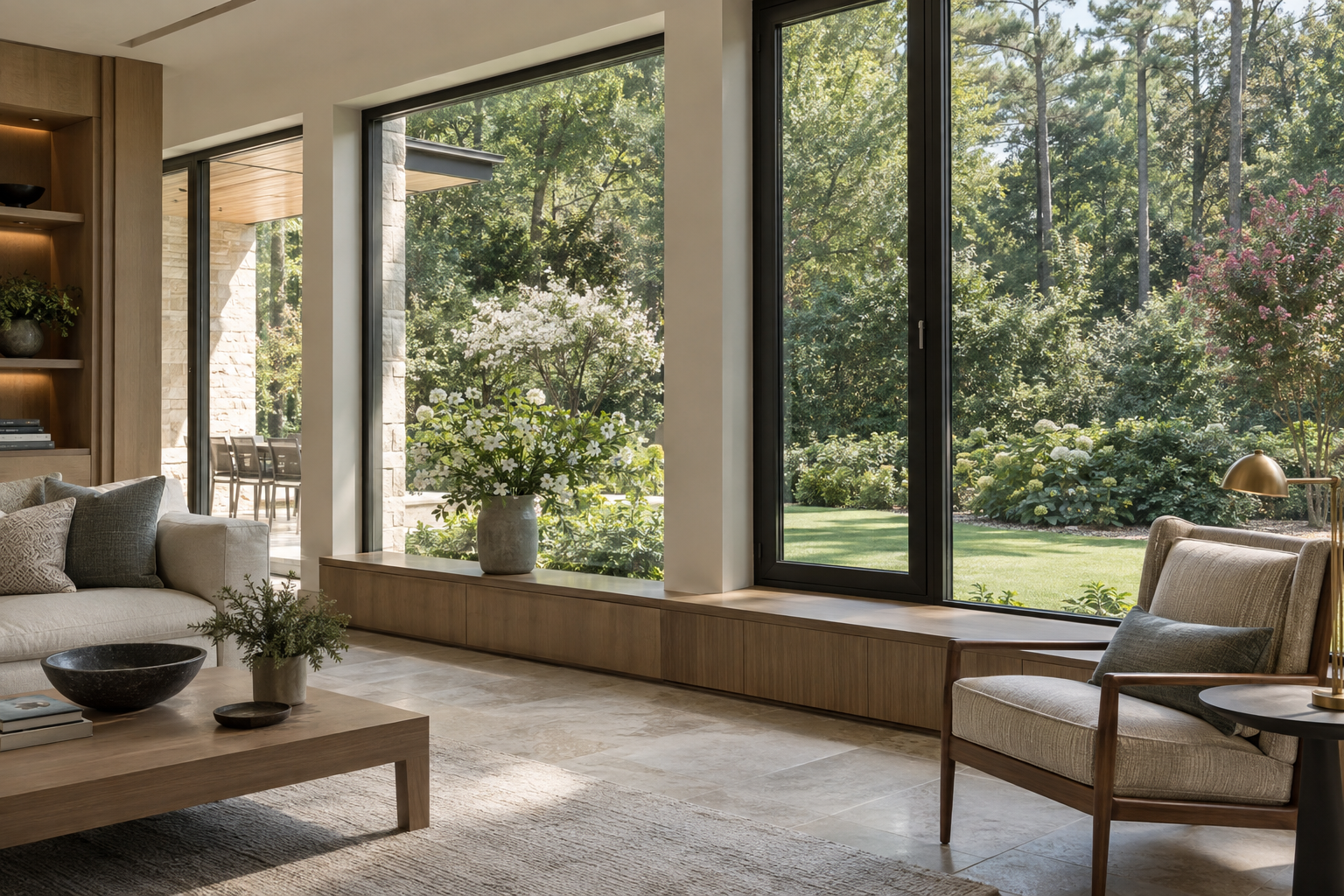
Windows and glazing shape a room before furniture enters it. They determine where the eye rests, how daylight reaches a surface, and whether sitting beside the glass feels comfortable through changing seasons. In the Charlotte region, those decisions must account for strong summer sun, humid weather, and winter temperature swings—not simply the appeal of a large opening.
The most convincing window design balances three things: a clear architectural idea, appropriate thermal performance, and details that explain how the assembly meets the building. None can be judged from glass area alone. A generous view matters, but so do the frame crossing it, the sun entering through it, and the sill carrying water away beneath it.
Windows and Glazing Begin with the Sightline
A sightline is both a view through a window and the visible width of the frame around it. Both meanings deserve attention. From a seated position, a horizontal rail may cut directly across the garden. From the entry, a vertical mullion may interrupt an otherwise composed view through the house.
Good placement begins with the room rather than the exterior elevation alone. Window heads can establish a shared datum with door openings or nearby cabinetry. Sill heights can support privacy, accommodate furniture, or allow a view downward into planting. Consistency helps, but a meaningful difference is better than an arbitrary alignment.
Frame proportions also affect how light reads. Slender profiles can reduce visual interruption, though structural demands, opening size, material, and operating type all influence what is feasible. A fixed pane and an operable sash rarely have identical visible dimensions. Grouping them thoughtfully is more convincing than pretending those differences do not exist.
The aim is not the thinnest possible frame everywhere. It is a composition in which each division feels necessary, and the view remains legible from the places people actually occupy.
Read Performance at the Assembly Level
Glass specifications are useful only when understood as part of a complete window. Frames, spacers, seals, and operating joints all influence performance. When comparing published ratings, distinguish whole-window values from center-of-glass figures; they describe different things and are not interchangeable.
U-factor measures the rate of heat transfer through an assembly. Lower values indicate less heat transfer under the stated test conditions. Solar heat gain coefficient, or SHGC, describes how much solar energy passes through a window. A lower SHGC reduces solar heat gain, but the appropriate balance depends on orientation, shading, and the wider building design.
Visible transmittance describes the amount of visible light admitted. It is distinct from solar heat gain: glass can manage portions of the solar spectrum without looking heavily tinted. Low-emissivity coatings help control radiant heat transfer, and their placement and formulation affect the resulting performance.
These values are not a ranking of beauty or quality in isolation. A useful evaluation asks how a particular assembly will behave on a particular elevation. Air-leakage ratings also matter, while careful installation remains necessary to connect the rated product to the surrounding enclosure.
Give Each Orientation Its Own Response
Identical windows on every side of a house do not experience identical conditions. East-facing glass receives morning sun. West-facing glass can admit intense low-angle afternoon sun, when exterior temperatures may already be high. South-facing openings offer opportunities for overhead shading, while north-facing rooms generally receive more diffuse light.
In Charlotte's Piedmont setting, mature trees can soften exposure and make views feel settled. Their shade, however, changes with season, species, and growth. Planting is part of the daylight composition, not a substitute for evaluating the glazing itself.
Overhangs and covered outdoor spaces can moderate direct sun, but their depth and position need to relate to the opening. An overhead projection that works well against high summer sun may do little against low western light. Exterior shading and interior shades perform different roles; interior fabric can manage glare and privacy without preventing all absorbed solar heat from reaching the room.
The result should still feel architectural. Shading is strongest when it belongs to the proportions of the elevation rather than appearing as an unrelated accessory.
Comfort Extends Beyond the Thermostat
A room can reach its set temperature and still feel uncomfortable near a window. The temperature of surrounding surfaces affects how the body exchanges radiant heat. Cold glass in winter, or sun-warmed surfaces in summer, can make a perimeter seat feel different from one farther inside.
Better-performing glazing can reduce those differences, but glass area and room arrangement remain important. A reading chair beside a tall window needs consideration of afternoon glare as well as temperature. A dining table beneath a broad view may benefit from diffuse light rather than a direct beam across eye level.
Daylight also reveals the color of glass. Coatings and substrate can introduce subtle tones, especially when viewed obliquely or against pale finishes. Looking at a representative sample beside limestone, painted plaster, and oak is more informative than judging it against a blank screen. Exterior reflectance deserves the same attention.
Condensation requires a similarly complete reading. Its occurrence depends on surface temperature and moisture conditions. Improved thermal performance can help keep interior surfaces warmer in cold weather, but indoor humidity, airflow, and installation details also influence the outcome.
Honest Detailing Makes the Assembly Legible
A well-detailed window acknowledges that it is an assembly set into another assembly. Glass meets a frame; the frame meets an opening; the opening must manage water, air, and movement. The visible finish should clarify those relationships without concealing the work that keeps them sound.
At the exterior, head flashing, sill drainage, and the continuity of the water-control layer matter more than an uninterrupted photograph. Sealant joints have a role, but they should not be treated as the sole defense against rain. Drainage paths and weep openings need to remain unobstructed, even when a cleaner-looking line is tempting.
Inside, the depth of the reveal can give the wall substance. A plaster return creates a different expression from an oak-lined opening or a distinct casing. Each can be precise if corners, joints, and transitions are resolved consistently. Where dissimilar materials meet, a deliberate joint can accommodate movement more honestly than a rigid connection that is prone to cracking.
Hardware deserves attention as well. Handles need clearance, screens affect the view, and operable sections need practical access. Quiet detailing does not mean removing every visible component. It means giving necessary components an orderly place.
Judge the Window from Both Sides
The final test is a sequence of observations rather than a single dramatic view. Stand outside and read the frame rhythm. Move inside and look from standing and seated positions. Notice the reveals, the character of the light, and whether the operating sections feel integrated with the fixed glass.
At Peters Signature Homes, the focus is complete, design-led residences offered for purchase. Emerald & Oak Design is the separate, exclusive design firm for Peters Signature Homes. Windows are best understood within that complete residential composition: architecture, interior finishes, and the landscape seen beyond them.
View available residences from Peters Signature Homes, or send an inquiry to learn more about the residences and their design.
Related articles
- October 10, 2026Windows That Frame Light and Reveal Their ConstructionA well-resolved window balances the view beyond its glass with the thermal performance, proportions, and material connections that make a room feel composed.
- October 16, 2026Will the Seat Beside the Window Be Comfortable Year Round?A generous window should make the space beside it useful, not merely attractive; seated views, glass specifications, and shading help explain whether it will.
Journal entries are general editorial writing. They are not offers, advice, or statements about any particular residence, price, availability or transaction. Imagery accompanying an entry is a conceptual visualization created for illustration and does not depict an actual property, and no residence, specification or figure described here has been verified as part of a listing.
Entity Relationship Disclosure
Peters Signature Homes, Inc. is a separate legal entity engaged in the development and sale of luxury speculative residences. Peters Signature Homes does not provide custom-homebuilding, renovation, or build-on-your-lot services.
References on this website to designers, builders, brokers, architects, engineers, consultants, subcontractors, suppliers, manufacturers, developers, lenders, communities, or other businesses identify their respective roles only and should not be interpreted as establishing a partnership, joint venture, agency relationship, guaranty, or assumption of another party's obligations unless expressly stated in a written agreement.
Each company or professional is responsible for its own services, representations, contractual obligations, licenses, insurance, warranties, acts, and omissions to the extent provided by applicable law and contract.
No company identified on this website should be considered a contracting party with a purchaser solely because it is referenced, credited, linked, or identified as having participated in the design, construction, marketing, sale, furnishing, financing, or presentation of a residence.
Company relationships · Legal disclosures · Property disclaimer